
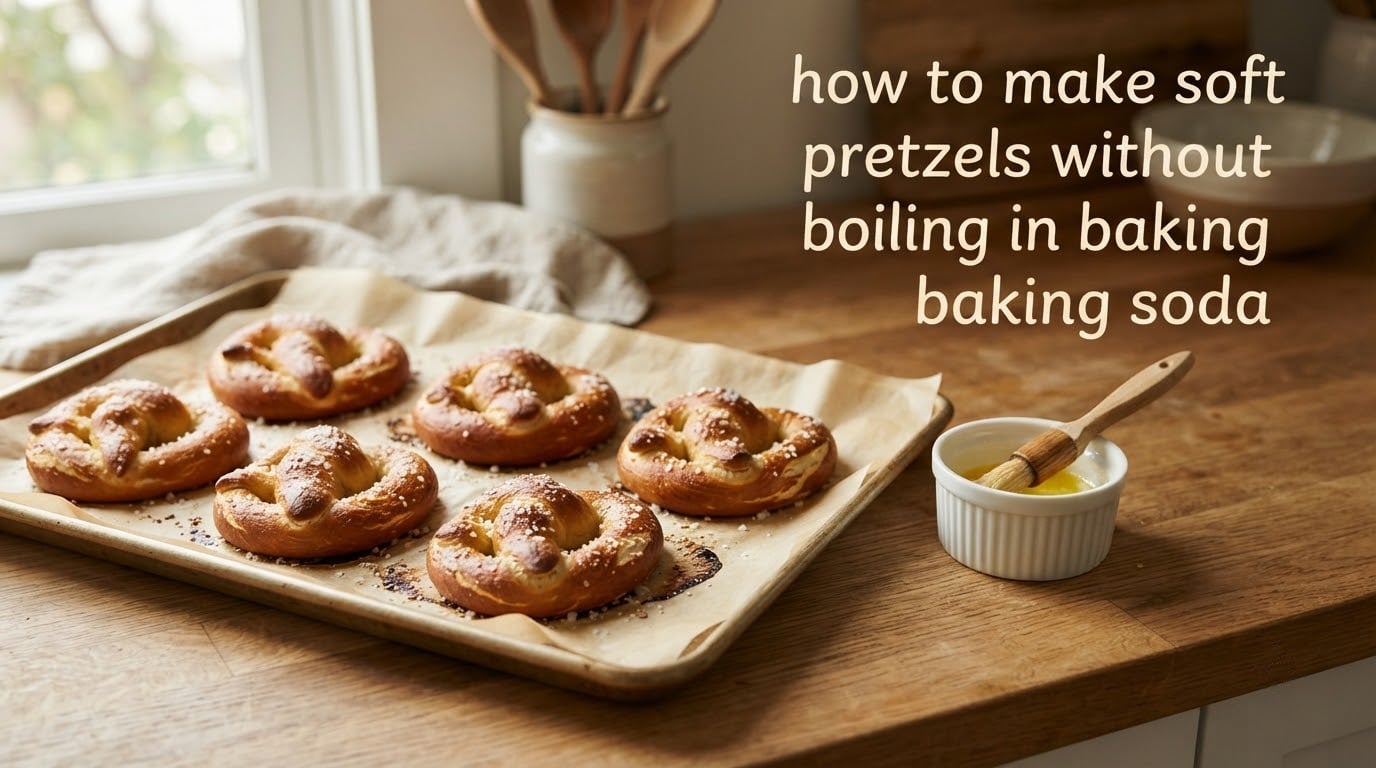
I have baked soft pretzels every weekend for the past three months, and the question I hear most often is the same one that brought you here: can you skip the boiling step entirely? After testing hot water baths, egg washes, and even baked baking soda side by side in my own kitchen, the answer is a confident yes. This guide walks you through exactly how to make soft pretzels without boiling in baking soda, and I will show you which no-boil method gives you the closest result to a mall-style pretzel.
Soft pretzels get their signature dark, glossy crust and that unmistakable tang from an alkaline surface. The traditional method drops shaped pretzels into a rolling boil of water and baking soda for 20 to 30 seconds. That step is short, but it is also where most home bakers get nervous. I have burned my fingers, splattered starchy water, and once forgot the baking soda altogether. The good news is that you can replicate the chemistry without the boil. Three methods work reliably: a warm water bath, an egg wash plus broiler finish, and a pre-baked baking soda trick for deeper flavor.
In this article I will share the master dough recipe that pairs with every method, a side-by-side comparison of all three approaches, a visual shaping guide with fixes for the most common failures, and a FAQ block answering the exact questions people ask on Reddit and cooking forums. By the end you will know which method fits your kitchen and your time.
Table of Contents
- Why Skip the Baking Soda Boil? Three Reasons Home Bakers Make the Switch
- The Science of a Pretzel Crust (and Why the Bath Matters)
- No-Boil Methods Compared: Hot Water Bath vs Egg Wash vs Baked Baking Soda
- Master Pretzel Dough Recipe (Works With Every Method)
- Method 1: Hot Water Baking Soda Bath (No Boil Required)
- Method 2: Egg Wash and Broiler Finish for Buttery Color
- Method 3: Baked Baking Soda for a Deeper Pretzel Flavor
- How to Shape Soft Pretzels (Visual Troubleshooting Guide)
- Topping Variations: Salt, Cinnamon Sugar, Garlic Parmesan, Everything Bagel
- Make-Ahead, Storage, and Freezing Instructions
- Troubleshooting Common Pretzel Problems
- Frequently Asked Questions
- Final Thoughts
Why Skip the Baking Soda Boil? Three Reasons Home Bakers Make the Switch
You can absolutely skip the baking soda boil and still get pretzels with proper color and chew. The three reasons most home bakers switch are time, safety, and consistency. A rolling pot of water adds five to seven minutes to your workflow and one more thing to babysit while your dough rests. The warm water method gets the same chemistry without the watch.
Safety matters too. Boiling water plus slippery dough equals splashes and the occasional burn. Reviewers on r/Baking repeatedly mention this exact concern, with several saying the hot water approach let them bring kids into the kitchen to help shape. The third reason is consistency: when you skip a rolling boil, you cannot over-cook the alkaline surface, so you never get that metallic taste some pretzels pick up when the bath runs too long.
If you have ever had a pretzel that tasted slightly bitter or chemical, the bath was probably the culprit. Each of the three methods below avoids that pitfall while still delivering the deep brown crust and chewy interior.
The Science of a Pretzel Crust (and Why the Bath Matters)
Pretzels look and taste different from dinner rolls because of chemistry, not just shape. When dough meets a strongly alkaline solution, the surface pH jumps above 12, which speeds up the Maillard reaction during baking. Maillard is the browning process where amino acids and sugars react under heat, and pretzels get a head start on it because their surface is already alkaline before they hit the oven.
That same alkalinity gelatinizes a thin layer of starch on the outside of the dough. The result is the glossy, almost lacquered sheen and the chewy bite that separates a pretzel from a soft breadstick. A traditional bath uses food-grade lye (sodium hydroxide), but home bakers almost always reach for baking soda (sodium bicarbonate) because it is safer to handle and easier to source.
The reason baking soda baths work is that heat converts some of the bicarbonate into sodium carbonate, a stronger alkali. When you bake the baking soda in your oven first, you push that conversion further and get a more pretzel-like result without ever needing lye. The hot water bath approach relies on the same conversion, just less of it. The egg wash and broiler method skips the alkaline step entirely and instead leans on browning from proteins and sugars plus a quick blast of high heat to mimic the color and crust.
None of these methods is fake chemistry. They are all real ways to get a pretzel-flavored pretzel. The differences come down to flavor depth, color, and how hands-on you want to be.
No-Boil Methods Compared: Hot Water Bath vs Egg Wash vs Baked Baking Soda
Here is how the three no-boil methods stack up against each other. I tested each one on the same dough, in the same oven, on the same day, and rated them on the criteria that matter most for home bakers.
Hot water baking soda bath is the closest to traditional. You heat water to around 150 F, stir in baking soda, dip each pretzel for 30 seconds, then bake. Color is deep brown, flavor is balanced, and the method takes about 10 extra minutes. Egg wash plus broiler skips the alkaline step. You brush pretzels with beaten egg, bake them, then finish under the broiler for two minutes. Crust is buttery and golden, chew is slightly softer, and it is the fastest method. Baked baking soda is the advanced option. You spread baking soda on a sheet pan and bake it at 250 F for an hour to convert it into sodium carbonate, then dissolve that in warm water for the dip. Flavor is the most pretzel-like of the three, color is the darkest, and total time is the longest because of the soda baking step.
Pick hot water bath if you want traditional flavor with the least extra effort. Pick egg wash plus broiler if you want speed and you prefer a buttery crust. Pick baked baking soda if you want the deepest, most authentic pretzel taste and you do not mind an extra hour of prep.
Master Pretzel Dough Recipe (Works With Every Method)
This dough is the foundation for all three no-boil methods below. It makes eight large pretzels or about 24 pretzel bites. Measure by weight if you can; a kitchen scale removes most of the guesswork.
You will need 3 1/2 cups (440g) all-purpose flour, 1 teaspoon (4g) instant yeast, 1 tablespoon (12g) granulated sugar, 1 1/2 teaspoons (9g) fine sea salt, 1 cup (240ml) warm water at 110 F, and 3 tablespoons (42g) unsalted butter, melted and cooled slightly. For finishing, set aside 1/4 cup (60g) baking soda if you are using Method 1 or Method 3, 1 large beaten egg if you are using Method 2, coarse pretzel salt, and 2 tablespoons melted butter for brushing.
Whisk the flour, yeast, sugar, and salt in a large bowl or the bowl of a stand mixer. Pour in the warm water and melted butter and mix on low until a shaggy dough forms. Knead by hand on a lightly floured surface for 8 minutes, or with a dough hook on medium for 5 to 6 minutes, until the dough is smooth and springs back when poked. The windowpane test is a good checkpoint: stretch a small piece thin. If it stretches enough to see light through without tearing, the gluten is ready.
Shape the dough into a ball, place it in a lightly oiled bowl, cover with plastic wrap, and let it rise in a warm spot for 60 to 75 minutes, until nearly doubled. Punch down gently, divide into 8 equal pieces (about 90g each), and cover with a kitchen towel while you shape. If your kitchen is cold or you live at high altitude, give the dough an extra 15 minutes; reviewers on r/Breadit note that cool kitchens slow fermentation noticeably.
Method 1: Hot Water Baking Soda Bath (No Boil Required)
This is the gentlest path to a real pretzel crust. You heat water to about 150 F, dissolve baking soda in it, dip each shaped pretzel for 30 seconds, then bake. No rolling boil, no splatter, and no risk of over-alkalizing the surface.
Heat 4 cups (960ml) of water in a large shallow bowl or Dutch oven until it reaches 150 F on an instant-read thermometer. If you do not have a thermometer, aim for water that is hot to the touch but not steaming. Stir in 1/4 cup (60g) baking soda until dissolved. The water will look cloudy and may fizz briefly; that is normal.
Shape your pretzels (instructions in the next section). Working one at a time, lower a shaped pretzel into the bath top-side down for 30 seconds. Use a slotted spoon or spider to lift it out, let the excess drip off, and place it on a parchment-lined baking sheet. Repeat with the remaining pretzels, reusing the same bath.
Bake at 450 F (230 C) for 12 to 14 minutes, until the crust is deep mahogany. Brush immediately with melted butter and sprinkle with coarse pretzel salt while the surface is still tacky. The result is a pretzel with traditional color, classic chew, and a tangy finish without any metallic aftertaste.
Method 2: Egg Wash and Broiler Finish for Buttery Color
If you want to skip the alkaline step altogether, this is your method. The egg wash gives the crust protein for browning, and the broiler blast adds color in the final two minutes. Reviewers on Modern Crumb built their whole recipe around this approach and report pretzels that are softer inside and a touch buttery on the outside.
Shape your pretzels and place them on a parchment-lined baking sheet. Beat 1 large egg with 1 tablespoon water and brush a thin, even coat over each pretzel. Sprinkle with coarse salt now so it sticks to the wash.
Bake at 425 F (220 C) for 12 minutes. Then turn on the broiler and move the rack to the upper third of the oven. Broil for 60 to 90 seconds, watching closely, until the tops are deep golden and slightly blistered in spots. Pull the sheet out immediately; broilers vary widely and these can scorch in seconds.
Brush with melted butter right away and serve warm. The crust is softer than the bath methods, the color leans more golden than mahogany, and the flavor is mild and buttery. It is the fastest method and the most forgiving for beginners, especially if you do not want to handle a pot of hot alkaline water.
Method 3: Baked Baking Soda for a Deeper Pretzel Flavor
Food science writers like J. Kenji López-Alt popularized this trick. Baking baking soda in your oven drives off carbon dioxide and water, leaving behind sodium carbonate, a stronger alkali that sits closer to lye on the pH scale. The result is a pretzel with the deepest flavor and darkest color of the three methods, all without boiling or handling lye.
Spread 1/2 cup (120g) baking soda in a thin, even layer on a rimmed baking sheet. Bake at 250 F (120 C) for 60 minutes, stirring once at the 30-minute mark. The powder will look slightly different, more granular and less fluffy, when it is done. Let it cool completely before using. Store any leftover baked soda in an airtight jar; it keeps for months.
Heat 4 cups (960ml) water to 150 F and stir in 1/4 cup of the baked baking soda. Dip each shaped pretzel for 30 seconds, drain, and place on a parchment-lined sheet. Bake at 450 F for 11 to 13 minutes. Brush with melted butter and salt while warm.
Color comes out a deep, almost reddish brown. Flavor has more of that classic pretzel tang without any bitterness. This method takes the most planning because of the soda-baking step, but the payoff is real if you are chasing an Auntie Anne’s style pretzel at home.
How to Shape Soft Pretzels (Visual Troubleshooting Guide)
Shaping is the part that trips up most home bakers. The dough wants to spring back, the ends refuse to stay tucked, and somehow your pretzel ends up looking like a sad snake. Here is the method that works for me, plus fixes for the three most common failures.
Roll each portion into a smooth rope about 22 inches long, applying even pressure from the center out. If the dough shrinks back, cover it and let it rest for five minutes; gluten that tightens during rolling needs time to relax. Hold the rope in a U shape, cross the two ends over each other once, then twist them around each other once more and press the ends firmly into the bottom curve of the U. The classic pretzel shape comes from that double twist and a firm press.
Common failure one: dough bounces back when poked. This means the gluten is too tight or the dough is under-proofed. Cover the dough, walk away for five minutes, and try again. If it still fights you, your kitchen is probably cool; move the bowl near a warm oven or on top of a running dryer for the next rise.
Common failure two: ends spring up after twisting. The fix is more pressure when you press the ends into the bottom curve, plus a 30-second rest before the bath so the shape sets. Pressing with wet fingertips also helps the dough stick to itself.
Common failure three: dough sticks to the counter while rolling. Lightly flour the surface, not the dough. Flouring the dough directly dries out the surface and leads to cracks. A silicone rolling mat also helps if you bake often; reviewers on r/Breadit swear by them for sticky enriched doughs.
Once shaped, rest each pretzel under a kitchen towel for 5 minutes before dipping or egg washing. This short rest relaxes the gluten so the pretzel holds its shape during the bath and bakes evenly.
Topping Variations: Salt, Cinnamon Sugar, Garlic Parmesan, Everything Bagel
The base pretzel is a canvas. Once you have a method that works, you can rotate toppings based on the occasion. Here are the four I make most often.
Classic coarse salt is the move for game day. Use pretzel salt if you can find it; it is coarser than kosher salt and stays crunchy. Melted butter brushed on right out of the oven makes the salt stick.
Cinnamon sugar is the sweet version. Brush warm pretzels with melted butter, then roll them in a mix of 1/2 cup granulated sugar and 2 teaspoons ground cinnamon. Best for breakfast or dessert.
Garlic parmesan is the savory adult version. Brush with melted butter, then sprinkle with a mix of 1/4 cup finely grated parmesan, 1 teaspoon garlic powder, and 1/2 teaspoon dried Italian seasoning. Bake 2 more minutes so the cheese sets.
Everything bagel is the crowd-pleaser. Brush with egg wash (or skip if you are using Method 1) and press 2 tablespoons of everything bagel seasoning into the surface before baking. Sesame, poppy, garlic, and onion all toast up nicely.
Make-Ahead, Storage, and Freezing Instructions
Soft pretzels are best within an hour of baking, but they store well if you handle them right. The biggest mistake reviewers report is storing pretzels while still warm, which traps steam and turns the crust soggy. Always cool pretzels completely on a wire rack before storing.
Room temperature: Keep pretzels in a paper bag at room temperature for up to 24 hours. A paper bag lets moisture escape; a plastic bag traps it and softens the crust. Do not salt pretzels you plan to store; salt draws moisture and makes them soggy. Salt right before reheating instead.
Refrigerate: For dough, you can refrigerate the shaped or unshaped dough for up to 24 hours. Cover tightly and let it come to room temperature for 20 to 30 minutes before dipping and baking. Baked pretzels do not refrigerate well; the crust gets rubbery.
Freeze: Freeze baked pretzels in a single layer on a sheet pan, then transfer to a freezer bag once solid. They keep for 2 to 3 months. Reviewers on r/Cooking specifically mention paper bags inside freezer bags as a way to keep the salt from getting soggy. Reheat from frozen in a 350 F oven for 5 to 7 minutes, or air fryer for 3 minutes at 350 F.
Make-ahead dough method: Mix and knead the dough, then refrigerate it overnight in a covered bowl. The next day, let it warm on the counter for 30 minutes, divide, shape, dip, and bake. Several forum readers report this gives even more flavor because of the slow cold ferment.
Troubleshooting Common Pretzel Problems
Even with a good recipe, pretzels can go sideways. Here are the fixes for the issues that come up most often, drawn from common reader questions and forum threads.
Pretzels look pale after baking: Your oven runs cool, or you skipped the alkaline step and the broiler was too brief. Use an oven thermometer to confirm temperature, and bake a few minutes longer. If using Method 2, push the broiler step closer to 90 seconds and watch the tops turn deep gold.
Pretzels taste metallic or bitter: The bath was too concentrated or pretzels soaked too long. Cut baking soda to 2 tablespoons per 4 cups water, dip for 20 to 30 seconds only, and use a thermometer to keep water at 150 F rather than boiling. If you used Method 3, you may have skipped the baking step for the soda and ended up with too-strong a solution.
Dough is sticky and hard to shape: Your kitchen is humid, or you under-measured the flour. Add flour 1 tablespoon at a time during kneading until the dough is tacky but not sticky. Weighing flour is more accurate than measuring cups.
Pretzels deflate when baking: Either the dough over-proofed, or the oven was not hot enough. Aim for a rise that nearly doubles the dough but does not triple it, and preheat the oven for a full 20 minutes before baking.
Salt falls off after baking: You brushed butter too early or skipped the salt step. Brush butter first, then salt immediately while the surface is wet, so the salt embeds in the butter layer.
Frequently Asked Questions
Can I boil pretzels without baking soda?
Yes. You can skip the baking soda entirely and still get good pretzels using the egg wash and broiler method. The egg proteins brown under high heat and the broiler adds color in the final minute. The crust will be slightly softer and buttery rather than chewy and glossy, but the flavor is still pretzel-like.
Do I have to boil my pretzels in baking soda?
No. Boiling in baking soda is the traditional approach, but it is not required. A hot water bath at about 150 F delivers the same alkaline surface treatment without the rolling boil. Egg wash plus broiler and baked baking soda methods both skip the boil entirely and produce traditional pretzel flavor and color.
What can I use instead of baking soda for pretzels?
Three reliable options work without baking soda: a hot water bath at 150 F with reduced baking soda, an egg wash plus broiler finish, and a pre-baked baking soda solution. Each gives a different balance of color, flavor, and effort. Hot water bath is the closest to traditional, egg wash is the fastest, and baked soda gives the deepest flavor.
How can I make pretzels without boiling them?
Use the hot water bath method. Heat 4 cups of water to 150 F, dissolve 1/4 cup baking soda in it, dip each shaped pretzel for 30 seconds, drain, and bake at 450 F for 12 to 14 minutes. This skips the rolling boil entirely and still gives a deep brown crust and classic pretzel tang.
Final Thoughts
You now have three reliable paths for making soft pretzels without boiling in baking soda. The hot water bath is my everyday default because it gives the most authentic crust with the least hassle. The egg wash and broiler method is the right call when you want to skip alkaline solutions altogether or you are baking with kids. Baked baking soda is the move for special occasions when you want pretzels that taste as close to a mall counter as possible.
Whichever method you choose, the master dough and shaping steps stay constant. Practice shaping once or twice before you commit to a full batch; muscle memory makes the rest of the process feel easy. Once you have a batch that looks right, rotate the toppings to keep things interesting and freeze extras so you always have a warm pretzel within ten minutes of a craving.