
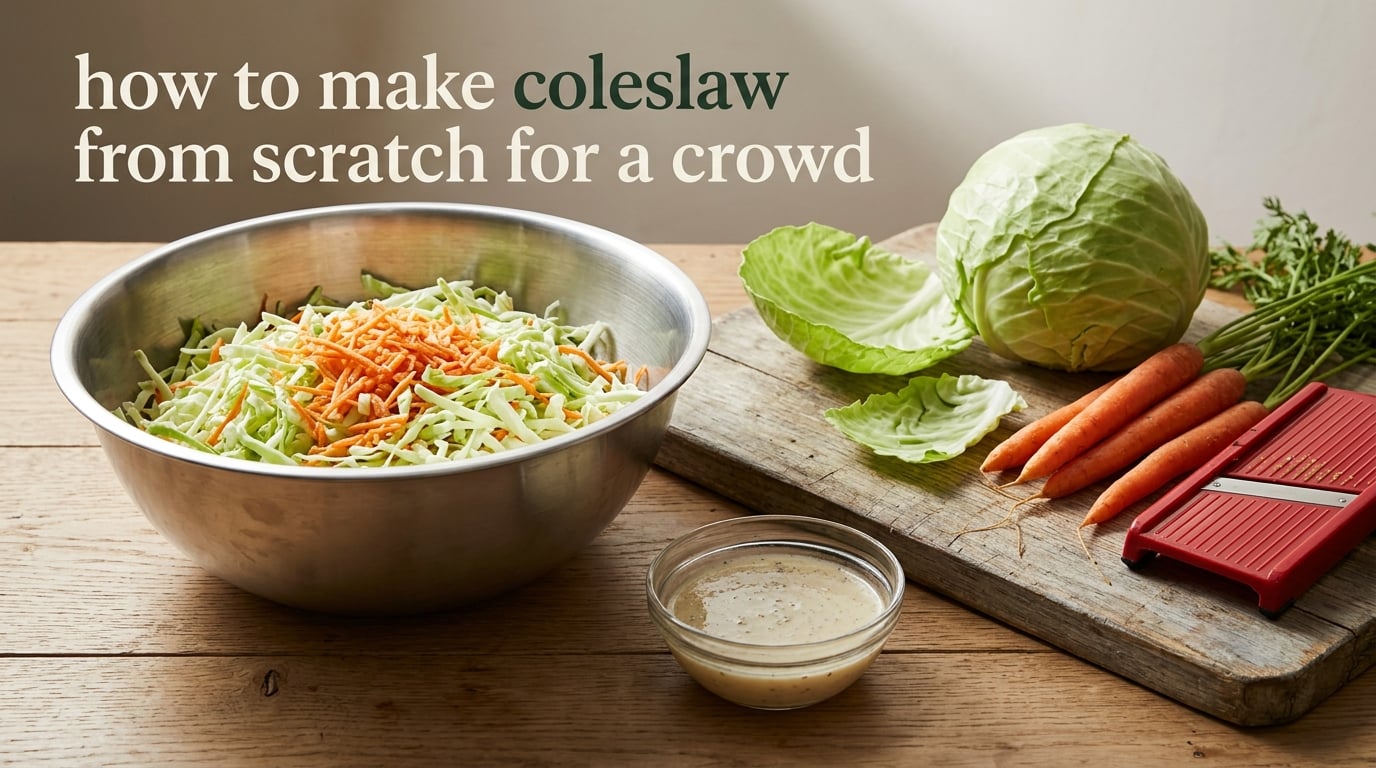
Short answer: plan about 3/4 cup of finished coleslaw per guest, and buy 1 cup per head to cover a hungry crowd and a second helping. That works out to roughly one small head of cabbage (about 1.5 pounds) for every 6 people. Everything below scales from that single number.
Most coleslaw recipes stop at 6 servings, which is fine for a Tuesday dinner and useless the moment you are feeding 25 people on a picnic blanket. Scaling up is not really a cooking problem. It is a math problem and a water problem, and both are easy once you know where the water comes from.
In this guide I break down how to make coleslaw from scratch for a crowd, from the base recipe through the shredding, the salting-and-draining step that keeps it crunchy, a headcount table you can read at a glance, and a make-ahead plan that fits a real party schedule. Updated for 2026.
Table of Contents
- How to Make Coleslaw From Scratch for a Crowd
- The base recipe (serves 6, makes about 6 cups)
- Step 1: Shred the cabbage
- Step 2: Salt the cabbage and let it sit
- Step 3: Drain and squeeze
- Step 4: Mix the dressing
- Step 5: Combine, starting with part of the dressing
- Step 6: Chill at least 30 minutes
- Step 7: Taste and adjust before serving
- What “from scratch” actually means here
- How Much Coleslaw Do You Need Per Person?
- Choosing the Cabbage, the Cut, and the Dressing Base
- Make-Ahead Timeline and How Long Coleslaw Lasts
- Flavor and Regional Variations That Scale
- Why Is Your Batch of Coleslaw Watery?
- What to Serve Coleslaw With at a Gathering
- Frequently Asked Questions
- How much coleslaw do I need per person?
- How do I scale a coleslaw recipe up for 20, 30, or 50 people?
- Can I make coleslaw ahead of time?
- How long does homemade coleslaw last in the fridge?
- Why is my coleslaw watery?
- Should I dress the slaw before or after storing it?
- What is the best way to shred a large amount of cabbage?
- How much cabbage do I need for a large batch?
- Conclusion
How to Make Coleslaw From Scratch for a Crowd
Coleslaw is a cold salad of raw shredded cabbage, usually with grated carrot and a bit of onion, tossed in a dressing. The only ingredient every version shares is the raw cabbage, which is why the recipe below is built in parts you can multiply without rethinking.
The base recipe (serves 6, makes about 6 cups)
- 1 small head green cabbage (about 1.5 pounds), cored and outer leaves removed
- 2 medium carrots, peeled
- 1/2 small onion
- 1/2 cup mayonnaise
- 2 tablespoons cider vinegar
- 1 tablespoon sugar
- 1 teaspoon salt, plus more for the cabbage
- 1/2 teaspoon black pepper
Swap the mayonnaise for 1/3 cup neutral oil plus 1 tablespoon extra vinegar if you want a vinegar-based slaw, or for 1/2 cup buttermilk if you want the tangier, thinner result. The method below does not change.
Step 1: Shred the cabbage
Cut the cabbage into wedges, then shred each wedge across the grain. Fine shreds give a creamy, even texture and are the classic restaurant look. Coarse chop gives a crunchier, more rustic result, and both are conventional cuts for coleslaw. Shred the carrots and the onion on the same pass so everything matches.
Push the shreds off to one side and keep slicing. Large batches need two sessions, and that is normal.
Step 2: Salt the cabbage and let it sit
Toss the shredded cabbage with 1 tablespoon of salt and leave it in a large bowl or a colander set over a sink for 20 to 30 minutes. This is the step most recipes skip, and it is the one that decides whether a big batch is crisp or soupy. Salt pulls water out of the cabbage cells, and that water ends up in the bottom of the bowl instead of in your dressing.
Do not skip it and do not shorten it at scale. A 20-serving batch needs the same 20 to 30 minutes as a 6-serving batch, because the salt acts on the surface of each shred rather than on the volume of the bowl.
Step 3: Drain and squeeze
Tip the cabbage into a colander and press down hard with the back of a large spoon or a clean, heavy pot lid. You should see liquid pooling underneath. Squeeze in batches if the quantity overwhelms your hands, and give it at least a full minute. The cabbage should feel dry and squeak slightly.
Skim any liquid out of the serving bowl, return the cabbage, and move on quickly. The shreds start absorbing again the moment they are drained.
Step 4: Mix the dressing
Whisk the mayonnaise, vinegar, sugar, remaining salt, and pepper together in a separate bowl until smooth. Taste it on a spoon before it touches the cabbage. A large batch usually needs slightly more acid than a small one, because the sugar ratio that reads balanced in a 6-cup bowl reads flat in a 30-cup batch. Start with the recipe amounts, then add a splash of vinegar.
Step 5: Combine, starting with part of the dressing
Pour about two-thirds of the dressing over the drained cabbage and fold gently with your hands or a large spoon. Add more dressing a little at a time until every shred is lightly coated. You want a thin, even sheen, not a heavy coating, because the cabbage gives up a little more liquid as it sits.
Step 6: Chill at least 30 minutes
Cover and refrigerate for at least 30 minutes before serving so the dressing settles into the cabbage. Cold slaw tastes brighter and crunchier, and the flavors need the time to marry.
Step 7: Taste and adjust before serving
Give it a stir and a taste 15 minutes before you set it out. If a pool of liquid has formed, drain it off and fold the slaw back together. Add a pinch of salt, a dash of vinegar, or a little more sugar as needed. This final check is the difference between a batch that looks like it came from a deli and one that does not.
What “from scratch” actually means here
Scratch coleslaw means shredded raw cabbage and a dressing you mix yourself, rather than a bottled dressing poured over a bag of slaw. The cabbage is never cooked. The word comes from the Dutch koolsla, cabbage salad, and “cole” traces back to the Latin caulis, also the root of cauliflower.
How Much Coleslaw Do You Need Per Person?
The number most people are missing is the serving size. A standard 1/2 cup scoop is a side dish, not a party portion. For a buffet, 3/4 cup per person is the working figure, and 1 cup per person is the figure to buy if you want nobody scraping the bowl.
One small head of shredded cabbage yields roughly 6 cups, so a head feeds about 6 guests generously. Multiply the base recipe by the number of batches you need rather than trying to eyeball it.
| Guests | Cabbage | Carrots | Onion | Dressing batches | Finished volume |
|---|---|---|---|---|---|
| 6 | 1 small head (about 1.5 lb) | 2 medium | 1/2 small | 1 | 6 to 7 cups |
| 10 | 2 small heads (about 3 lb) | 3 medium | 1 small | 2 | 10 to 12 cups |
| 20 | 4 small heads (about 6 lb) | 7 medium | 2 small | 4 | 20 to 25 cups |
| 30 | 5 small heads (about 7.5 lb) | 10 medium | 3 small | 5 | 30 to 36 cups |
| 50 | 9 small heads (about 13.5 lb) | 17 medium | 4 small | 9 | 50 to 60 cups |
Two things about this table are worth memorizing. Cabbage scales by head, not by weight, because heads arrive in those sizes. Dressing scales by batch, because the mayonnaise-to-vinegar ratio breaks down if you eyeball it with a spoon.
If you are serving coleslaw as one of several sides rather than the main event, drop to 1/2 cup per person. If it is the star side at a barbecue with fried fish or pulled pork sandwiches, hold at 1 cup.
Choosing the Cabbage, the Cut, and the Dressing Base
Green cabbage is the default, and it is the right call for a crowd because it holds its crunch for days after dressing. Red cabbage works and looks striking, but its color softens to purple-grey within a few hours. Napa cabbage shreds into longer, paler ribbons and is a good option if you want a lighter texture.
Broccoli slaw is a recognized variant that swaps cabbage for shredded broccoli stems and florets. It is lower in starch than cabbage slaw and it works well in big batches, though it softens faster, so dress it closer to serving time.
Shredding equipment for batches above 20 servings
| Method | Batch capacity | Effort | Result |
|---|---|---|---|
| Box grater | One head at a time | High above 25 servings | Even, fine, no motor to stop |
| Food processor | About 1 to 2 heads per load | Low | Fastest, slightly uneven |
| Mandoline | Several heads per session | Moderate | Fastest manual option, long even strands |
| Commercially shredded bag | Several bags | None | Consistent, less control over cut size |
For 20 servings, a food processor is the practical choice: roughly eight to ten batches of shredding. Above that, a mandoline plus a willing set of helpers beats a single processor doing twenty rounds. Use the guard, and keep fingers away from the blade.
Dressing families and the ratio that survives scaling
Three dressing families cover almost all coleslaw. Vinegar-based slaw uses a neutral oil, vinegar, and sugar, and it is the sturdiest choice for a crowd because it does not break or weep when it sits. Mayonnaise-based slaw is creamy and sweet, familiar from delis and BBQ tables, and it is the one most sensitive to a wet cabbage. Buttermilk slaw is thin and tangy, almost a salad dressing than a slaw dressing, and it also travels well.
The ratio that scales cleanly is 1 part fat to 1 part acid by volume, plus sugar to taste. For a 6-serving batch that is 1/2 cup of fat and 1/2 cup of acid, and it holds for every multiple. If a large batch tastes flat, the fix is almost always more acid, not more sugar.
Make-Ahead Timeline and How Long Coleslaw Lasts
Yes, coleslaw can be made ahead, and for a crowd it almost has to be. The key decision is whether you dress it now or later, because those two versions keep for very different lengths of time.
| State | Refrigerated at or below 40°F | Notes |
|---|---|---|
| Shredded cabbage, undressed, in a sealed container | 5 to 7 days | Longest window, best for prepping 2 days ahead |
| Salted and drained, undressed | 2 to 3 days | Already seasoned, do not re-salt |
| Mayonnaise-based dressed slaw | 3 to 4 days | Use a container with headroom, not packed tight |
| Vinegar-based dressed slaw | 5 to 7 days | Most forgiving of a long party weekend |
These are home-kitchen windows for a chilled side dish, not commercial holding times. When in doubt, eat it within a day of the party rather than stretching it. Discard slaw that smells off, feels slimy, or has been unrefrigerated for more than two hours on a warm day, and use a cooler with plenty of ice for a picnic or tailgate.
A workable party timeline
- Two days out: buy the cabbage and carrots, and shred and salt the cabbage. Drain, cover, and refrigerate undressed.
- Day before: mix the dressing, store it covered in the fridge, and decide your serving vessel. A wide, shallow bowl shows off the slaw better than a deep tub and keeps the weight off the bottom.
- Four hours before: combine the drained cabbage and the dressing, taste, and adjust. Refrigerate covered.
- Thirty minutes before: take it out, stir, drain any liquid, and serve with a large spoon rather than a small one.
Do not put the bowl out more than an hour before guests eat. Cold slows the weeping, but the acid keeps working once the slaw warms up.
Flavor and Regional Variations That Scale
Once the base method is solid, the dressing is where the personality lives, and every one of these changes works at any batch size.
- Vinegary slaw: Skip the mayo, use 1/3 cup oil and 1/4 cup cider vinegar, and add a pinch of red pepper flakes. This is the style common in North Carolina, and it holds the longest of any version.
- Mayo slaw: Keep the base ratio and add a spoonful of pickle juice. This is the Memphis style, and it is the one people expect at a barbecue.
- Buttermilk slaw: Use 1/2 cup buttermilk, a tablespoon of lemon juice, and a teaspoon of sugar. Thin, tangy, and very refreshing in summer heat.
- Hot slaw: Add sliced jalapeno and a teaspoon of prepared mustard. Tennessee named hot slaw its official state food in 2024, and the heat is the whole point.
- Lexington red slaw: Shredded red cabbage with ketchup and vinegar instead of mayo. Sweet, sharp, and pink enough to stand out on a buffet table.
- Krautsalat: The German-influenced version pairs white cabbage with bacon and a light vinaigrette rather than a sweet dressing.
Common additions that scale without trouble: grated cheese, diced bell pepper, apple or pear, pineapple tidbits, and thinly sliced onion. Add pineapple last and refrigerate overnight if you use it, since it releases liquid.
Why Is Your Batch of Coleslaw Watery?
If the bowl has a puddle at the bottom an hour after serving, the cause is almost always in this list, and the fixes run from most to least likely.
- You did not salt and drain the cabbage. This is the top cause. Salt the shreds, wait 20 to 30 minutes, and squeeze them dry.
- You salted the cabbage and then salted the dressing too. After draining, taste before adding more salt. The cabbage carries a surprising amount forward.
- You dressed it hours early and it sat undrained. Drain off any liquid and fold the slaw back together right before serving.
- You packed it too tightly in a small container. Give it headroom, and use a wide bowl for the service portion.
- You added fruit or tomato. Both release water. Drain the slaw after mixing, or add them in the final five minutes.
- You served it warm. Warm cabbage releases liquid faster. Cold slaw weeps more slowly.
One preventive trick for a big batch: mix the dressing in a jar with the drained cabbage, seal it, and invert the jar every 20 minutes during the initial chill. Gravity pulls the liquid to the bottom where you can see it, and the shreds stay coated rather than sitting in a pool.
What to Serve Coleslaw With at a Gathering
Coleslaw is a side dish built for main dishes that need something cold and acidic next to them. Fried fish, pulled pork sandwiches, hot dogs, barbecue chicken, and grilled shrimp are the classic pairings, because each one is rich or smoky and the slaw cuts straight through it.
It also holds up on its own at a buffet, next to baked beans, deviled eggs, and cornbread. For a picnic, pack it in a cooler in a sealed container and keep it separate from the mayo-heavy dishes so it does not sit in a warm spot all afternoon.
If you are building a menu, remember that coleslaw is a raw side dish. It works best alongside hot, cooked mains rather than next to other cold salads, and it is the easiest item on the table to make in advance.
Frequently Asked Questions
How much coleslaw do I need per person?
Plan about 3/4 cup of finished coleslaw per guest for a buffet, and 1 cup per person if you want to cover second helpings. One small head of shredded cabbage yields roughly 6 cups, so one head feeds about 6 people.
How do I scale a coleslaw recipe up for 20, 30, or 50 people?
Multiply the base 6-serving recipe by the number of batches you need. For 20 guests use 4 small heads of cabbage, 7 carrots, 2 small onions, 4 batches of dressing, and expect 20 to 25 cups. For 30 guests use 5 heads, 10 carrots, 3 onions, and 5 dressing batches. For 50 guests use 9 heads, 17 carrots, 4 onions, and 9 dressing batches.
Can I make coleslaw ahead of time?
Yes, and for a large batch you almost need to. Shred and salt the cabbage up to two days ahead, store it covered and undressed, then mix in the dressing 4 hours before the event and refrigerate until about 30 minutes before serving.
How long does homemade coleslaw last in the fridge?
Undressed shredded cabbage keeps 5 to 7 days covered in the fridge. Dressed mayo-based slaw keeps 3 to 4 days, and vinegar-based slaw keeps 5 to 7 days. Keep it refrigerated at or below 40F and discard it if it smells off or feels slimy.
Why is my coleslaw watery?
The usual causes are skipping the salting and draining step, salting twice, dressing too far ahead, packing the slaw tightly in a small container, or adding fruit or tomato. Salt the shreds for 20 to 30 minutes, squeeze them dry, and drain off any liquid before serving.
Should I dress the slaw before or after storing it?
Store it undressed when you are prepping more than a day ahead, and dress it 4 hours before serving otherwise. Undressed cabbage keeps roughly twice as long, and the dressing stays separate from the moisture the cabbage gives off.
What is the best way to shred a large amount of cabbage?
A food processor is fastest for batches of 20 servings, at roughly 1 to 2 heads per load. Above 25 servings a mandoline with helpers beats doing many processor rounds, and a box grater works fine if you have the time. Keep the cut consistent so the texture stays even.
How much cabbage do I need for a large batch?
Figure one small head, about 1.5 pounds, for every 6 guests. That means 4 heads for 20 people, 5 heads for 30, and 9 heads for 50. Shredded cabbage loses volume to salting and draining, so buy a head or two more than you think you need.
Conclusion
To make coleslaw from scratch for a crowd, start with the only two numbers that matter: 1 cup of finished slaw per guest, and one small head of cabbage per 6 people. Multiply the base dressing by the number of batches rather than eyeballing it.
Then protect the crunch. Salt the shredded cabbage for 20 to 30 minutes, squeeze it dry, and only then add the dressing. That single step is the difference between a bowl that holds up for an hour on a picnic table and one that pools in the middle.
Shred and salt the cabbage two days ahead, dress it the day of, and drain it once more right before you set the bowl out. From there, pick the dressing family that matches the meal: vinegar for the longest hold, mayo for the familiar barbecue table, buttermilk for something lighter.