
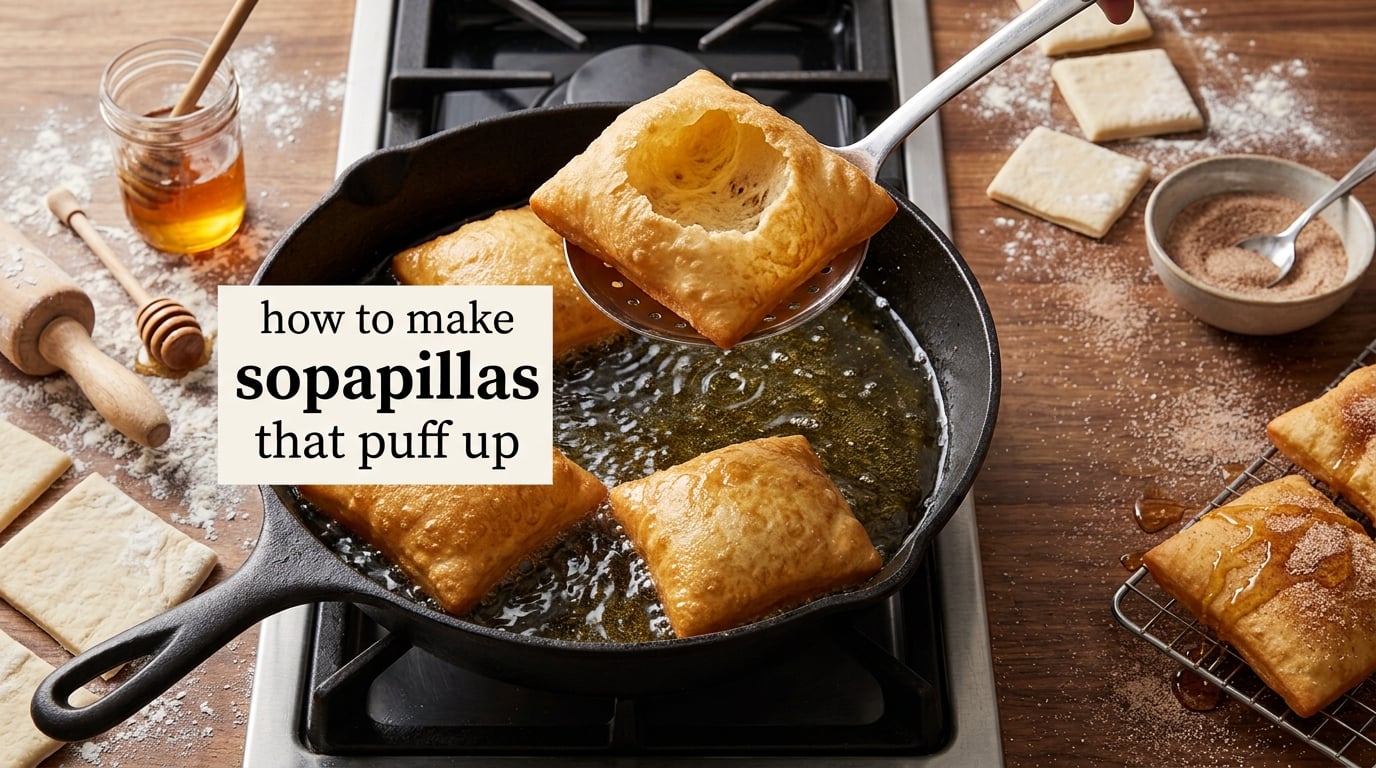
Learning how to make sopapillas that puff up comes down to four things: fresh double-acting baking powder, dough thin enough to balloon, oil hot enough to trap steam instantly, and small batches. Miss any one of them and you get the flat, greasy, doughy disks that disappoint most home cooks on their first attempt. The good news is that every one of those levers is something you control with a spoon, a rolling pin, and a thermometer.
Sopapillas are thin squares of fried dough built from flour, baking powder, salt, a little fat, and warm water. There is no yeast, no kneading, and no rising time in the traditional sense. That is exactly why they are such a satisfying weeknight project and such a frustrating one when the puff fails.
A quick note on spelling before we start: both sopapillas and sopaipillas appear constantly in search results. The doubled-i sopaipilla is the traditional New Mexican spelling, and both versions mean the same pastry. Search engines treat them as near-variants, so you will see both on this page.
Table of Contents
- The short answer: the secret to perfect sopapillas
- Why do sopapillas puff up?
- The base recipe for puffy sopapillas
- How to make sopapillas that puff up: step by step
- The hot oil spoon trick that forces the puff
- Troubleshooting: why your sopapillas stay flat, greasy or doughy
- Baking powder vs baking soda: which one puffs
- Air fryer and oven-baked sopapillas that still puff
- Freezing, storing and reheating sopapillas
- Frequently Asked Questions
- Conclusion
The short answer: the secret to perfect sopapillas
The secret to perfect sopapillas is a hot fry that meets a rested, paper-thin dough made with fresh double-acting baking powder. Heat oil to 350F to 375F, rest the dough 30 to 60 minutes, roll it to 1/8 inch, cut sharp 2-3 inch squares, and fry two or three at a time so the oil stays hot. The gas from the baking powder and the steam from the dough inflate each square into a hollow pillow within the first 45 seconds.
Why do sopapillas puff up?
Sopapillas puff up because double-acting baking powder releases carbon dioxide gas on contact with warm water, and that gas expands violently the moment the dough hits hot oil. Steam from the water in the dough inflates the same pocket, the thin sheet balloons outward, and the crisp shell sets around a hollow, airy center. The puff is chemistry happening in about 45 seconds, not frying technique alone.
Think of it as two leavens working together. The baking powder is the gassing agent, and the water in the dough is what makes the steam. Hot oil is the trigger that converts both into volume before the outside has time to crisp and seal the pocket shut.
This is also why store-bought flour tortillas are a dead end. A poster on the ChefTalk “Easy Sopapilla Recipe” thread tried tortillas and the community’s verdict was consistent: they fry fine, but they arrive as fried dough rather than puffed pillows, because tortillas carry no baking powder to produce the gas.
What “puffed” actually looks like
A properly puffed sopapilla is a pillow, not a disc. The center balloons until the two faces nearly touch, the shell turns an even golden brown, and the interior shows a fine, soft crumb rather than a solid bite of raw dough. If you press the top gently and it feels firm and hollow, the gas held.
A failed puff looks different at every stage. No rise at all means the leavener was dead or the dough was too thick. A split that blows open in the oil means the edge sealed before the interior could inflate. A rise followed by a collapse means the shell set from the outside while the inside was still wet.
Does baking powder puff or spread?
Baking powder puffs rather than spreads, and that distinction is the whole technique. Baking powder is a double-acting leavener: it releases gas once when the dough is mixed with liquid, and a second, larger burst when heat hits it in the fryer. That second burst is the one that builds pressure fast enough to balloon the sheet before the shell sets.
Baking soda needs an acidic partner such as honey, molasses, or brown sugar to release its gas, and even then the dough behaves differently. A honey-soda dough browns fast and spreads into a crisp cookie-like wafer, because there is far less gas pressure and far more sugar. For a hollow pillow you want the alkaline chemistry of baking powder.
The base recipe for puffy sopapillas
Sopapilla dough is a hot-water dough, which is why it needs no kneading and no yeast. This base makes roughly 18 to 22 squares depending on how thin you roll and how large you cut them.
- 2 cups (250 g) all-purpose flour
- 2 teaspoons (8 g) baking powder, double-acting, fresh
- 1 teaspoon (6 g) salt
- 2 tablespoons (28 g) lard or solid vegetable shortening
- 3/4 cup (180 ml) warm water, about 110F / 43C
- Frying fat for the bath: neutral oil such as canola, peanut, or vegetable, plus 1 tablespoon lard for flavor if you like
What each ingredient is doing
The flour supplies the gluten structure that holds a pocket of gas. The baking powder is the gassing agent, and the amount is not adjustable downward if you want a dramatic puff. Salt tightens the gluten and sharpens the flavor.
The lard or shortening makes the dough tender so a very thin sheet does not turn cracker-hard when it fries. Warm water hydrates the flour quickly, which lets you mix with a spoon and start resting almost immediately.
Water temperature matters more than most recipes admit. Lukewarm water hydrates without setting the gluten, which keeps the dough supple. Cold water leaves the flour stiff and slow to relax; water that is too hot cooks the starch on contact and makes the dough gummy and prone to tearing.
Fat choices that still puff
Lard gives the most traditional New Mexican flavor and the best aroma. Shortening works nearly as well and is easier to find. A neutral oil stirred into the dough works too, though the result is slightly less flaky. What you should not do is swap in melted butter alone; the water in the butter thins the dough and encourages spreading.
You can fry with the same oil you bake with
Canola oil is the common New Mexican choice and it fries evenly with a neutral flavor. Peanut oil adds a faint nuttiness and a higher smoke point. Whatever you choose, the fat needs to be new enough that it does not smoke before the dough browns, because smoke means the temperature is already past where you want it.
How to make sopapillas that puff up: step by step
Step 1: Mix the dough with a spoon
Whisk the flour, baking powder, and salt together in a large bowl so the baking powder is evenly distributed. That even distribution is what keeps the puff uniform across every square you cut.
Rub the lard or shortening in with your fingertips until the mixture looks like coarse crumbs, then pour in the warm water and stir with a spoon until no dry flour remains. The dough will be shaggy and sticky. That is correct. Do not knead it.
Step 2: Rest the dough for 30 to 60 minutes
Wrap the dough and let it sit at room temperature for 30 to 60 minutes before rolling. This is the most actionable lever nobody puts on the recipe card, and it is the one a ChefTalk reply names directly: bulk dough that has not sat at room temperature for at least an hour will not puff evenly.
What the rest does is simple. The gluten relaxes, so the dough stops springing back as you roll, which means even thickness, which means even puff. A rested sheet inflates uniformly; an unrested sheet puffs in the middle and stays heavy at the edges.
Step 3: Roll thin and cut with a sharp cutter
On a well-floured surface, roll the dough to 1/8 inch / 3 mm. Thinner is better here, and paper-thin edges will balloon the most. If the dough fights you and springs back, give it another 15 minutes of rest rather than fighting it with more flour.
Cut squares 2 to 3 inches on a side with a very sharp knife or a pizza wheel. Clean edges matter more than they look like they should. A ChefTalk reply makes the same point about biscuits and puff pastry: sharp cuts let the layers separate and rise, while a dull cut compresses the edge into a sealed lump that blocks the puff.
Step 4: Heat the oil to 350F to 375F
Fill a heavy skillet with 1.5 to 2 inches of oil and heat it to 350F to 375F / 175C to 190C. You will see 350F, 370F, and 375F quoted across different recipes, and they are not in conflict. That range is a band, and what matters is that the oil is comfortably hot enough to flash the surface and form a sealed shell within seconds.
If you have no thermometer, drop a small square of dough in. It should sizzle immediately and vigorously. Lazy bubbling means the oil is too cool and the square will soak up oil instead of puffing. Instant violent bubbling with no browning at all means the oil is too hot and the outside will scorch before the inside inflates.
Use a heavy skillet rather than a thin one. Thin cookware swings wildly in temperature every time you lower a wet square into the oil, and those swings are what cause the flaky, inconsistent puff most home cooks blame on the recipe.
Step 5: Fry two or three pieces at a time
Lower each square away from you into the oil, sliding it off the spatula rather than dropping it. Wait 30 to 45 seconds, then turn once. Fry for 1 to 2 minutes per side, until the surface is blistered and golden brown and the piece floats easily.
Batching is the quiet factor nobody quantifies. Adding six squares at once drops the oil temperature fast enough that the dough soaks instead of sealing, and your first batch comes out greasy while the last batch puffs beautifully. Two or three at a time lets the oil recover between batches. If you notice the bubbling dying down, pause and let the oil come back up before adding more.
Flip exactly once. A second flip is tempting because the first face often pales unevenly, but repeated handling collapses a half-formed pocket. One turn gives the second side even heat and leaves the interior alone to finish setting.
Step 6: Drain, then top while warm
Move the sopapillas to a wire rack or paper towels for a minute so the residual oil drains off rather than pooling under the bottom. Dust with cinnamon sugar, shower with powdered sugar, or drizzle with honey while they are still warm, since warm pastry holds a topping far better than a cooled one.
Freezing unbaked squares for a fresh fry later
Sopapillas fry best the day they are rolled, but you can freeze the cut squares unbaked. Lay them on a tray without touching, freeze until solid, then transfer to a bag for up to a month. Fry from frozen at 350F and add 30 to 60 seconds, since the added chill lowers the oil temperature on contact.
The hot oil spoon trick that forces the puff
Baste the puffing sopapilla with hot oil for a more dramatic rise, using a tablespoon of the hot frying oil drizzled over the top as soon as the square hits the pan. Multiple creators describe this step independently, and once you see it, you will never skip it. It is the difference between a nice rise and a balloon.
Here is the mechanism. The top face is in contact with hot oil at the same moment the underside is, but the top has been exposed to air and is slightly cooler when the dough lands. Spooning oil over it equalizes the two surfaces, so the sheet inflates from all directions rather than bulging upward and then tearing at the top edge.
Use a long spoon so your hand stays clear of the steam, and add the oil over the piece after it has been in the pan 15 to 20 seconds. Baste once or twice per side. This is a finishing touch on top of correct technique, not a substitute for it. Spooning oil over dough made with dead baking powder still gives you a greasy flat wafer.
Troubleshooting: why your sopapillas stay flat, greasy or doughy
Use this table to diagnose the symptom you actually have, then fix the cause rather than adjusting the recipe at random. Almost every failure traces back to one of four variables: leavener freshness, dough thickness, oil temperature, or batch size.
| What you see | What is causing it | How to fix it |
|---|---|---|
| Flat, dense, no volume at all | Baking powder has lost its potency, or you used baking soda | Test the baking powder in hot water. If it only fizzles, replace the box and use double-acting baking powder at full strength. |
| Puffy on top, heavy and raw in the center | Dough rolled too thick, so the middle never cooks through | Roll to 1/8 inch / 3 mm and check the center by feel, not by eye. Thick squares need 3 minutes a side and still underperform. |
| Greasy and heavy, no crust | Oil below 340F, or too many pieces frying at once | Bring the oil to 350F to 375F, and fry only two or three squares per batch so the temperature recovers. |
| Splits or blows open in the oil | Edges sealed before the interior inflated, usually from a dull cut or dough that was stretched | Use a sharp knife or pizza wheel, keep cuts square, and lay the dough down without pulling it. |
| Outside dark, inside gummy | Oil above 390F, so the shell charred before the steam could expand the center | Lower the heat and let the oil cool before adding dough. Use a thermometer rather than guessing by color. |
| Sticks to the pan or to itself | Dough sat in the pan too long before sliding, or the oil was not hot enough to release immediately | Hold each square over the oil for 3 to 4 seconds so the underside sets, then slide it in. |
| Uneven puff, one corner ballooning | Uneven dough thickness, usually because the dough sprang back while rolling | Give the dough another 15 minutes of rest and roll with even pressure from the center outward. |
| Puffs, then deflates on the rack | Shell set before the interior finished releasing steam | Hold the pieces over the pan for a few seconds longer before draining so residual steam can escape gradually. |
| First batch greasy, later batches fine | Oil temperature dropped and had not recovered | Fewer pieces per batch, and a 60 to 90 second pause between batches to let the oil come back up. |
Baking powder vs baking soda: which one puffs
Baking powder puffs, and baking soda spreads. Here is the practical difference in the context of fried dough.
| Baking powder | Baking soda | |
|---|---|---|
| What it is | Acid and base already combined in one box | Pure sodium bicarbonate, needs an acid to react |
| When the gas releases | Twice: once with liquid, once with heat | Once, only when an acidic ingredient is present |
| Result in hot oil | A hollow, ballooned pillow | A fast-browning, thin wafer that spreads |
| Typical amount for a 2-cup-flour dough | 2 teaspoons | Not recommended |
| Suitability for sopapillas | The correct leavener | Produces fried dough, not puffed dough |
How to test if your baking powder is still good
Test baking powder freshness with half a teaspoon in a third of a cup of hot water. Fresh powder fizzes and bubbles vigorously for several seconds. A weak reaction means you are holding mostly starch and filler, and that box will give you flat sopapillas no matter how hot the oil is.
Because dry leavening loses potency slowly in an open box, a box that is two years old and has been scooped out with a wet spoon can easily be inert. Replace the box, and write the date on a new one with a marker. Buy the size you will use within six months.
Air fryer and oven-baked sopapillas that still puff
Air fryer sopapillas still puff, but the result is a lighter shell and a smaller balloon. Set the air fryer to 375F, arrange the squares in a single layer with a little oil brushed on, and air fry for 5 to 6 minutes, flipping at the 3 minute mark. They brown in about 6 minutes rather than the 90 seconds of deep frying, so the leavener has time to gas out with less force.
Oven-baked sopapillas follow the same logic. Heat the oven to 425F, brush the squares with melted fat, and bake for 9 to 11 minutes, flipping once. The high temperature recreates the flash-seal of hot oil, which is what keeps the interior airy rather than dense.
Be honest about the tradeoff. Baked and air-fried versions are crisp and hollow enough to satisfy, and they save a lot of oil, but they never deliver the blistered, tender shell of a proper fry. If the puff is the entire point, the fryer is still the answer.
Freezing, storing and reheating sopapillas
Serve sopapillas the same day you fry them. They are at their best within a few hours, while the shell is still crackling-crisp and the interior is soft and airy. A thin layer of reheating restores some of that crackle but not all of it.
To store, let the pieces cool completely uncovered, then transfer them to an airtight container lined with paper towels. Refrigerate for up to two days. Reheat in a 350F oven for 5 to 8 minutes so the shell crisps again rather than going soft in a microwave.
The better storage strategy is to freeze them unbaked. Cut squares, freeze on a tray until solid, bag them, and fry straight from frozen whenever you want a fresh batch. That is the only way to get a puff that tastes like it was just made.
Frequently Asked Questions
How to get sopapillas to puff?
To get sopapillas to puff, control four variables: fresh double-acting baking powder, dough rested 30 to 60 minutes, oil at 350F to 375F, and batches of two or three pieces. Roll the dough 1/8 inch thick, cut sharp 2-3 inch squares, and fry 1 to 2 minutes per side until golden. Baste the top with hot oil once the piece is in the pan for a more dramatic balloon.
What’s the secret to perfect sopapillas?
The secret is temperature discipline rather than any single ingredient. The oil must be hot enough to seal the surface within seconds, and the dough must be thin enough for steam to lift it. Resting the dough at room temperature for 30 to 60 minutes relaxes the gluten so the sheet inflates evenly instead of bulging in the middle. Basting hot oil over the top finishes the job.
Why are my sopapillas not rising?
The most common causes are dead baking powder, oil that is too cool, and dough rolled too thick. Test your baking powder in hot water to confirm it still fizzes. Keep the oil between 350F and 375F so the shell seals fast, and roll to 1/8 inch. Adding too many pieces at once also drops the oil temperature, which makes the dough soak instead of sealing.
Why isn’t my sopapilla dough rising?
Sopapilla dough is not supposed to rise before frying. It is a chemically leavened hot-water dough, so there is no bulk rise and no yeast fermentation. The dough rests so the gluten relaxes and the sheet rolls evenly, but the visible puff happens in the fryer when baking powder gas and steam expand. If you want dough that rises before cooking, you are looking at puff puff, which uses yeast.
What kind of dough is used for sopapillas?
Sopapillas use a hot-water dough made from all-purpose flour, double-acting baking powder, salt, a little lard or shortening, and about three-quarters of a cup of warm water. There is no yeast, no egg, and no kneading. The dough is mixed with a spoon, rested 30 to 60 minutes, then rolled thin and cut into squares before frying.
Does baking powder puff or spread?
Baking powder puffs, because it is a double-acting leavener that releases gas when mixed with liquid and again when heat hits it. That second burst is what inflates a sopapilla in hot oil. Baking soda spreads, since it needs an acidic partner and only reacts once. A honey-soda dough browns quickly into a thin crisp wafer instead of a hollow pillow.
Conclusion
To make sopapillas that puff up, the recipe barely needs to change at all. What needs to change is your control over four things: baking powder fresh enough to gas, dough rested long enough to roll even, oil at 350F to 375F, and batches small enough to keep that temperature. Roll thin, cut sharp, fry two or three at a time, and baste the top with hot oil while the pocket is still forming.
Start by checking your baking powder in a cup of hot water before you mix anything. If the fizz is weak, the entire exercise is already decided, and no amount of oil temperature will save it. Beyond that, trust the dough when it is sticky, trust the rest even when you are in a hurry, and trust the fry over the color of the oil.
Once you get one clean puff, the rest is repetition. Updated for 2026, this is the method our kitchen uses for every batch.