
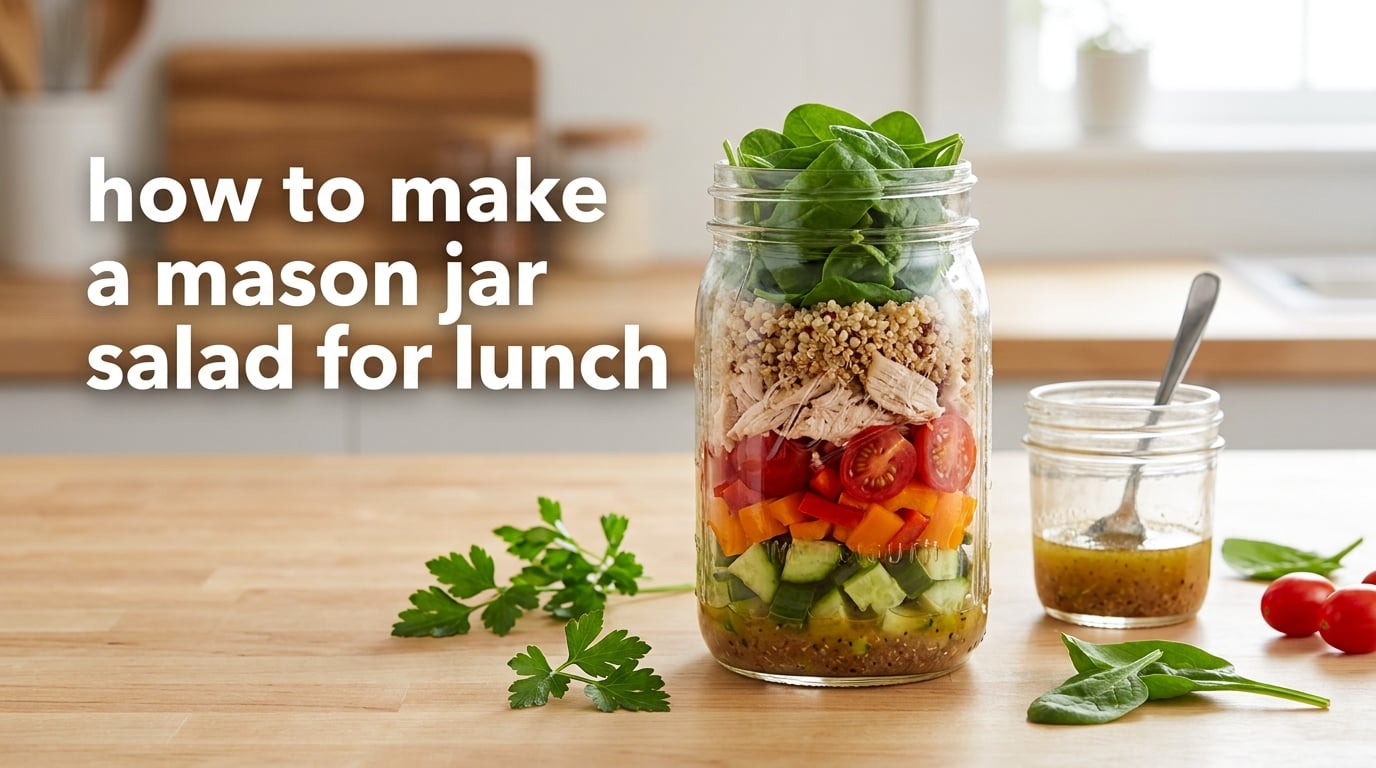
To make a mason jar salad for lunch, put the dressing in the bottom of a wide-mouth jar, then stack sturdy vegetables, protein, grains and cheese, and delicate greens on top in that order. Seal it, keep it cold, and shake just before eating so the lettuce is still crisp at noon.
A jar salad solves two problems at once: the soggy-lettuce problem and the utensils problem. The dressing sits at the base where it cannot reach the leaves until you decide to shake, and the whole meal travels in a container you eat straight from.
That makes it a genuinely useful grab-and-go lunch for the office, a school bag, a commute, or a picnic. It is also a no-cook method once your ingredients are ready, so a Sunday batch of five jars takes about 40 minutes and covers the whole work week.
If you are new to this, you are in good company. In one r/cookingforbeginners thread, a poster wrote that they kept seeing coworkers eat mason jar salads and had no idea how to prepare them. This guide is the answer they were looking for, plus the storage answers that most recipe pages skip.
Table of Contents
- The Mason Jar Salad Method at a Glance
- How to Make a Mason Jar Salad for Lunch, Step by Step
- What Goes in Each Layer, Bottom to Top
- The Base Mason Jar Salad Recipe
- The Mason Jar Salad Dressing Formula
- Which Greens and Vegetables Actually Stay Fresh?
- How Long Does a Mason Jar Salad Last?
- How to Make a Mason Jar Salad for a Full Work Week
- Which Mason Jar Size Do You Need?
- 5 Mason Jar Salad Variations
- Mistakes That Ruin a Mason Jar Salad
- Frequently Asked Questions
- The One Rule to Remember
The Mason Jar Salad Method at a Glance
Here is the whole method before any detail. Five steps, and one order to remember.
- Wash and dry the jar completely.
- Pour 2 to 3 tablespoons of dressing in the bottom.
- Add sturdy vegetables next.
- Add protein, then grains or cheese.
- Add delicate greens, seal, and shake to eat.
The order, in one line: dressing, sturdy vegetables, protein, grains and cheese, delicate greens, lid on with an inch of headspace left.
How to Make a Mason Jar Salad for Lunch, Step by Step
Prep time is 20 minutes plus anything you need to cook. Assembly is 30 seconds per jar. One 16 oz wide-mouth quart jar makes one generous adult lunch, and five jars cover a full work week.
- Start with a bone-dry jar. Wash it, dry it thoroughly, and if you are serious about this, let it air out on the counter for ten minutes. Any residual moisture makes the greens go slimy within hours. This is the single most cited fix in the tips lists that rank on this topic.
- Measure the dressing into the bottom. Two to three tablespoons for a 16 oz jar. The dressing has to be able to climb when you shake, so do not drown the base.
- Pack the sturdy vegetable layer. Grated carrot, cucumber, bell pepper, onion, broccoli, corn and whole cherry tomatoes. Press each layer down gently with a thin spatula or the back of a spoon so it stays put.
- Add your protein. Shredded chicken, drained tuna, sliced hard-boiled egg, chickpeas, tofu cubes or edamame. Protein keeps the layers separated, which is a bonus of the format.
- Add grains and cheese. Cooked quinoa, farro, brown rice, crumbled feta or shredded cheddar. Cheese placed here rather than on top stays drier and firmer.
- Finish with delicate greens, seal and shake. Baby spinach, arugula or mixed leaves go on last, right under the lid. Leave about an inch of empty space at the top or you will pack a compressed salad brick you cannot shake loose.
At lunch, put the lid back on, hold the jar with one hand at the neck and one at the base, and shake for five seconds. When you cannot hear the contents clanging against the glass, the dressing has coated everything.
What Goes in Each Layer, Bottom to Top
The layering order is the entire technique. Moisture rises, and it rises because water moves from a wetter surface to a drier one through the leaves, a process called moisture migration. Put the wettest thing in the jar at the bottom and the driest thing on top, and that movement has nowhere to go.
| Layer (bottom to top) | Best ingredients | Why it belongs there |
|---|---|---|
| 1. Dressing | Olive oil and vinegar with Dijon, salt and pepper | Stays at the base, coats everything on shaking, and never touches the leaves |
| 2. Sturdy vegetables | Grated carrot, cucumber, bell pepper, red onion, broccoli, corn, cherry tomatoes | Dense enough not to wilt and not to release water into the layer above |
| 3. Protein | Shredded chicken, drained tuna, hard-boiled egg, chickpeas, tofu | Adds weight, which keeps layers separated, and salt is fine here |
| 4. Grains and cheese | Quinoa, farro, brown rice, feta, shredded cheddar | Handles light moisture well and absorbs dressing without turning mushy |
| 5. Delicate greens | Baby spinach, arugula, mixed greens, romaine | Wilts within hours of contact with moisture, so it goes where the dressing is not |
You will see recipes that reverse this and start with lettuce. That version works only when you eat the jar within a day, or when the dressing is on top in a separate container you tip in at the table. Dressing at the bottom is the rule that holds for a jar built to last until Friday.
The Base Mason Jar Salad Recipe
This is the formula I build from, and it scales by adding a jar. It is balanced enough to eat four days in a row without getting boring.
- 2 tablespoons olive oil
- 2 tablespoons balsamic or red wine vinegar
- 1 teaspoon Dijon mustard
- 1 teaspoon lemon juice, salt, pepper and dried oregano
- 1/3 cup cherry tomatoes, halved
- 1/4 cup grated carrot
- 1/4 cup diced cucumber
- 1/4 cup diced bell pepper
- 1/3 cup cooked quinoa, cooled
- 1/3 cup shredded chicken breast
- 2 tablespoons crumbled feta
- 1/4 cup dry shredded romaine
- 2 cups baby spinach
Pack in that order and leave an inch of headspace. No cooking is required unless you want to cook the quinoa and chicken, and both take about 20 minutes together.
The Mason Jar Salad Dressing Formula
Every good jar dressing follows the same ratio: one part oil, one part acid, a dab of mustard, and salt. The mustard is the emulsifier that keeps the oil and vinegar from separating in the jar over five days.
The house dressing from the r/salads thread that ranks above most editorial pages is exactly that formula, and it is worth copying: olive oil, balsamic vinegar, Dijon mustard, lemon juice, salt, pepper and dried oregano. The same poster’s ingredient list is notably sturdy-first, which is the other half of why their jars hold up. Cherry tomatoes, celery, onion, bell pepper, broccoli, feta, black olives, cucumber and carrots, plus a boiled egg for protein and a spinach mix for greens.
You can also skip the dressing entirely. Season the protein and grains with salt, pepper and lemon before they go in, and add a small jar of oil and vinegar to toss with at the table. Many of the best tips lists online make the same point, and it is the fastest route for anyone who finds a two-day-old jar salad over-dressed.
Which Greens and Vegetables Actually Stay Fresh?
Sturdy vegetables are dense enough not to wilt or release water in a sealed jar. Delicate greens are leaves that start wilting within hours of touching any moisture at all. Sorting your ingredients into those two groups is most of the work.
| Stays crisp all week | Wilts fast, use by day 3 | Keep it out of the jar |
|---|---|---|
| Kale, romaine hearts, green cabbage, carrots, broccoli, cucumber, bell pepper, onion, corn, celery, radish, grapes, blueberries | Baby spinach, arugula, mesclun mix, butter lettuce, cherry tomatoes cut in half, avocado, apple, pear | Banana, cut apples and pears unless tossed in lemon juice, pre-dressed bagged salad, croutons |
Two details matter more than the rest. Dry your produce completely after washing, because a wet tomato will pulp in the dressing within a day. And keep acid-heavy items like tomato and cucumber low in the jar so they do not drip upward into the greens.
How Long Does a Mason Jar Salad Last?
A properly layered jar salad stays good for 4 to 5 days refrigerated, but the quality drops by ingredient, not all at once. Greens are usually what limits you, not the vegetables or the protein.
| Day in the fridge | Greens | Vegetables | Protein | Verdict |
|---|---|---|---|---|
| Days 1 to 2 | Baby spinach, arugula, romaine: crisp | Firm and bright | Fresh, dressing well distributed | Best eating window |
| Days 3 to 4 | Baby spinach softens, kale and cabbage still fine | Still good, tomatoes release liquid into the dressing | Fine, chicken or egg hold up | Still very good, skip the spinach |
| Day 5 | Delicate greens wilted | Good | Good | Eat the sturdy layers, compost the leaves |
Food safety. Keep the jar refrigerated from the moment you seal it. Get it into a fridge within two hours, and if it spends the morning in a bag, pack it next to a frozen gel pack so the cold chain holds until lunch. A sealed jar of dressed leaves sitting on a warm desk all morning is not a safe lunch, and no amount of headspace changes that.
How to Make a Mason Jar Salad for a Full Work Week
Batch prep works because the layering means most components never touch. The only thing that truly must be added late is the dressing, and the only thing that truly must stay out is the leafy layer if you want day-five greens.
Sunday, 40 minutes:
- Cook quinoa and chicken, or open canned tuna and cooked chickpeas. Cool everything completely.
- Wash and cut every vegetable. Dry them thoroughly with a salad spinner or paper towels.
- Mix one batch of dressing in a small jar with a lid. This makes five portions at once.
- Fill five dry jars in this order: sturdy vegetables, protein, grains and cheese, then greens. Skip the dressing entirely.
- Seal, label, and refrigerate. Keep the dressing jar in the fridge beside them.
Monday to Friday morning, 30 seconds: pour two tablespoons of dressing into the bottom of your jar, seal, and put it in the fridge on its side so nothing settles. Take the frozen pack out of the freezer and pack the jar next to it.
Building it dry and dressing it at the table buys you a full extra day of texture, and it means one spilled jar costs you a lunch instead of a week.
Which Mason Jar Size Do You Need?
A regular straight-sided wide-mouth quart jar is the right default. The straight sides let layers slide down cleanly instead of jamming at the shoulder, and the wide opening fits a spoon or your hand so you can pack firmly and eat without a fork.
| Jar size | Good for | Jars per batch of a full week |
|---|---|---|
| 8 oz pint | A side salad, a snack-level lunch, or a kid’s portion | 10 |
| 16 oz wide-mouth quart | A full adult lunch with protein and grains, the standard choice | 5 |
| 32 oz half-quart | Two lunch portions, or a single salad for someone who eats a lot | 3 |
Avoid narrow-mouth jars. They pack well for smoothies and they frustrate you the moment you try to build a salad in one, because nothing goes in past the shoulder.
The rest of the kit is small. A wide-mouth funnel makes loading soft greens possible without crushing them, and a thin silicone spatula lets you press each layer down. A small lidded jar holds a week’s dressing, and a kitchen scale turns two tablespoons into a repeatable five-portion batch.
5 Mason Jar Salad Variations
Once the base method is second nature, the layering rule is the only thing you repeat. These five follow the same order and each fills one 16 oz jar.
1. Chicken Cobb in a Jar. Two tablespoons ranch-style dressing, chopped romaine, shredded chicken, bacon pieces, hard-boiled egg, crumbled blue cheese, cherry tomatoes, then arugula on top. The egg and cheese sit in the middle where they stay firm. Pack the tomatoes just above the dressing, not above the greens.
2. Taco Jar. Two tablespoons of lime vinaigrette, black beans, corn, diced bell pepper, shredded chicken or tofu, a spoon of salsa, shredded cheese, then romaine and a little cilantro on top. Keep the salsa below the cheese so the shreds do not slide wet.
3. Mediterranean Quinoa. Two tablespoons of olive oil and lemon dressing, cucumber, cherry tomatoes, red onion, chickpeas, quinoa, crumbled feta, kalamata olives, then baby spinach. This is the version that holds to day five if you use spinach only on the first two jars.
4. Tuna and Egg. Two tablespoons of olive oil and red wine vinegar with Dijon, chopped celery, diced bell pepper, cucumber, drained tuna, two sliced hard-boiled eggs, then mixed greens. No grains, so it packs flatter and shakes more easily.
5. Tofu Rainbow Slaw. Two tablespoons of sesame dressing, shredded red and green cabbage, grated carrot, julienned broccoli, cubed pressed tofu, edamame, sesame seeds, then arugula. Cabbage is the most forgiving green here, which makes it the best choice for prepping Sunday for a week out.
Mistakes That Ruin a Mason Jar Salad
- Starting with a damp jar. Residual water is the number one cause of slimy leaves by Tuesday.
- Filling to the top. No headspace means no shaking, and no shaking means undressed lettuce or a compressed salad brick.
- Adding wet produce. Spin dry your tomatoes, cucumber and greens, every time.
- Putting tomatoes high in the jar. They sit in liquid and collapse, turning the layer below watery.
- Putting cut apple, pear or banana in. They brown. If you want fruit, use grapes or whole blueberries, or toss the cut fruit in lemon juice first.
- Pouring in a heavy dressing. More than three tablespoons in a quart jar overwhelms everything above it.
- Leaving a sealed jar unrefrigerated all morning. Keep it cold the whole time, not just at the ends.
- Using a narrow-mouth jar. It is hard to pack and impossible to eat from without a fork.
Frequently Asked Questions
How long will a salad last in a mason jar?
A properly layered mason jar salad stays good for 4 to 5 days refrigerated. Days 1 and 2 are the best window for delicate greens like baby spinach and arugula. By days 3 and 4 the greens soften while the vegetables and protein are still fine, and by day 5 you are better off eating the sturdy layers and discarding the leaves.
Are mason jar salads worth it?
They are worth it if you are packing lunch for work, school or a commute and want a salad that is still crisp at noon. The jar keeps dressing away from the leaves, travels without utensils, and needs no cooking once your ingredients are ready. They are not worth the effort if you eat at a desk where you can toss a bowl right before eating.
How long will lettuce stay fresh in a mason jar?
Romaine hearts, kale and green cabbage stay crisp for the full 4 to 5 days because they are dense. Baby spinach softens by day 3, arugula by day 2 or 3, and butter lettuce wilts within hours. Keep the dressing at the bottom of the jar, leave an inch of headspace, and refrigerate the sealed jar the entire time.
What is the best order to layer a mason jar salad?
Dressing first, then sturdy vegetables, protein, grains and cheese, and delicate greens on top. Moisture moves upward through the jar, so this order keeps the liquid away from the leaves. Leave about an inch of headspace at the top so you can shake the jar to coat everything just before eating.
The One Rule to Remember
Everything in this guide reduces to a single ordering decision, and it is the reason the method works. Dressing at the bottom, greens on top, and the wetter the ingredient, the lower it sits.
Get that right and a mason jar salad for lunch is a 30-second assembly job that tastes like you planned it. Build five dry jars on Sunday, dress them on Friday morning, and eat a salad that is still crisp at noon without cooking a thing all week.
{ “@context”: “https://schema.org”, “@type”: “Recipe”, “name”: “Base Mason Jar Salad for Lunch”, “description”: “A layered salad in a 16 oz wide-mouth mason jar, built dressing first and greens last so it stays crisp for 4 to 5 days.”, “recipeYield”: “1 jar (about 2 cups)”, “prepTime”: “PT20M”, “totalTime”: “PT20M”, “recipeCuisine”: “American”, “recipeCategory”: “Lunch”, “keywords”: “mason jar salad, mason jar salad recipe, meal prep, grab-and-go lunch, layered salad in a jar”, “recipeIngredient”: [ “2 tablespoons olive oil”, “2 tablespoons balsamic or red wine vinegar”, “1 teaspoon Dijon mustard”, “1 teaspoon lemon juice”, “Salt, pepper and dried oregano to taste”, “1/3 cup cherry tomatoes, halved”, “1/4 cup grated carrot”, “1/4 cup diced cucumber”, “1/4 cup diced bell pepper”, “1/3 cup cooked quinoa, cooled”, “1/3 cup shredded chicken breast”, “2 tablespoons crumbled feta”, “1/4 cup dry shredded romaine”, “2 cups baby spinach” ], “recipeInstructions”: [ {“@type”:”HowToStep”,”text”:”Wash and dry a 16 oz wide-mouth mason jar completely.”}, {“@type”:”HowToStep”,”text”:”Measure 2 tablespoons of dressing into the bottom of the jar.”}, {“@type”:”HowToStep”,”text”:”Add the sturdy vegetables: cherry tomatoes, carrot, cucumber and bell pepper. Press down gently.”}, {“@type”:”HowToStep”,”text”:”Add the protein: shredded chicken breast.”}, {“@type”:”HowToStep”,”text”:”Add cooked quinoa and crumbled feta.”}, {“@type”:”HowToStep”,”text”:”Add dry shredded romaine, then baby spinach on top, leaving about an inch of headspace.”}, {“@type”:”HowToStep”,”text”:”Seal, refrigerate, and shake for five seconds just before eating.”} ], “nutrition”: {“@type”:”NutritionInformation”,”servingSize”:”1 jar (about 2 cups)”,”calories”:”approximately 410″} }