
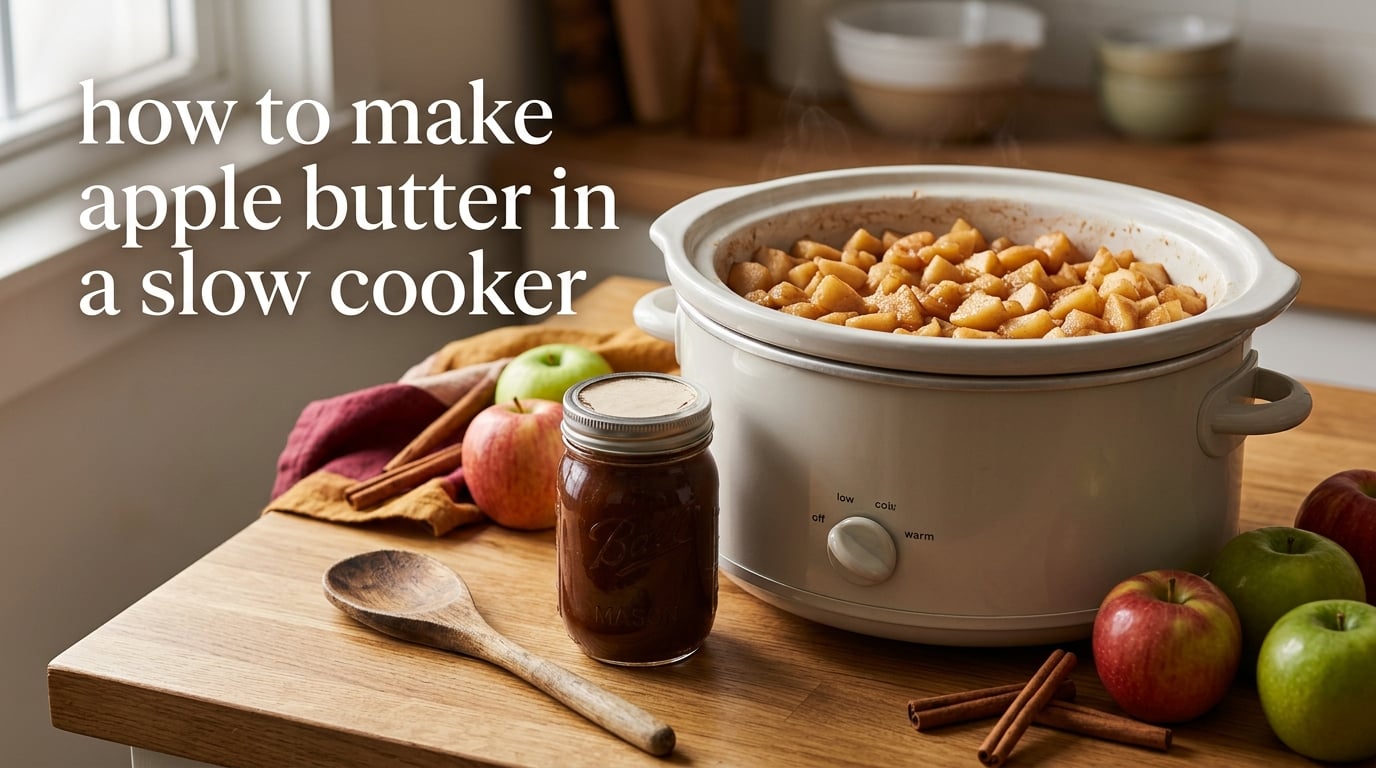
To make apple butter in a slow cooker, peel and dice 5 to 6 pounds of apples, stir them into brown sugar, cinnamon, nutmeg, ground cloves, and a pinch of kosher salt, then cook uncovered on LOW for 8 to 10 hours, stirring occasionally, until the mixture is deep brown and thick enough to coat a spoon. Switch the lid to HIGH for the final 45 to 60 minutes to drive off the last of the moisture, then blend until smooth.
That is the whole method. The slow cooker does nearly everything while you are at work or asleep, which makes it the easiest way I have found to turn a crate of windfall apples into something that keeps for weeks. I have made batch after batch on this exact schedule, and the two details that decide whether the result is spreadable or runny are keeping the lid off during the long cook and giving it an uncovered finish on HIGH.
Below is the full method with the measurements, the cook-setting math, and the fixes for a thin batch, so you get it right the first time.
Table of Contents
- Slow Cooker Apple Butter at a Glance
- What You Need for Slow Cooker Apple Butter
- How to Make Apple Butter in a Slow Cooker
- Cook Setting Guide: LOW, HIGH, and Overnight
- Which Apples Are Best for Apple Butter?
- Do You Have to Peel the Apples?
- How to Know When Apple Butter Is Done
- Troubleshooting: My Apple Butter Is Too Thin or Runny
- No-Sugar and Reduced-Sugar Slow Cooker Apple Butter
- How to Store Apple Butter
- Ways to Use Apple Butter
- Apple Butter vs Applesauce vs Apple Jam
- Frequently Asked Questions
- Which apples are best for making apple butter?
- How do I make homemade apple butter?
- Do you need to peel apples when making apple butter?
- How to thicken apple butter in a crockpot?
- What to do if apple butter is too runny?
- Does apple butter get thicker as it cools?
- What is the shelf life of homemade apple butter?
- Conclusion
Slow Cooker Apple Butter at a Glance
Here is the shape of the recipe before any detail, so you can see whether it fits your morning before you start.
- Yield: about 5 to 6 cups, roughly 6 to 8 half-pint jars
- Prep time: 20 to 25 minutes
- Cook time: 8 to 10 hours on LOW, or about 5 hours on HIGH
- Overnight option: LOW for 10 to 12 hours while you sleep, stirred every 2 hours
- Slow cooker size: 6-quart minimum, 7 to 8 quart for a double batch
- Apples: 5 to 6 pounds, roughly 12 to 14 medium apples
- Lid: off during the entire cook, on only for the final resting period
Updated and re-tested for October 2026.
What You Need for Slow Cooker Apple Butter
The ingredient list is short, and the sugar is adjustable. I always start a little under the stated amount because the fruit carries plenty of sweetness on its own.
- 5 to 6 pounds apples (about 2.3 to 2.7 kg), peeled, cored, and diced into 1-inch pieces
- 3/4 to 1 cup packed light brown sugar (150 to 200 g), start with the lower end
- 2 teaspoons ground cinnamon
- 1/2 teaspoon ground nutmeg
- 1/4 teaspoon ground cloves
- 1 teaspoon pure vanilla extract, added near the end
- 1/2 teaspoon kosher salt
- 1 to 2 tablespoons lemon juice, optional, to hold the color
For the spice blend, one tablespoon of apple pie spice plus one teaspoon of extra cinnamon replaces the individual cinnamon, nutmeg, and cloves in most cases. Bottled apple pie spice varies a lot in strength, so taste before adding more.
You also need a 6-quart slow cooker or larger, a sturdy potato masher or ladle for stirring, and an immersion blender for the smoothest finish. A standard blender works too, but only in small batches with the lid vented and a towel laid across the top, because hot apple butter expands and can push the lid straight off the base.
On batch scaling, a 6-quart cooker comfortably holds about 3 pounds of diced apples, and a full 5 to 6 pound recipe fills an 8-quart cooker nearly to the top. Fill no more than two-thirds to three-quarters of the insert, or the pot boils over and takes hours longer to reduce.
How to Make Apple Butter in a Slow Cooker
These are the steps I follow, in order, for a consistently thick result.
- Prepare the apples. Peel, core, and dice 5 to 6 pounds of apples into roughly 1-inch cubes. Cutting them small rather than large is what shortens the cook and gives you a more even, faster reduction.
- Layer the pot. Put the diced apples in the slow cooker insert with the brown sugar, cinnamon, nutmeg, cloves, and kosher salt. Toss everything together with your hands or a big spoon so the sugar and spice coat the fruit evenly instead of settling to the bottom.
- Cook uncovered on LOW for 8 to 10 hours. Leave the lid off. The steam needs somewhere to go, and trapped moisture is the single biggest reason a slow cooker apple butter stays thin. Stir every 2 to 3 hours to keep the bottom from scorching and to move the syrup through the fruit.
- Check for doneness around hour 8. Press a spoon into the mixture and drag a line across the bottom of the pot. If the line stays open, keep going. The color should have moved from pale gold to a deep brown, and the aroma will shift from raw apple to caramelized sugar.
- Finish uncovered on HIGH for 45 to 60 minutes. This is the step most recipes treat as optional and it is the one I never skip. The higher heat boils off the final bit of water quickly and drops the mixture from loose to spreadable.
- Stir in the vanilla. Turn the cooker off, add the vanilla extract, and stir it through. Adding vanilla after cooking keeps its flavor bright rather than cooked away over ten hours of heat.
- Blend to your preferred texture. Use an immersion blender right in the pot for a silky, spreadable butter, or leave it chunky with a masher for a coarse, rustic spread. If you use a standard blender, work in small batches, no more than a third full.
- Taste and adjust. Add more sugar for sweetness, a splash of apple cider or water if it tightened past what you like, or a pinch more salt if the spices taste flat. Store as directed below.
A note on volume: your pot will look alarmingly full at the start and end up less than half full when you are done. That drop is the whole point, so do not be tempted to add more fruit to compensate.
Cook Setting Guide: LOW, HIGH, and Overnight
Published cook times for this recipe range from 5 hours on HIGH to 12 hours on LOW, and both are correct. Here is how to pick.
- LOW, 8 to 10 hours: the standard and most reliable option. The long, gentle cook caramelizes the sugars more deeply and is what I use for gifting batches.
- HIGH, about 5 hours: a legitimate shortcut that trades some caramelized depth for convenience. Stir more often, every hour, because the bottom scorches faster.
- Two-stage, HIGH 1 hour then LOW 8 to 10 hours: the best of both when you are short on time. The first hour on HIGH softens the fruit quickly, then LOW finishes the cook without scorching.
- Overnight, LOW 10 to 12 hours: start before bed and stir when you get up. Reader cooks report this produces a deeper flavor, and the longer reduction is forgiving. One cook on The Magical Slow Cooker described losing count of the batches they had made, with Gala apples cooked low overnight.
Whichever schedule you choose, the clock does not decide when the batch is finished. The spoon test does.
Which Apples Are Best for Apple Butter?
The best apples for making apple butter are a mix of sweet and tart varieties, roughly two parts sweet to one part tart, and variety matters more than any other choice in the recipe.
Sweet apples such as Fuji, Gala, Honeycrisp, Braeburn, and Jonagold supply the flavor and the caramelizing sugars. Tart apples such as Granny Smith, McIntosh, and Ida Red cut that sweetness so the finished spread does not read as candy. A single-variety batch works, but a blend tastes more like fall.
Moisture content is the part most recipes skip, and it is the real reason two people can follow identical instructions and get different results. High-moisture varieties like Honeycrisp, McIntosh, and Granny Smith release a lot of water as they cook, so a batch built only from those needs extra uncovered time or a longer HIGH finish. Firmer, drier apples like Fuji, Gala, and Red Delicious reduce faster and thicken with less effort. Red Delicious is a poor choice for texture; it is watery and turns mealy, which makes the finished butter grainy.
For fall baking, Cortland, Grimes Golden, and Liberty are all excellent, and McIntosh gives the deepest, darkest color of the bunch.
Do You Have to Peel the Apples?
No, you do not have to peel apples when making apple butter, and leaving the skins on is the usual choice for smooth apple butter.
The skins are packed with pectin, and during a long uncovered cook they break down into the mixture, which is part of what makes the texture so silky. Skins also mean less prep work and less fruit waste.
Two caveats. First, if you plan to leave the butter chunky rather than blending it, peel them, or you will be chewing on strips of skin in your toast. Second, if your cooker runs hot and the fruit scorches at the bottom, the skins can catch and turn bitter, so peel in that case. Some cooks also peel Red Delicious regardless, since its peel is thick and its texture is mealy.
How to Know When Apple Butter Is Done
Apple butter is done when it is a deep brown color and thick enough to coat a spoon, and there are four checks that tell you.
- Spoon coat: dip a cold spoon in and lift it. The butter should cling in a thick layer and fall slowly, not run off like a thin glaze.
- Drag test: drag the back of a spoon across the pot. If the channel closes behind it within a second or two, the batch is close. If it stays open, keep reducing.
- Color: it should be a deep, dark brown with no pale or golden patches, the color of caramelized sugar rather than raw apple.
- Yield check: you started with about 3 gallons of diced fruit and should have roughly 5 to 6 cups of finished butter. A large drop in volume is the clearest signal that the water is gone.
One reassurance: apple butter thickens further as it cools, so a batch that looks slightly loose in the pot often sets to a perfect spread once it is chilled. Judge it warm but correct for a little extra cooling, and pull it a shade earlier if you are unsure.
Troubleshooting: My Apple Butter Is Too Thin or Runny
If your slow cooker apple butter is watery, the cause is almost always one of four things, and each has a straightforward fix. Work down this list rather than guessing.
- The lid was on. A covered slow cooker traps steam, so the water never leaves. Fix: take the lid off and continue. Do not skip this even if the recipe did not say so, because the difference in final texture is dramatic.
- It needs more reduction time. This is the most common cause and the easiest to fix. Fix: set the cooker to HIGH with the lid off for 45 to 60 minutes and stir every 15 minutes. Most thin batches tighten within the hour.
- The apples were too wet. High-moisture varieties like Honeycrisp, McIntosh, and Granny Smith release more water than Fuji or Gala. Fix: give it a second uncovered HIGH session, or transfer the butter to a wide saucepan on the stove for faster evaporation and stir constantly.
- It has not been blended. Whole apple pieces hold a surprising amount of trapped liquid, so a chunky batch can look thinner than it is. Fix: blend it, either with an immersion blender in the pot or in small batches in a blender, and re-check the spoon test.
Two more things worth knowing. Adding a tablespoon of cornstarch, whisked in cold and simmered for two minutes, will thicken a small batch quickly, though it dulls the clean apple flavor slightly. And if you overshoot and the butter is now too stiff, warm it gently with a splash of apple cider or water and stir until spreadable again.
Does apple butter get thicker as it cools? Yes, noticeably. It firms up considerably in the refrigerator, which is why a batch judged in the pot can seem thinner than what lands in the jar.
No-Sugar and Reduced-Sugar Slow Cooker Apple Butter
You can make slow cooker apple butter with no added sugar at all, but the texture is different and the cook is longer.
Without sugar, you lose both the sweetener and the viscosity sugar provides, so the butter sets into something closer to a thick, unsweetened purée. It is still delicious, just more delicate. To compensate, use very ripe, sweet apples such as Fuji, Honeycrisp, or Jonagold, and skip Granny Smith entirely.
The trade-off is time. Water is the only thing left to carry the flavor, so an unsweetened batch usually needs an extra 1 to 2 hours uncovered, or a full extra stretch on HIGH at the end, to reach a spreadable consistency. Plan for 10 to 12 hours on LOW.
A middle path that I prefer: cut the brown sugar to one-third cup for a 6-pound batch, and add any sweetening at the very end. That keeps a light hand while still giving you control over how sweet the finished spread is.
Whatever you do, taste as you reduce. Sugar added early dissolves and cooks away, so the last 30 minutes is when the final adjustment actually counts.
How to Store Apple Butter
Store homemade apple butter in the refrigerator for up to 2 weeks, or freeze it for up to a year, and use a tested recipe if you plan to water-bath can it.
- Refrigerator: spoon it into clean glass jars with tight lids and refrigerate for up to 2 weeks. Make sure jars are washed and completely dry before filling, since any moisture on the rim can encourage mold.
- Freezer: leave 1/2 inch of headspace in each jar, because apple butter expands as it freezes. Straight-sided mason jars are the safe choice for freezing. Thaw in the refrigerator overnight.
- Small portions: freeze it in silicone ice cube trays or in flattened freezer bags so you can pull out a single serving instead of thawing a whole jar.
- Canning: do not improvise this one. Home-canned fruit butter carries a real botulism risk because its low acidity and sealed environment are exactly what the bacteria want. If shelf-stable jars are the goal, use a tested recipe from the National Center for Home Food Preservation or your local extension office, and follow it exactly.
For gifting, plain 4-ounce or 8-ounce jars with a strip of parchment over the lid and a length of twine look like something from a farmers market, and the batch sizes above will fill about a dozen small jars.
Ways to Use Apple Butter
Apple butter is far more useful than a single-purpose spread, and it is one of the easiest ways to use up a surplus of apples.
- Spread it on toast, sourdough, biscuits, and scones, especially with sharp cheddar or aged gouda on a cheese board.
- Dollop it into oatmeal, yogurt, or ricotta toast with a drizzle of honey and a few toasted walnuts.
- Fold it into quick breads, muffins, pancakes, and waffles, or swirl it into batter before the top of a loaf bakes.
- Use it as a glaze for pork tenderloin, roast chicken, or a batch of oatmeal cookies.
- Stir a spoonful into oatmeal cookie dough in place of part of the brown sugar, which keeps the cookies chewy and adds fruit.
- Fill the gap between two cake layers, thin it with a little cider, and brush it over a bundt cake.
If you bake with it often, a small batch kept in the freezer is the most useful version of all. Portion it into 4-ounce jars so a single jar covers one loaf or one breakfast.
Apple Butter vs Applesauce vs Apple Jam
Apple butter is not sweetened applesauce and it is not chunky jam, and the three differ in cook time, texture, and how they behave in a recipe.
Applesauce is peeled or unpeeled apples simmered in a small amount of liquid and blended. It cooks in 20 to 40 minutes, stays thin and pourable, and is meant to be eaten with porridge, as a drink base, or frozen.
Apple butter takes that same fruit and cooks it uncovered for 8 to 10 hours until most of the water evaporates and the natural sugars caramelize. It is thick, dark, spreadable, and concentrated in flavor, which is why a tablespoon of it sweetens a loaf of bread the way a cup of sauce never could.
Apple jam keeps fruit pieces or uses pectin to set into a soft gel. It is cooked much faster, usually 20 to 30 minutes, and relies on sugar and pectin for structure rather than on reduction. It spreads but does not coat a spoon the way butter does.
The practical difference in a kitchen: reach for sauce when you want moisture and a fresh apple flavor, for jam when you want visible fruit and a set texture, and for apple butter when you want intensity, sweetness, and a spreadable body that behaves like a fat in baking.
Frequently Asked Questions
Which apples are best for making apple butter?
A mix of sweet and tart apples works best, roughly two parts sweet to one part tart. Fuji, Gala, Honeycrisp, Braeburn, and Jonagold add sweetness and caramelizing sugars, while Granny Smith, McIntosh, and Ida Red cut that sweetness and deepen the flavor. Avoid Red Delicious, which is watery and turns mealy. Variety also affects thickness: high-moisture apples such as Honeycrisp and McIntosh need extra uncovered time, while Fuji and Gala reduce faster.
How do I make homemade apple butter?
Peel, core, and dice 5 to 6 pounds of apples. Toss them in a 6-quart or larger slow cooker with brown sugar, cinnamon, nutmeg, ground cloves, and kosher salt. Cook uncovered on LOW for 8 to 10 hours, stirring every 2 to 3 hours. Finish uncovered on HIGH for 45 to 60 minutes, stir in vanilla extract, and blend with an immersion blender until smooth. Expect about 5 to 6 cups of finished apple butter.
Do you need to peel apples when making apple butter?
No, peeling is optional and the skins are usually kept. They are full of pectin, which breaks down during a long cook and is part of what makes the texture silky, and leaving them on saves prep time. Peel instead if you want a chunky, rustic spread rather than a smooth one, or if your cooker runs hot enough that the bottom scorches. Red Delicious is worth peeling regardless because its skin is thick and its flesh is mealy.
How to thicken apple butter in a crockpot?
Set the crockpot to HIGH with the lid off for 45 to 60 minutes and stir every 15 minutes. If it still needs work, move the butter to a wide saucepan on the stove and stir it until the water evaporates, which goes faster than the slow cooker. Blending also thickens the texture, because whole fruit pieces hold trapped liquid. A tablespoon of cornstarch whisked in cold and simmered for two minutes works in a pinch.
What to do if apple butter is too runny?
Check the lid first. A covered slow cooker traps steam and the water never leaves, so keep the lid off for the entire cook. If the butter is already thin, run an uncovered HIGH session for 45 to 60 minutes. High-moisture apples such as Honeycrisp, McIntosh, and Granny Smith release extra water, so those batches may need a second reduction. Remember that apple butter thickens noticeably as it cools, so judge the warm batch with that in mind.
Does apple butter get thicker as it cools?
Yes. Warm apple butter looks softer than the finished spread, and chilling firms it up considerably. This means a batch that seems slightly loose in the pot often sets to a perfect spread in the jar, so pull the reduction a shade early if you are unsure. If you overshoot and it becomes too stiff, warm it gently with a splash of apple cider or water and stir until it spreads again.
What is the shelf life of homemade apple butter?
Refrigerated in clean, airtight glass jars, homemade apple butter keeps about 2 weeks. Frozen with 1/2 inch of headspace in straight-sided jars, it keeps up to a year and thaws overnight in the refrigerator. For shelf-stable canning, do not improvise: fruit butter has a real botulism risk because of its low acidity, so follow a tested recipe from the National Center for Home Food Preservation or your local extension office exactly.
Conclusion
Knowing how to make apple butter in a slow cooker comes down to three things: a sweet and tart mix of apples, an uncovered cook, and a finish on HIGH. Get those right and the rest is waiting.
Dice your apples small, leave the lid off from the first hour, stir every couple of hours, and test with a cold spoon rather than the clock. If the batch looks thin, that is a fixable problem, not a ruined one. Portion what you do not need into 4-ounce jars and put them in the freezer, because the batch you make in October is the one you are glad to find in February.