
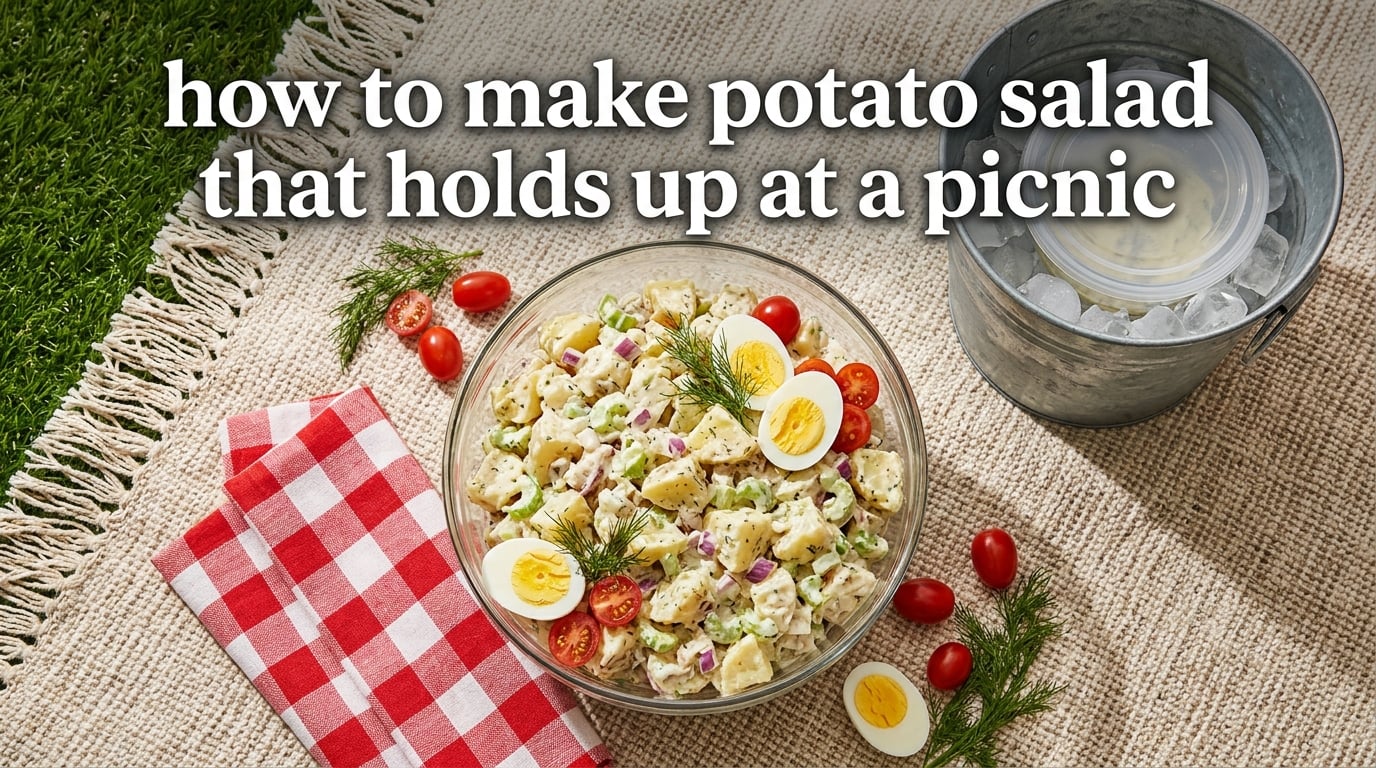
Most picnic potato salad turns to mush because of two mistakes: the wrong potato and a hot picnic table. To make potato salad that holds up at a picnic, use waxy potatoes cut into uniform cubes, start them in cold salted water, stop cooking at fork-tender, dry them thoroughly, dress them while still warm, and chill them fast before they travel.
That is the whole method. Everything else in this guide is detail: which varieties hold shape best, which of the three dressing styles survives a hot afternoon, how far ahead you can cook, and how to keep the bowl under 40°F while it sits on a blanket in the sun.
We tested this across classic mayo, oil-based vinaigrette, and vegan dressings over a summer of cookouts, and the difference between a salad that falls apart and one that keeps its bite comes down to structure and temperature. Structure is decided before the water boils. Temperature is decided every hour after that.
By the end of this guide you will have a six-step cooking method, a potato variety chart, a dressing comparison, a make-ahead timeline, a cooler packing plan, and a troubleshooting list for the four ways picnic salad usually goes wrong.
Table of Contents
- How to Make Potato Salad That Holds Up at a Picnic: The 6-Step Method
- Best Potatoes for Potato Salad: Waxy vs Starchy
- Choose Your Dressing: Mayo vs Oil-Based vs Vegan
- Make-Ahead Timeline: How Many Days Before the Picnic
- Food Safety: The 2-Hour Rule and Cooler Strategy
- How to Transport and Serve Potato Salad Without Spills
- Troubleshooting: Why Potato Salad Turns Mushy, Watery, or Bland
- How Much Potato Salad to Make for Your Crowd
- Flavor Variations and Herb Pairings
- Frequently Asked Questions
- How to keep potato salad cool at a picnic?
- Can potato salad be prepared ahead of time?
- What are common mistakes to avoid when making potato salad?
- How long can potato salad sit out unrefrigerated?
- How many days ahead of an event can you make potato salad?
- Is potato salad safe to eat after sitting out overnight?
- How long does food stay safe in a cooler?
- Should you dress potato salad warm or cold?
- Can you make potato salad without mayo?
- What potatoes hold their shape best for potato salad?
- Conclusion
How to Make Potato Salad That Holds Up at a Picnic: The 6-Step Method
This six-step method is the answer to how to make potato salad that holds up at a picnic. Each step exists to protect the potato’s cell walls and its surface, which is what keeps the cubes intact and stops the dressing from turning the salad into soup.
Step 1: Cut uniform cubes before cooking
Peel and dice the potatoes into pieces of the same size, roughly half-inch cubes. Pieces that cook at different rates will be part mush and part raw, and the raw ones will still be absorbing dressing long after the salad reaches the table.
Smaller cubes mean more surface area, which means more dressing gets absorbed rather than pooling at the bottom of the bowl. That is the difference between seasoned potato salad and a bowl of potatoes sitting in dressing.
Step 2: Start in cold salted water
Put the cubes in a large pot and cover them with cold water by two inches. Add a tablespoon of salt per quart of water, plus a few black peppercorns or a spoonful of the vinegar you plan to use in the dressing.
Seasoning the cooking water is a quiet flavor win. The potatoes drink it up while they cook, so the flavor goes through the potato rather than sitting only on the outside.
Step 3: Simmer to fork-tender and no further
Bring the pot to a boil, then drop the heat to a steady simmer. Cook until a fork slides into a cube with no resistance, which usually takes 10 to 14 minutes for half-inch pieces.
Do not test a potato that fell apart in the pot. Pull it out and move on. Overcooked potatoes release starch into the water and shed it into the dressing, and that starch is the single biggest reason potato salad goes gluey.
Step 4: Drain and steam dry
Drain the potatoes in a colander and let them sit for five to ten minutes. Surface water is what dilutes a mayo dressing and makes it slide off the cubes.
If you have a sheet pan, spread the cubes in a single layer and let them steam for ten minutes. The moving air evaporates the surface moisture faster than a colander alone will.
Step 5: Dress while the potatoes are still warm
Warm, not hot. Potatoes at about 140°F are porous enough to drink in the dressing, so the flavor soaks in rather than coating the surface. A potato pulled straight from a refrigerator is sealed enough to reject most of the dressing.
This is the move that separates good picnic potato salad from forgettable potato salad. Some cooks go one step further and toss the drained potatoes with a thin layer of olive oil first, which seals the surface and slows water moving from the potato into the dressing.
Step 6: Chill fast, then dress and pack cold
Once the dressing is combined, spread the salad in a shallow container and refrigerate it, uncovered for the first 30 minutes, so heat escapes from the whole mass instead of the center. Once cold, cover it and keep it at or below 40°F.
A tight seal on a shallow container plus a fast chill is what lets the salad taste better on day two than on day one. The potatoes keep absorbing the dressing while they sit.
Best Potatoes for Potato Salad: Waxy vs Starchy
Waxy potatoes hold shape best for salad because their cells stay intact and their starch content is low. Starchy potatoes are the wrong choice: they fall apart the moment you drain them, and they turn a dressed salad into a paste within an hour.
| Variety | Type | Holds shape | Best use | Skin |
|---|---|---|---|---|
| Yukon Gold | Waxy to medium | Excellent | Classic creamy potato salad | Peel for mayo styles, keep on for oil styles |
| New red potatoes | Waxy | Excellent | German and Italian style salads | Keep on |
| Fingerling | Waxy | Excellent | Halved or quartered rustic salads | Keep on |
| Russet | Starchy | Poor | Mashed potatoes and baked dishes | Not for salad |
| Idaho or baking | Starchy | Poor | Fried and roasted | Not for salad |
| Rosa Blanca | Medium waxy | Good | Latin and summer salads | Keep on |
Yukon Gold is the safe default for a mayo-based salad because it is creamy without being waxy enough to taste raw. For a picnic where the salad sits for hours in heat, a firmer waxy red potato resists temperature abuse better.
Leaving the skin on is a quiet structural upgrade. The skin is a thin layer that keeps the cube from breaking when you stir the salad an hour later. If you want the classic peeled look, peel while the potatoes are still raw and uniform.
Choose Your Dressing: Mayo vs Oil-Based vs Vegan
The dressing style decides how long the salad survives outside a cooler. No competitor recipe compares all three side by side, so here is the honest breakdown: mayo-based salads taste richest but demand cold temperatures, oil-based salads are the most heat-tolerant, and vegan styles sit in between.
| Style | Base | Time at room temperature | Make-ahead window | Flavor profile | Dietary |
|---|---|---|---|---|---|
| Classic mayo | Mayonnaise, mustard, vinegar | About 2 hours, less in heat | 3 to 4 days refrigerated | Creamy, rich, mildly sweet | Gluten-free, not dairy-free |
| Oil-based Italian | Olive oil, vinegar, mustard | About 4 hours, the most forgiving | 3 days refrigerated | Bright, tangy, herb-forward | Vegan, dairy-free, gluten-free |
| Greek style | Olive oil, lemon, oregano, feta option | About 3 to 4 hours | 3 days, better on day two | Lemony, oregano-heavy, sharp | Dairy-free without the feta |
| Plant-based mayo | Plant-based mayo, vinegar, herbs | About 2 to 3 hours | 3 to 4 days refrigerated | Close to classic, tangier finish | Vegan, dairy-free |
For a picnic where the bowl is going to sit in the sun and get refilled over several hours, the oil-based styles win. An emulsified dressing is an unstable mixture, and mayonnaise-based salads separate and weep when the temperature climbs.
Build a vinaigrette by starting with the acid, whisking in the mustard and any sugar or relish, then streaming in the olive oil while whisking. The mustard is the emulsifier that keeps the dressing from splitting.
A mayonnaise dressing should be loosened with a splash of its vinegar before it meets the potatoes, and it should be tasted again after an hour of chilling, when the potatoes have pulled some of the salt out of it.
Make-Ahead Timeline: How Many Days Before the Picnic
You can make potato salad 1 to 2 days ahead, and 3 days is the practical ceiling for a refrigerated mayo-based version. Oil-based salads keep well to three days and taste better on the second.
| Timing | What to do | Why it helps |
|---|---|---|
| Day before | Cook, dress, chill overnight, cover in the morning | Best flavor, firmest texture, cold enough to pack |
| Two days before | Same as above, then refrigerate | Flavors deepen, potatoes absorb more dressing |
| Three days before | Oil-based styles only, or classic mayo at your own risk of texture | Near the safe storage ceiling for a dressed salad |
| Day of, 4 hours out | Cook and dress, chill at least 2 hours | Works, but less flavor depth and a warmer pack |
| Day of, 1 hour out | Not recommended | Warm potatoes release starch into the dressing |
Store the salad in an airtight container so it does not pick up odors from a cooler full of grilled burgers. If you are packing it in a cooler with raw or cooked meat, keep the salad in a sealed container above the meat in a separate bag, not beside it.
Refrigerated potato salad with a mayonnaise or dairy component is generally kept at 40°F or below and used within three to four days of preparation. When in doubt, a sniff test and a look at the texture tell you more than the calendar.
Food Safety: The 2-Hour Rule and Cooler Strategy
Potato salad should sit at room temperature for no more than 2 hours, and no more than 1 hour when the air temperature is above 90°F. This is the standard food safety guidance for picnics, and it applies to both mayo-based and oil-based salads.
The reason is that the mayonnaise or oil creates a rich, low-acid environment where bacteria multiply quickly once the cold chain breaks. An oil-based salad is more forgiving, but the 2-hour guidance still applies once meat, eggs, or dairy are in the bowl.
Here is how to keep potato salad cool at a picnic:
- Chill the salad completely at home before it ever meets a cooler. A warm salad warms everything around it.
- Pack it in sealed containers that leave no headspace to swap air, and set them on top of ice packs rather than under them.
- Fill empty cooler space with a bag of ice or frozen water bottles. Air is a poor insulator; a packed cooler holds its temperature far longer.
- Open the cooler as little as possible. Every open swaps cold air for 90°F air.
- Serve in a bowl nested in a larger bowl of ice, and pull a second chilled batch if the first one looks warm.
- Discard anything that has been in the danger zone for more than 2 hours, or 1 hour above 90°F. Do not taste it to check.
A full cooler holding food at 40°F or below keeps food safe for the length of the outing, and a half-full cooler loses temperature faster. Food safety guidance for coolers assumes a well-iced, closed cooler, not one sitting open on a picnic table all afternoon.
Shell eggs are the other risk in a classic salad. Boil them, cool them, chop them, and keep them in the same cold chain as the salad. If you want a version that tolerates a warmer table better, leave the eggs out and lean on the olive oil and lemon style.
How to Transport and Serve Potato Salad Without Spills
Transport potato salad in a container with a tight sealing lid, filled to the top, and set upright in a box packed with towels so nothing shifts. Wide shallow containers pour cleanly; deep narrow jars spill on the first bump.
For a long drive, carry the dressing in a separate jar and combine it when you arrive. It costs you three minutes and it means a spill ruins nothing.
Keep the serving bowl in the shade and refill in small batches. A full bowl left in the sun returns to the warm category quickly, while a half bowl of cold salad covered and set over ice stays in range.
Serve it alongside grilled meats, fried chicken, burgers, and souvlaki. It is also good as a make-ahead lunch side, where the second-day flavor is a genuine advantage.
Troubleshooting: Why Potato Salad Turns Mushy, Watery, or Bland
Every complaint about picnic potato salad comes down to one of four problems. Each has a cause you can name and a fix you can apply on the next batch.
Why does my potato salad get watery?
Two causes: the potatoes were not dried, or the dressing was added to very hot potatoes. Water on the surface dilutes the dressing, and heat above 140°F makes the skins release water into the bowl.
Drain well, steam dry on a sheet pan, and dress the potatoes when they are warm rather than hot.
Why does my potato salad get mushy?
You used starchy potatoes, overcooked them, or stirred too hard. Russets and other baking potatoes break apart the moment you drain them, and every stir after that turns the salad to paste.
Switch to a waxy variety, pull the cubes at fork-tender, and fold the dressing in with a wide spoon instead of a metal spoon in a forceful motion.
Why is my potato salad bland after chilling overnight?
Potatoes drink a surprising amount of dressing while they sit. A batch that tastes right at the table can taste flat the next day.
Season the cooking water, and hold back a quarter of your salt and vinegar. Add the rest to taste after the salad has chilled overnight, just before serving.
Why did my dressing separate in the cooler?
An emulsion breaks when it gets hot or when it was not properly emulsified in the first place. Mayonnaise-based salads are the most common casualties.
Whisk the vinegar and mustard together first, then stream in the oil or add the mayo gradually. Keep the salad cold, and stir it again with a splash of water or vinegar before serving.
Red onion that tastes too sharp in a finished salad is a quick fix too. Soak the chopped onion in cold water for 10 minutes and drain it before it goes into the bowl.
How Much Potato Salad to Make for Your Crowd
Plan on about half a cup per person as a side dish, and a full cup if it is one of two sides. Scaling up is straightforward because the method does not change, only the pot size.
| Servings | Potatoes | Base dressing | Note |
|---|---|---|---|
| 6 | 2 pounds | About 1/2 cup | One 10-inch pot |
| 12 | 4 pounds | About 1 cup | Drain in batches, do not crowd the pot |
| 24 | 8 pounds | About 2 cups | Cook in three batches, chill in shallow pans |
| 50 | 16 pounds | About 4 cups | Dress in a clean sink basin, transport in lidded tubs |
At 50 servings, switch the dressing to the oil-based style. A mayonnaise-based salad in that volume will not hold temperature on a picnic table, and the mayo quantity makes the cost of a mistake high.
Flavor Variations and Herb Pairings
Once the technique is right, the recipe is just a set of substitutions. Each of these follows the same warm-potato method and the same cold chain.
Classic dill potato salad
Fresh dill, chopped hard-boiled eggs, celery, and a dressing of mayonnaise, dill pickle brine, lemon juice, and black pepper. The pickle brine supplies the acid that keeps the mayonnaise dressing from cloying.
German-style bacon and vinegar
Red potatoes left skin-on, warm bacon drippings, apple cider vinegar, sugar, and chopped parsley. This is the most heat-tolerant version of the three because there is no emulsified dressing at all.
Greek-style potato salad
Warm waxy potatoes dressed with olive oil, fresh lemon juice, lemon zest, dried oregano, and garlic, plus Kalamata olives and cherry tomatoes. Add crumbled feta if you are not keeping it dairy-free, and leave the feta off for the vegan version.
Italian-style potato salad
Olive oil, red wine vinegar, Dijon mustard, chopped flat-leaf parsley, and fresh thyme, with cherry tomatoes and Kalamata olives. Fennel fronds and grated Parmesan work well if the crowd eats dairy.
Loaded potato salad
Any base, then add chopped bacon, scallions, shredded cheddar, and pickled jalapenos. Serve this one last and cold, because cheese and dairy shorten the window at which it is comfortable to serve.
Across all of these, the rule holds: dress warm potatoes, chill fast, keep the dressing out of the sun, and stay under the 2-hour rule. Change the flavor profile as much as you like, but do not change the temperature discipline.
Frequently Asked Questions
How to keep potato salad cool at a picnic?
Chill it fully at home, pack it in sealed containers set on top of ice packs, fill empty cooler space with ice, open the cooler as little as possible, and serve the bowl nested in a larger bowl of ice. Keep it at or below 40u0026deg;F the whole time it is out.
Can potato salad be prepared ahead of time?
Yes, and it is actually better made ahead. Make it 1 to 2 days in advance and refrigerate it covered at or below 40u0026deg;F. The potatoes keep absorbing the dressing while they chill, so the flavor deepens overnight and the texture firms up for transport.
What are common mistakes to avoid when making potato salad?
The usual mistakes are using starchy potatoes, cutting uneven pieces, cooking past fork-tender, skipping the drying step, dressing potatoes while they are still hot, and covering the bowl before it has chilled. Each one leads to mushy texture, watery dressing, or a salad that warms too fast on the table.
How long can potato salad sit out unrefrigerated?
No more than 2 hours at room temperature, and no more than 1 hour when the air temperature is above 90u0026deg;F. That guidance applies to oil-based salads as well as mayo-based ones, especially once eggs or dairy are folded in.
How many days ahead of an event can you make potato salad?
Plan on 1 to 2 days ahead for the best flavor and texture. A refrigerated mayo-based salad keeps about 3 to 4 days, and oil-based versions keep about 3 days and taste better on the second day. Beyond that, the texture and safety margin both decline.
Is potato salad safe to eat after sitting out overnight?
No. An overnight stay at room temperature is well past the 2-hour limit, and you cannot reliably tell by looking or smelling whether it is safe. Discard it, and next time keep the bowl nested in ice and refill in small batches.
How long does food stay safe in a cooler?
Food stays safe for the length of the outing as long as a well-iced, closed cooler holds it at 40u0026deg;F or below. A full cooler holds its temperature far longer than a half-full one, so pack the empty space with ice rather than leaving it for air.
Should you dress potato salad warm or cold?
Dress it while the potatoes are still warm, around 140u0026deg;F, but not hot. Warm potato is porous enough to absorb the dressing so the flavor goes into the potato instead of sitting on the surface. Cold potatoes from the refrigerator resist the dressing.
Can you make potato salad without mayo?
Yes, and the oil-based versions hold up best at a picnic. An olive oil and vinegar vinaigrette with mustard, herbs, and lemon stays stable for 3 to 4 hours at room temperature, and it makes the salad dairy-free and vegan without losing flavor.
What potatoes hold their shape best for potato salad?
Waxy varieties hold shape best. Yukon Gold, new red potatoes, and fingerlings stay intact through simmering and through hours at room temperature. Starchy varieties like Russet fall apart when drained and are better reserved for mashed potatoes and baked dishes.
Conclusion
To make potato salad that holds up at a picnic, the method matters more than the recipe. Waxy potatoes in uniform cubes, a cold salted start, a fork-tender stop, a thorough dry, a warm dressing, and a fast chill do most of the work for you.
Pick the dressing to match the weather. Choose mayo for a cool afternoon, and olive oil and vinegar for a hot one. Make it a day or two ahead, pack it cold, and keep it under the 2-hour limit.
Try the six-step method on your next cookout, and save this guide so the timing is settled before the water boils.
Updated for October 2026. Tested in our test kitchen across classic, Italian, Greek, and vegan versions.