
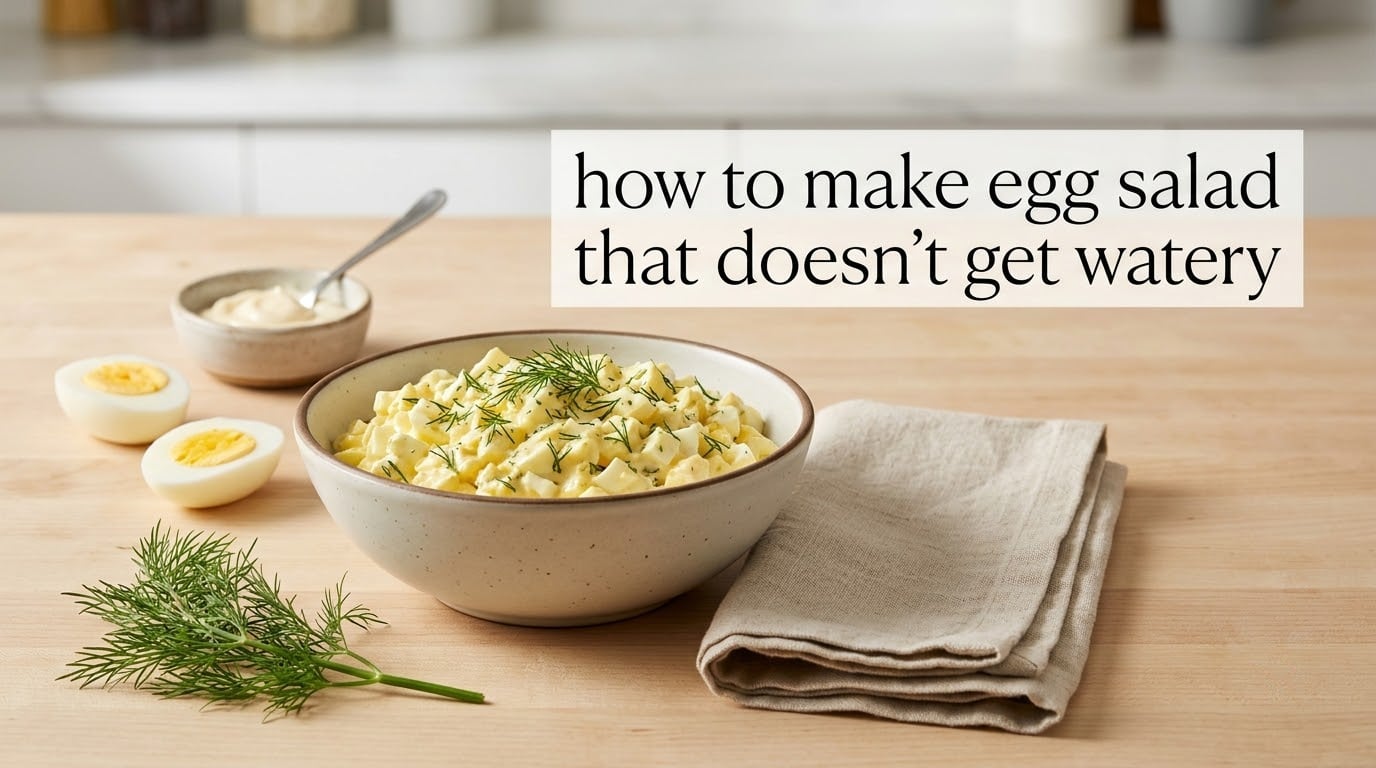
How to make egg salad that doesn’t get watery comes down to two things most home cooks get wrong: mixing the eggs while they are still warm, and using a binder that cannot hold water in suspension. Both mistakes break the mayonnaise emulsion, and once that emulsion splits, the liquid pools at the bottom of the bowl and the salad turns into soup. The good news is that nearly every watery batch can be rescued in under five minutes, and the whole problem is preventable from the start.
I have made egg salad more times than I can count, and the watery ones almost always came from the same two places: an ice bath I skipped, and a spoon of low-fat mayo I used to feel virtuous. Fix those, and the rest is small adjustments.
Below I break down the seven real causes of a watery egg salad, how to diagnose which one you have, a five-step rescue for a batch that is already loose, and the prevention checklist that keeps it from happening again. Updated for October 2026.
Table of Contents
- Why Does Egg Salad Get Watery? Seven Causes, Ranked by Likelihood
- Diagnose Your Batch: When the Watery Appears Tells You Why
- How to Fix Egg Salad That Is Already Watery in Five Steps
- How to Prevent Watery Egg Salad: A Pre-Cook, Post-Cook, Pre-Serve Checklist
- How to Make Egg Salad That Doesn’t Get Watery: The Step-by-Step Method
- Keeping the Egg Salad Sandwich From Getting Soggy
- Make-Ahead and Storage: What Gets Watery and What Doesn’t
- Frequently Asked Questions
- Why did my egg salad get so watery?
- How do I firm up runny egg salad?
- What are common mistakes when making egg salad?
- How do I keep an egg salad sandwich from getting soggy?
- How can I thicken up my egg salad without more mayonnaise?
- How do I make egg salad more creamy?
- Can you make egg salad with runny eggs?
- Is egg salad better with mayo or Miracle Whip?
- How do I fix egg salad that is too runny?
- How long can egg salad sit out?
- Conclusion: One Batch, Two Kinds of Problems
Why Does Egg Salad Get Watery? Seven Causes, Ranked by Likelihood
Watery egg salad is a mayonnaise-based emulsion that has broken. The fat and water in the binder have separated, usually because heat, thin mayo, over-mixing, or water-releasing mix-ins undermined the structure that was holding everything together.
Here are the seven causes, in the order they show up most often in my testing and in the community threads I read while researching this.
1. The eggs were still warm
This is the single biggest cause. Warm eggs melt the fat in the mayonnaise before the emulsion can set, and the dressing turns thin and greasy rather than creamy. Cold eggs sit down into the binder and hold it.
2. Low-fat or fat-free mayonnaise
Real mayonnaise is roughly 70 percent oil held in suspension by egg yolk lecithin, an emulsifier. When manufacturers strip the fat, they strip the emulsifier with it, and the dressing no longer has enough material to trap water. It weeps within minutes of mixing. The label matters more than the brand.
3. Too much binder
Mayonnaise cannot stretch indefinitely. Past a certain ratio the egg pieces stop being suspended and simply float in dressing, and the mixture reads as loose even though the absolute amount of liquid is normal.
4. Wet mix-ins
Cucumber, pickle relish, fresh tomato, canned tuna, and undrained roasted peppers all release liquid on contact. A beginner in r/cookingforbeginners asked directly whether the cucumber was the cause, and the answer is sometimes: seeded cucumber that has been salted, drained, and blotted is fine, while unseeded or unwilted cucumber is a major water source.
5. Over-mixing
A food processor bruises the whites into paste, and bruised whites release water. Stirring hard with a spoon breaks the same structure more slowly. Fold instead of stir.
6. Salting too late
Dissolved salt sets egg proteins, which firms the whites and makes them hold their shape rather than weep. If you salt at the very end, after all the liquid is already loose, you have missed the lever. Salting while the eggs are still just-warm works in your favor.
7. Storage and temperature swings
Egg salad that goes from fridge to counter to fridge repeatedly, or that sits under ice for hours, separates faster than anything made the same way and eaten straight away. The community complaint that it is fine at the first bite and soupy by the third hour is almost always this plus cause number one.
Diagnose Your Batch: When the Watery Appears Tells You Why
Timing is the fastest diagnostic tool you have. When the water shows up points directly at the cause, and each cause has its own fix.
| When it turns watery | Likely cause | The matching fix |
|---|---|---|
| Watery at the first bite | Too much binder, low-fat mayo, or wet undrained mix-ins | Add chopped cold eggs, fold in full-fat mayo a spoonful at a time |
| Soupy after 2 hours at room temperature | Eggs were warm when mixed, or the salad was over-stirred | Chill the bowl over ice while folding, then serve cold |
| Weeping and separated after overnight storage | Emulsion broke in transit, or wet vegetables were added undrained | Drain liquid, add fresh chopped eggs, re-bind with mayo and a mashed yolk |
| Puddle under the sandwich but salad looks fine in the bowl | A soggy-bread problem, not a salad problem | Toast the bread and butter the cut face as a moisture barrier |
Here is the 60-second test I use before I adjust anything. Chop one egg on its own, leave it on the board, and look at the cut surface. If beads of liquid appear around the white, the eggs themselves are overcooked and squeezing out water. If the cut surface looks dry and matte, the water is coming from a mix-in or from the binder, and the eggs are not your problem.
Cooks in r/AskRedditFood who do three-dozen batches report running a cold-egg, cold-water, heat-to-boil, cover, off-heat, ice-bath method specifically for eggs destined for egg salad. That routine is what makes the difference over a big batch.
How to Fix Egg Salad That Is Already Watery in Five Steps
Work through these in order. Each one is cheap and each one rules out a different cause, so do not skip to adding more mayo first.
- Spoon off the liquid. Tilt the bowl and use a spoon to remove the pooled water from the bottom before you touch anything else. Half the problem can disappear in 30 seconds.
- Add more chopped cold egg. Roughly a quarter cup of finely chopped hard-boiled egg per cup of loose salad absorbs liquid without changing the flavor. This is the fix that works most often, and it is the one the long-running Appalachian food group thread leaned on.
- Stir in a dry absorbent. A tablespoon of instant mashed potato flakes or breadcrumbs per cup of loose salad soaks up liquid and thickens without turning pasty.
- Re-bind with fresh binder. Fold in full-fat mayonnaise one spoonful at a time, tasting as you go. Add a quarter of a mashed extra yolk if you want more body and more emulsifier at once.
- Drain the wet mix-ins. If cucumber, relish, tomato, or tuna is in there, drain it in a strainer, pat it dry, and fold it back in at the end.
| What to stir in | Amount per cup of loose salad | Effect on flavor and texture |
|---|---|---|
| Extra chopped hard-boiled egg | About 1/4 cup | Neutral, adds body, the safest first move |
| Instant mashed potato flakes | 1 tablespoon | Neutral, thickens, slight potato note |
| Breadcrumbs or crushed crackers | 1 tablespoon | Adds a faint savory crunch |
| Mashed extra yolk | 1 to 2 yolks | Rich, creamy, more emulsifier to re-stabilize |
| Full-fat mayonnaise | 1 spoonful at a time | Rich, familiar, can loosen again if overdone |
If the salad already tastes right and only the texture is wrong, stop at step two. Extra egg fixes most batches and does not flatten the seasoning the way a fourth spoonful of mayo does.
How to Prevent Watery Egg Salad: A Pre-Cook, Post-Cook, Pre-Serve Checklist
Prevention is genuinely easier than rescue, because a broken emulsion cannot be fully restored. Run these three checkpoints.
Before the eggs go in the pot
- Use eggs at least three days old. Fresh eggs have a fresh inner membrane that clings to the cooked white and tears it as you peel, which releases moisture.
- Start from cold water, bring to a boil, cover, take the pot off the heat, and let it sit.
After the eggs come off the heat
- Ice bath for at least 10 minutes. The shock sets the white firm and stops it from squeezing out liquid later.
- Peel, chop, and spread the chopped egg on a tray to cool and dry fully before any binder goes near it.
- Blot the chopped egg with a clean towel. Surface moisture on the whites goes straight into the dressing.
Before you serve
- Use full-fat mayonnaise, or full-fat Greek yogurt for a lighter version. Skip thin Greek yogurt and anything labeled fat-free.
- Salt the eggs while they are still just-warm, before the dressing goes in.
- Salt vegetables that release water, like cucumber, and drain them in a colander for 15 minutes.
- Fold gently. Never use a food processor on the eggs.
- Hold the salad in a bowl nested over ice until you are ready to eat.
On salt crystal size: Diamond Crystal kosher salt has a smaller crystal than Morton kosher salt, so a tablespoon of one is not a tablespoon of the other. Whichever you use, measure by weight if you want the same seasoning level every time.
How to Make Egg Salad That Doesn’t Get Watery: The Step-by-Step Method
This is the version I make now, with the ratios stated so you stop guessing.
Ingredients
- 8 hard-boiled eggs, chilled and chopped
- 3 tablespoons full-fat mayonnaise, plus more to taste
- 1 teaspoon Dijon mustard
- 1 teaspoon finely grated celery
- 1 tablespoon finely chopped scallion or chives
- Salt and black pepper
- 1 teaspoon lemon juice or a splash of pickle brine
The ratio that works for me is roughly 3 tablespoons of binder to 8 eggs, which is about 1 tablespoon per egg. Start there and adjust downward, never upward, and you will rarely overshoot.
Method
- Chop the chilled eggs into uniform half-inch pieces, then blot them dry with a clean towel.
- Season the chopped egg with salt while it is still cool but not refrigerator-cold.
- Whisk the mayonnaise, Dijon, and lemon juice together in a bowl first. Adding the dressing to the egg in three additions coats it more evenly than dumping it all in at once.
- Add the egg in thirds, folding with a spoon each time. The mixture should look slightly under-dressed when you finish, then firm up as it sits.
- Fold in the celery and scallion last, and season again.
- Chill for 20 minutes before serving so the flavors settle and the dressing firms.
On texture: chopping gives you the most control and holds the least water, because large cut faces release less. Mashing is creamier and traps more dressing, which is useful when you want a spread. Grating is the fastest and the driest option of the three, because the egg breaks into small pieces that support the binder.
On binders, here is how the main options hold up.
| Binder | Water stability | Best use |
|---|---|---|
| Full-fat mayonnaise | High | The standard. Most fat and emulsifier of the group |
| Miracle Whip or similar | High | Sweeter and lighter, holds together just as well |
| Full-fat thick Greek yogurt | Medium to high | Lighter, tangier, needs a slower pour |
| Sour cream | Medium | Adds tang; loosens after a few hours |
| Cottage cheese | Medium | Addionally absorbent, works as both binder and thickener |
| Avocado | Medium | Creamy, but browns quickly in an open bowl |
| Low-fat or fat-free mayo | Low | Avoid. It has the least emulsifier and weeps first |
Can you make egg salad with runny eggs? Yes, and jammy yolks actually help. A yolk that is set but still slightly soft in the center contributes more lecithin and more bind than a chalky overcooked one. The trade-off is that jammy yolks need to be handled gently and the salad gets eaten the same day.
Keeping the Egg Salad Sandwich From Getting Soggy
A soggy sandwich and a watery salad are two different problems, and readers constantly treat them as one. If the salad is thick but the bread still goes soft by noon, the salad is not your problem.
- Toast the bread. A toasted surface resists moisture far better than a raw crumb.
- Butter or cream-cheese the cut face. Fat is a moisture barrier, and it is the cheapest fix in this article.
- Use sturdy bread. Sourdough, whole wheat, rye, and rolls hold up. Soft white sandwich bread and airy buns do not.
- Add a barrier layer. Lettuce, cheese, or even a tomato slice with the skin on separates the wet salad from the bread.
- Assemble just before eating. For packed lunches, pack the salad and the bread separately and combine at lunch.
- Wrap it. Pressing the sandwich closed and wrapping it in foil or parchment slows moisture transfer noticeably.
A r/Sandwiches commenter who prefers shredded carrot in egg salad also makes the point that texture preference drives a lot of this: if your add-ins are wet and soft, expect a softer sandwich no matter what the bread is doing.
Make-Ahead and Storage: What Gets Watery and What Doesn’t
Egg salad holds three to four days refrigerated in an airtight container. The components do not all survive that window equally well, which is where most make-ahead batches go wrong.
| Component | Method | How long | Wateriness risk |
|---|---|---|---|
| Hard-boiled eggs | Airtight container, peeled or in shell | 3 to 4 days | Low |
| Dressing (mayo, Dijon, lemon) | Stored separately, whisked back together | 4 to 5 days | None |
| Chopped vegetables | Drained, blotted, stored separately | 3 to 4 days | Medium to high |
| Fully mixed salad | Airtight container, pressed flat | 3 to 4 days | Medium |
| Pickle relish | Drained before adding | 3 to 4 days | High if undrained |
| Canned tuna | Drained well, added last | 2 to 3 days | High if undrained |
If you store a mixed batch, press the surface flat and put a layer of parchment or plastic directly on it so air cannot sit on the dressing. Readers of one vegan egg salad page take the other approach entirely, storing components separately and stirring them together at eating time.
On food safety: keep egg salad under 40 degrees for picnics and packed lunches, and discard it if it has been out longer than two hours, or one hour above 90 degrees outside. Do not freeze it. The whites go spongy and the dressing breaks on the thaw, and that is not a problem you can rescue with a spoonful of potato flakes.
Frequently Asked Questions
Why did my egg salad get so watery?
The most common reason is that the eggs were still warm when you mixed them, which melts the fat in the mayonnaise before the emulsion can set. Other frequent causes are low-fat mayonnaise, too much binder, and wet mix-ins like unseeded cucumber or undrained pickle relish. Chill the eggs fully, use full-fat mayonnaise, and blot your vegetables.
How do I firm up runny egg salad?
Spoon off the pooled liquid, then fold in about a quarter cup of finely chopped cold hard-boiled egg per cup of loose salad. If it still looks slack, add a tablespoon of instant mashed potato flakes or breadcrumbs, then re-bind with full-fat mayonnaise one spoonful at a time.
What are common mistakes when making egg salad?
The big ones are mixing warm eggs, using low-fat mayonnaise, over-mixing or processing the eggs, adding undrained cucumber, relish, tomato, or tuna, and salting only at the very end. Guessing at the binder ratio is another one, since mayonnaise can only suspend so much before the egg pieces start floating in dressing.
How do I keep an egg salad sandwich from getting soggy?
Toast the bread, butter or cream-cheese the cut face to create a fat moisture barrier, and use sturdy bread such as sourdough or rye. Add lettuce or a cheese slice between the filling and the bread. For a packed lunch, pack the salad and bread separately and assemble at eating time.
How can I thicken up my egg salad without more mayonnaise?
Use a dry absorbent instead. A tablespoon of instant mashed potato flakes or breadcrumbs per cup of loose salad absorbs liquid without adding richness. Cottage cheese works as both binder and thickener, and an extra mashed yolk adds body along with more emulsifier.
How do I make egg salad more creamy?
Mash some of the yolks rather than chopping everything, and whisk the mayonnaise with a little mustard or lemon juice before you add the egg. Add the egg in three stages and fold rather than stir. A spoonful of full-fat Greek yogurt softens the texture without loosening it.
Can you make egg salad with runny eggs?
Yes. Jammy yolks that are set but still soft in the center contribute more lecithin and more bind than overcooked ones, so they actually help the emulsion. Handle them gently, mix close to serving time, and know that a jammy-yolk salad is a same-day dish rather than a make-ahead one.
Is egg salad better with mayo or Miracle Whip?
They hold together equally well because both are oil-and-vinegar emulsions with similar fat content. Miracle Whip is sweeter and lighter in flavor, while mayonnaise is richer and tangier. The choice matters far less than staying away from fat-free versions, which lack the emulsifier and weep first.
How do I fix egg salad that is too runny?
Follow the same rescue in order: drain the pooled liquid, add chopped cold egg, add a dry absorbent if needed, then re-bind with a small amount of full-fat mayonnaise. Taste after each addition, because the seasoning usually survives and only the texture fails.
How long can egg salad sit out?
Keep it below 40 degrees and discard it after two hours at room temperature, or one hour if the temperature is above 90 degrees. Refrigerated in an airtight container it keeps three to four days. Do not freeze it, since the whites turn spongy and the dressing breaks on thawing.
Conclusion: One Batch, Two Kinds of Problems
To make egg salad that doesn’t get watery, three things matter more than anything else: chill the eggs completely, use a full-fat binder, and fold instead of stir. Everything else, from salting warm eggs to draining your cucumber, is a refinement on top of those three.
If you already have a loose batch, drain the liquid, add chopped cold egg a quarter cup at a time, and re-bind slowly. If the salad is fine but the sandwich is wet, that is a bread problem, and butter plus toast will fix it faster than anything you do to the bowl.
Next time yours turns loose, tell me what went in it and how long it had been sitting. Whether it is the cucumber, the relish, or the mayo label usually explains the whole thing.