
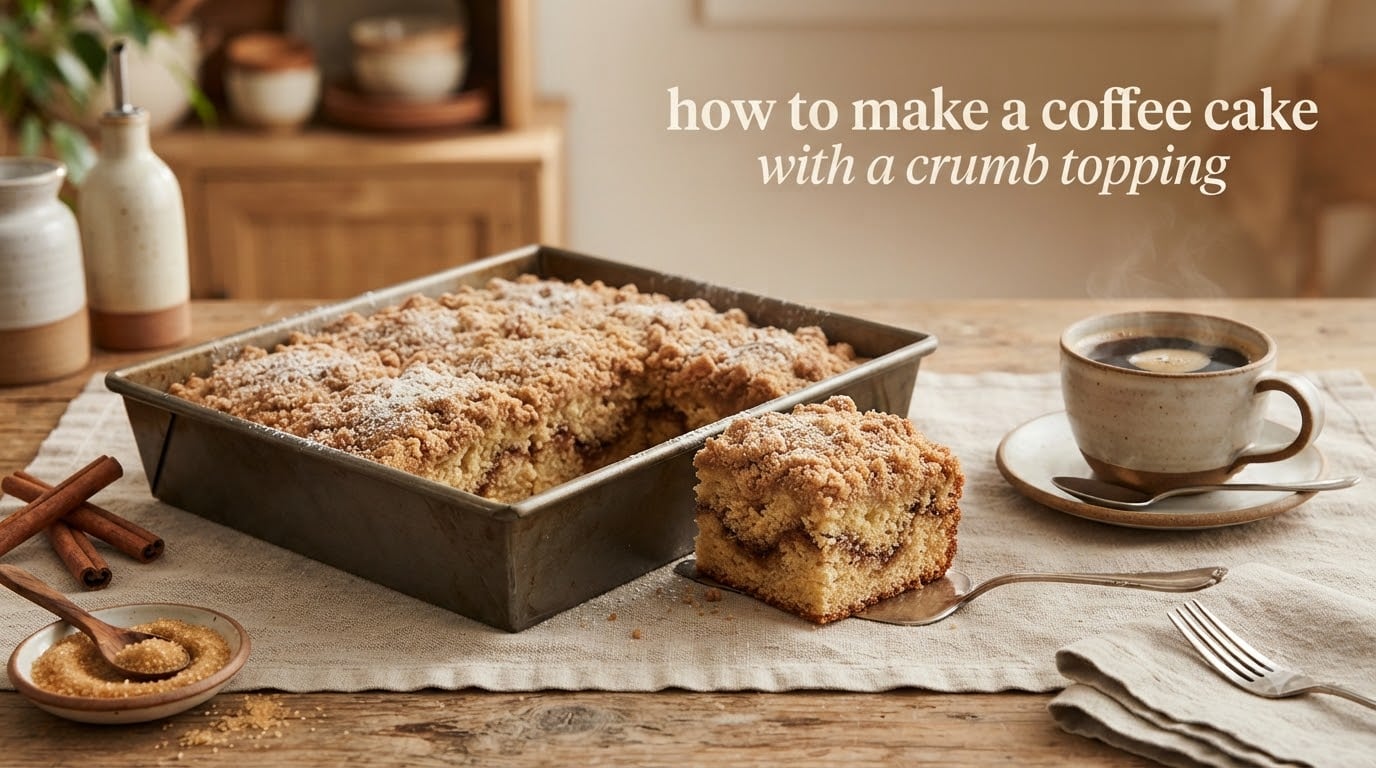
There is no coffee in this cake. Coffee cake is a buttery breakfast cake that gets its name from the pot it sits next to, and the whole reason anyone bakes one is the top: a thick, buttery crumb topping over a cinnamon ribbon running through the middle. This is how to make a coffee cake with a crumb topping that actually stays crumbly, and it takes about 25 minutes of prep, 35 to 45 minutes in the oven, and a little cooling time before you cut it.
The version below bakes in an 8-inch square pan, makes nine generous servings, and uses one cinnamon crumb mixture for two jobs. Half of it goes into the middle as a swirl, and half goes over the top, so you only measure one bowl. The crumb gets scattered cold and loose, which is the single technique that separates a crisp top from a sad puddle of melted streusel.
I have baked this cake dozens of times in a home oven that runs hot, and I have fixed the same three problems over and over: a crumb that melted, a batter too stiff to spread, and a cake that browned before the middle set. Each one has a specific cause, and all three are covered below.
Table of Contents
- What Is Coffee Cake?
- Coffee Cake at a Glance
- Ingredients and Why Each One Matters
- How to Make the Crumb Topping
- How to Make a Crumb Topping That Stays Crunchy
- How to Make Coffee Cake with a Crumb Topping
- Pan Sizes and How to Scale Them
- Coffee Cake Troubleshooting
- How to Make the Optional Vanilla Glaze
- Make-Ahead and Freezing
- Flavor Variations
- Frequently Asked Questions
- Why is it called coffee cake when there is no coffee in it?
- Should the butter be cold or room temperature for a crumb topping?
- Why does my crumb topping melt and sink into the batter?
- What is the ratio for a streusel topping?
- Do I need to prebake the streusel topping?
- Can I use Greek yogurt instead of sour cream?
- Can I make a coffee cake ahead of time?
- Can I freeze coffee cake with a crumb topping?
- How do you know when coffee cake is done?
- What size pan should I use for coffee cake?
- What is the difference between coffee cake and crumb cake?
- Conclusion
What Is Coffee Cake?
Coffee cake is a buttery breakfast cake baked in a square or rectangular pan with a cinnamon layer through the middle and a streusel-style crumb topping on top. The name traces back to 17th-century Germany, where a cake like this was served alongside coffee as a way to use up leftover stale bread. Despite the name, there is no coffee in the cake. It is simply meant to be eaten with a cup.
Coffee Cake at a Glance
- Oven: 350F (177C), conventional, middle rack
- Pan: 8-inch square metal pan, lined with parchment
- Bake time: 35 to 45 minutes
- Prep: 25 minutes | Cool: at least 1 hour
- Yield: 9 servings
If you bake in a convection or fan oven, drop the temperature to 325F (163C) and start checking at 25 minutes. Fan ovens cook the crumb faster and the middle slower than the top, which is exactly how a dry top edge and a raw center happen.
Ingredients and Why Each One Matters
For the Crumb Topping
- 6 tablespoons cold unsalted butter, cubed (85g) — cold, not softened. This is the rule that decides whether your topping stays crumbly. Warm butter melts into the flour and sugar and bakes as a thin sugary crust instead of clumps.
- 3/4 cup all-purpose flour (95g) — the structure that holds the clumps together. Too much flour and the topping bakes pasty; too little and the butter runs straight to the pan floor.
- 3/4 cup packed light brown sugar (150g) — brown sugar melts into caramel, which is what gives a crumb topping its deeper flavor than a white-sugar version. It also holds more moisture, so the crumbs stay tender longer.
- 1 teaspoon ground cinnamon (5g) — a full teaspoon reads as “cinnamon” rather than a perfume note. If you want to swap spices, keep the total at about 2.5 teaspoons so the balance holds.
- 1/4 teaspoon fine salt — not optional. Salt sharpens the brown sugar and makes the butter taste more buttery.
That is the streusel ratio in one line: about 1 part butter to 1 part flour to 1.5 parts brown sugar by weight. Weigh it if you scale up, and the crumb will behave the same in any pan.
For the Cake Batter
- 1.5 cups all-purpose flour (190g) — the base of a tender, bakery-style crumb. Spoon and level it, and do not pack it down.
- 1 teaspoon baking powder and 1/4 teaspoon baking soda — you need both. Baking powder gives lift, the soda reacts with the sour cream for extra lift and browning, and the two together keep the center tender instead of dense.
- 1/2 teaspoon fine salt
- 8 tablespoons softened unsalted butter (115g) — room temperature, about the softness of a give. Soft butter creams with the sugar; melted butter produces a cakier, tighter crumb.
- 3/4 cup granulated sugar (150g) — creamed with the butter until pale and fluffy, which is what aerates the batter.
- 2 large eggs, room temperature — room temperature, not cold. Cold eggs pull heat out of the batter and stall the rise.
- 1 teaspoon vanilla extract
- 3/4 cup full-fat sour cream (180g) — the moisture and acid that make this cake stay tender for days. Use it at room temperature. Cold sour cream seizes the softened butter and the batter turns curdled and dense.
- 2 tablespoons whole milk — a small amount of slack so the thick batter spreads over the cinnamon layer instead of tearing it. This batter is meant to be thick. It is not a mistake.
For the Cinnamon Layer
- 3 tablespoons granulated sugar plus 1.5 teaspoons ground cinnamon — the ribbon that runs through the middle of the finished slice.
For the Optional Vanilla Glaze
- 1 cup confectioners sugar, 2 tablespoons milk, 1/2 teaspoon vanilla
How to Make the Crumb Topping
No, you do not prebake the streusel. It goes onto the raw batter and bakes together with the cake. Here is the whole sub-process, and it takes five minutes.
- Cold butter first. Cut 6 tablespoons of unsalted butter into small cubes while it is still firm from the fridge, then set it out for about five minutes so it is not rock hard. You want it firm, not soft.
- Combine the dry ingredients. Stir the flour, brown sugar, cinnamon, and salt together in a medium bowl so the cinnamon is distributed evenly.
- Cut the butter in. Add the butter and work it with a pastry cutter, two forks, or your fingertips until the mixture looks like coarse crumbs with pieces the size of a small pea. Some pieces will be larger. Keep them.
- Stop before it turns sandy. When the dry flour is no longer visible and crumbs form when you squeeze a handful, you are done. Overworking it is the second most common reason a crumb topping turns out disappointing.
- Chill it. Spread the crumb on a plate or in the bowl and put it in the fridge while you mix the batter. Twenty minutes is enough.
A food processor works too. Pulse the flour and sugar first, add the cold butter, and pulse in one-second bursts until the crumbs form. A processor gives a more uniform crumb, while a pastry cutter gives you bigger, crunchier clumps.
How to Make a Crumb Topping That Stays Crunchy
A crumb topping stays crunchy when the butter is cold, the pieces are pea-sized rather than powdered, the mixture is not overworked, and it goes into the oven cold. That is four rules and they are not interchangeable.
- Use cold butter, cut to pea size. If you rub the butter in until everything looks evenly beige, you have gone too far and the topping will bake flat and soft. Uneven is correct.
- Do not over-mix. Flour contains gluten. As you work the mixture, it develops structure and eventually the crumbs turn pasty. Stop at the first sign of clumps.
- Chill before scattering. A cold crumb hits a room-temperature pan and sets in place instead of sliding into the wet batter. This is the fix most bakers are missing when the topping sinks.
- Scrunch for extra crunch. Squeeze a handful of crumbs tightly in your fist, then release it in clumps over the batter. Compacted pieces bake into nubbly crunch rather than a flat sugary lid. This single step gives you a noticeably crunchier top.
Expect a change on day two. A crumb topping softens as the sugar on its surface absorbs moisture from the cake, so a cake that was crisp straight from the oven has a tender-sugary crust the next morning. That is normal and it is the best point to serve it at. If you want the crunch back, a few minutes in a hot oven or under the broiler brings it around again.
How to Make Coffee Cake with a Crumb Topping
Read through the whole list once before you start, because the temperature rules only work if the butter, eggs, and sour cream are all where they should be before the first ingredient goes in the bowl.
- Heat the oven to 350F (177C) and position the rack in the middle. Set out an 8-inch square metal pan. Line the bottom and sides with parchment, leaving a couple of inches of overhang on two opposite sides. That overhang is your handle for lifting the cake out.
- Make the cinnamon crumb first. Follow the steps above for the crumb topping, then divide it in a rough half. Set one half in the fridge to keep cold while you make the batter. Use the reserved half for the middle layer later.
- Whisk the dry ingredients. In a medium bowl, whisk the flour, baking powder, baking soda, and salt together. Set it aside.
- Cream the butter and sugar. In a large bowl, beat the 8 tablespoons of softened butter and the granulated sugar on medium speed for 2 full minutes, until the mixture is pale and fluffy. Scrape the bowl once at the one-minute mark. Do not shorten this.
- Add the eggs and vanilla. With the mixer on low, add the eggs one at a time, mixing until each is absorbed before the next. Beat in the vanilla.
- Fold in the sour cream, milk, and dry ingredients. Add the sour cream, milk, and about a third of the dry mixture. Switch to low and fold with a spatula until barely combined. Repeat with the next third, then the last, stopping the moment no dry flour is visible. The batter will be thick. That is correct.
- Layer it. Spoon half the batter into the pan and spread it into an even layer. Scatter the reserved half of the crumb mixture over it and press it very lightly into the surface. Add the remaining batter on top and spread it to the edges, covering the cinnamon layer completely. The top layer can be spread thinner than the bottom layer, and that is deliberate. A heavier bottom layer pushes the ribbon up so it lands in the middle of the slice rather than at the bottom.
- Scatter the cold crumb. Tip the chilled crumb from the fridge over the pan. Scrunch clumps in your fist as you scatter so you get irregular pieces instead of an even blanket. Press nothing. Keep the crumb about a half inch from the edges so it does not scorch against the pan walls.
- Bake until a toothpick comes out clean. Bake at 350F (177C) for 35 to 45 minutes. Test with a toothpick or thin skewer inserted into the center of the cake, not through the crumb. It should come out with no wet batter clinging to it. A few moist crumbs are fine, wet batter means give it three more minutes. The top should be golden brown and the center should spring back lightly when you press it.
- Cool in the pan, then un-mold. Let the cake cool in the pan on a wire rack for at least 1 hour, until the center feels cool to the touch. Lift it out using the parchment overhang, peel the paper away from the sides, and place it right side up on the rack. Slice with a serrated knife in a single downward press rather than a sawing motion, which keeps the crumb from scattering.
If you plan to glaze, let the cake cool completely first. A warm cake will melt the glaze into a thin film that runs off the sides.
Pan Sizes and How to Scale Them
Not every pan needs a full doubling. The leavening does not scale linearly, and doubling the baking soda is the single most common scaling mistake readers make. Keep it at 1/4 teaspoon for any pan up to 9×13.
| Pan | Ingredient adjustment | Bake time | Serves |
|---|---|---|---|
| 8×8-inch square | Recipe as written | 35-45 minutes | 9 |
| 9×5-inch loaf | Recipe as written, no changes | 40-50 minutes | 8-10 |
| 9-inch round | Recipe as written, no changes | 35-45 minutes | 8 |
| 9×13-inch rectangular | Double the batter and all dry ingredients. Double the crumb if you want a full top. Do not double the baking soda. Add 2 tablespoons milk to the batter. | 40-50 minutes | 15-18 |
This batter will not work in a Bundt or tube pan. A tube pan needs far more batter than this produces, and you will end up with a thin ring that dries out before the crumb sets. If you want a Bundt coffee cake, use a recipe written and tested for one.
A glass baking dish works, but glass retains heat differently and you should add 5 to 10 minutes to the bake time. Dark metal and ceramic pans also run hotter than a light-colored aluminum pan, so check for doneness a few minutes early rather than trusting the clock.
Coffee Cake Troubleshooting
| Symptom | Why it happened | How to fix it |
|---|---|---|
| Crumb topping melted into the batter or disappeared | Butter was at room temperature, the mixture was overworked, or it sat out while the batter was mixed | Use butter straight from the fridge, cut only to pea size, stop mixing once crumbs form, and chill the crumb for 20 minutes before scattering |
| Crumb sank into the cake | The crumb was warm and the top batter layer was too thin | Scatter the crumb on a fully covered surface, spread the final batter layer to the pan edges, and chill the crumb until it is firm |
| Crumb slid off the edges and scorched | Crumb was scattered right up to the pan walls | Keep a half inch of bare batter around the perimeter when scattering |
| Batter tore the cinnamon layer while spreading | Batter was stiff, or the sour cream and eggs were cold | Bring the sour cream and eggs to room temperature for 30 minutes, and add the extra 2 tablespoons of milk before spreading |
| Cake sank in the middle | Underbaked, or the pan was moved in the oven before the batter set | Bake the full time, and give the cake 5 minutes at 350F before touching the pan door |
| Top browned long before the center was done | Hot or dark oven, or a convection setting used without lowering the heat | Drop convection ovens to 325F (163C), use a light-colored pan, and tent loosely with foil if the crumb darkens before the toothpick comes out clean |
| Cake was dry | Extended bake time, or a hot oven | Pull it as soon as the toothpick is clean, and add a third cup of sour cream next time for a moister crumb |
| Bottom of the cake stuck | No parchment, or it was trimmed flush with the pan | Always line the pan and leave a generous overhang for lifting |
How to Make the Optional Vanilla Glaze
A thin glaze sharpens the cinnamon and the crumb, and it is the difference between a breakfast cake and a bakery counter slice.
- Whisk 1 cup confectioners sugar, 2 tablespoons milk, and 1/2 teaspoon vanilla in a small bowl until smooth.
- Adjust the thickness. If it runs off the spoon, add another spoonful of sugar. If it sits in a stiff mound, add a teaspoon of milk.
- Drizzle over the cooled cake. Hold a teaspoon a few inches above the surface and let it fall in a thin stream in a loose zigzag. A thicker glaze will pool and slide off, so pour it thinner than looks right.
Make-Ahead and Freezing
Make the crumb ahead. The cinnamon crumb mixture can be made the night before and stored covered in the fridge, where it keeps its cold, loose texture. Give it a quick rub with your fingers before scattering so any clumps break back into crumbs.
Make the whole cake ahead. This coffee cake keeps at room temperature, covered, for 3 days. The crumb softens noticeably on day two and three, which is a good reason to bake it the day before a brunch rather than the morning of.
Freeze it for up to 3 months. Let the cake cool completely, wrap the whole pan tightly in two layers of plastic wrap, then foil. It freezes well for 2 to 3 months.
To serve from frozen, thaw the wrapped cake in the fridge overnight. Unwrap, then refresh the crumb in a 350F (177C) oven for 8 to 10 minutes. Once the crumb is hot and crisp again, glaze and slice. Warming it restores the texture that freezing flattens, and it tastes close to fresh.
Flavor Variations
Five changes are easy enough to make without a second recipe, and none of them need a different bake time.
- Pie spice crumb. Swap half the cinnamon in the crumb for apple pie spice or pumpkin pie spice. Keep the total spice at about 2.5 teaspoons so the crumb does not turn bitter.
- Chocolate chips. Fold half a cup of semisweet chips into the batter at the end, or scatter them over the crumb before baking.
- Fresh berries. Two cups of blueberries or diced plums folded into the batter at the very end work well. Expect a few extra minutes in the oven.
- Cream cheese layer. Beat 8 ounces of softened cream cheese with 1/3 cup sugar and spread it in the pan in place of the cinnamon layer, under the top batter layer. It adds moisture, so pull the cake about 3 minutes early.
- Orange glaze. Replace the milk in the vanilla glaze with orange juice and add 1 teaspoon of orange zest.
- Nut-based crumb. Swap the all-purpose flour in the topping for almond flour for a gluten-free streusel. Keep the same butter and sugar quantities and treat the crumb exactly the same way. The cake itself is not gluten-free.
Frequently Asked Questions
Why is it called coffee cake when there is no coffee in it?
It is served alongside coffee, which is where the name comes from. The cake itself contains no coffee at all.
Should the butter be cold or room temperature for a crumb topping?
Cold, cut straight from the fridge into pea-sized pieces. Room temperature butter melts into the flour and bakes as a flat sugary crust instead of clumps. The butter in the cake batter is the opposite: soften it to room temperature first.
Why does my crumb topping melt and sink into the batter?
The butter was too warm, the mixture was overworked into fine sand, or the crumb sat out while you mixed the batter. Use cold butter, cut only to pea size, stop as soon as crumbs form, and chill the mixture for 20 minutes before scattering it on.
What is the ratio for a streusel topping?
About 1 part butter to 1 part flour to 1.5 parts brown sugar by weight. That is 85g butter, 95g flour, and 150g brown sugar for an 8-inch square pan. Add cinnamon and salt to taste without changing the base ratio.
Do I need to prebake the streusel topping?
No. The streusel goes onto the raw batter and bakes together with the cake. Prebaking it dries the crumbs out before the cake is even in the oven.
Can I use Greek yogurt instead of sour cream?
Yes. Plain Greek yogurt works, full-fat or low-fat but not nonfat, used in the same 3/4 cup amount. Let it come to room temperature first, because cold yogurt seizes the softened butter the same way cold sour cream does.
Can I make a coffee cake ahead of time?
Yes. The cinnamon crumb mixture can be mixed the night before and kept covered in the fridge. The finished cake keeps at room temperature, covered, for 3 days, and the crumb softens on day two, so bake it a day ahead of a brunch for the best texture.
Can I freeze coffee cake with a crumb topping?
Yes. Cool it completely, wrap the pan in two layers of plastic wrap and foil, and freeze for up to 3 months. Thaw in the fridge overnight, then warm the cake at 350F for 8 to 10 minutes to bring the crumb back to crisp.
How do you know when coffee cake is done?
Insert a toothpick or thin skewer into the center of the cake, not through the crumb. It should come out with no wet batter on it. Moist crumbs are fine, wet batter means three more minutes.
What size pan should I use for coffee cake?
An 8-inch square pan for the recipe as written. A 9×5 loaf pan and a 9-inch round work without any ingredient changes. For a 9×13, double the batter and dry ingredients but keep the baking soda at 1/4 teaspoon. It will not work in a Bundt or tube pan.
What is the difference between coffee cake and crumb cake?
They are the same style of cake, and the names are often used interchangeably. Coffee cake is the broader name and usually describes a cake with both a cinnamon layer and a crumb topping. Crumb cake, and the New York style crumb cake most bakers picture, is defined by a heavy crumb topping, and it often has no filling at all. This recipe sits in between, with a thin cinnamon ribbon under a thick crumb top.
Conclusion
Learning how to make a coffee cake with a crumb topping comes down to three rules, and the rest of the recipe will follow if you keep them. Cold butter for the crumb, cut only to pea-sized pieces. Room temperature eggs and sour cream for the batter. A toothpick in the center that comes out clean at 35 to 45 minutes.
Everything else in this article is there to solve a specific failure. The chilling step keeps the crumb from sliding. The scrunch technique gives you crunch. The heavier bottom batter layer puts the cinnamon ribbon in the middle of the slice instead of on the bottom. The table of pan conversions tells you what changes and, more importantly, what does not.
This is a breakfast cake built for a coffee gathering, a Saturday brunch, a potluck, or an Easter table, and it is genuinely crowd-serving: one 8-inch pan cuts into nine generous squares. Bake it the morning you need it for maximum crunch, or the night before and warm it briefly so the topping comes back to life. Then let people pour the coffee.