
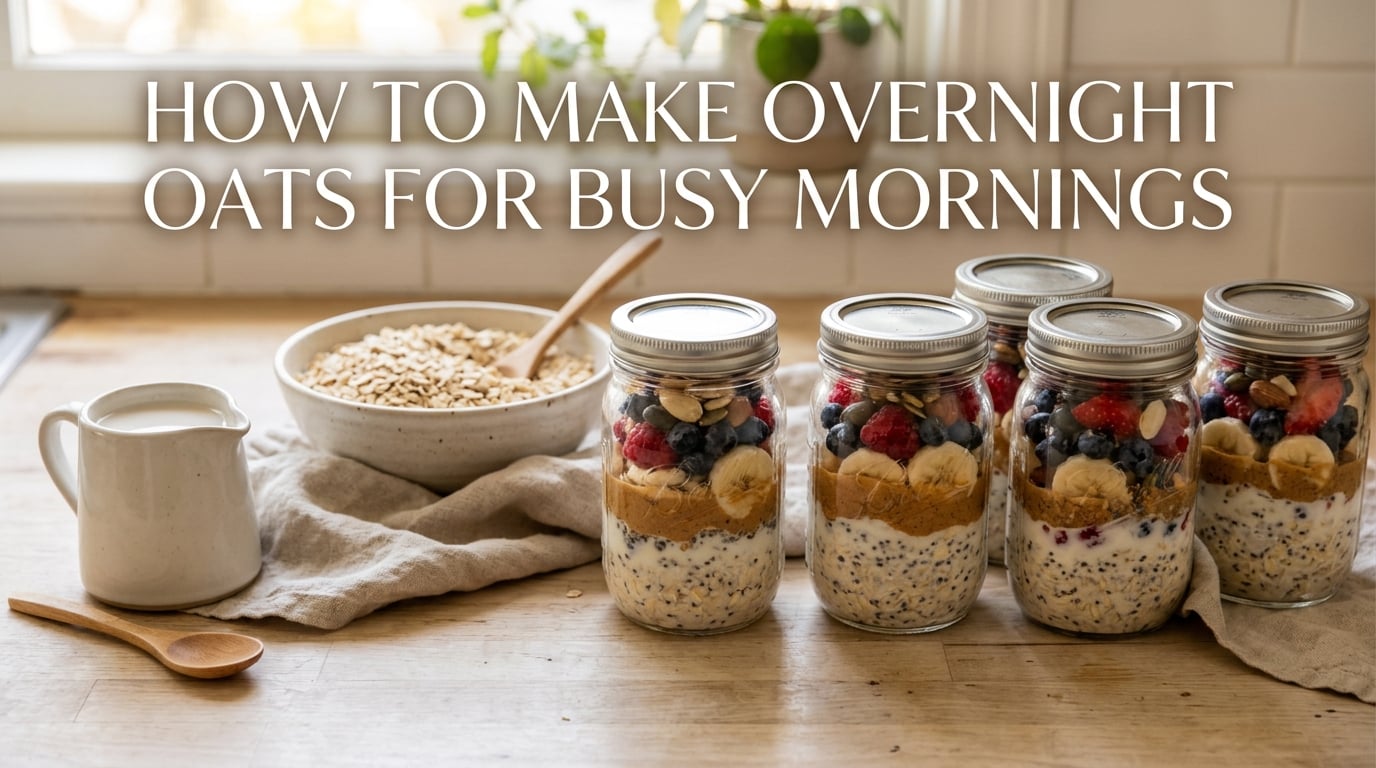
Overnight oats are a no-cook breakfast made by soaking raw old-fashioned rolled oats in milk or another liquid in the refrigerator for at least 4 hours, usually overnight, until the oats soften into a creamy, spoonable porridge. There is no pot, no stove, and no 6am timer involved, and that is the entire appeal for anyone trying to eat well on a rushed weekday.
I started making these after a stretch of mornings where breakfast was a granola bar eaten standing at the counter. Five minutes of assembly the night before replaced that, and I have not gone back. This guide covers the exact ratio, the four-step method, the oat type that actually works, and what to do when the result comes out too thin, which it will at least once while you learn the ratio your jar prefers.
If you have ever searched for how to make overnight oats for busy mornings, the confusing part is rarely the ingredient list. It is the ratio, and the fact that a recipe can be perfectly correct on paper and still turn into soup. Both get fixed below, with quantities rather than adjectives.
Table of Contents
- The Basic Overnight Oats Formula (Oats to Liquid Ratio)
- How to Make Overnight Oats in 4 Steps
- Which Oats Work Best for Overnight Oats
- What to Add and When (Toppings and Add-ins)
- Meal Prep Overnight Oats for a Full Work Week
- Flavor Variations With Exact Quantities
- Why Are My Overnight Oats So Soupy?
- Overnight Oats vs Cooked Oatmeal vs Chia Pudding
- Frequently Asked Questions
- What is the basic formula for making overnight oats?
- Why are my overnight oats so soupy?
- How to fix overnight oats that are too runny?
- What not to add in overnight oats?
- How long do overnight oats last in the fridge?
- Is oats overnight actually healthy for you?
- Why do some doctors say not to eat oats?
- Can I make overnight oats with instant oats?
- Final Thoughts on Overnight Oats for Busy Mornings
The Basic Overnight Oats Formula (Oats to Liquid Ratio)
Start from this block and adjust from there. It is the format that works, and every variation later in this guide swaps one component without changing the architecture.
- Oats: 1/2 cup old-fashioned rolled oats. Avoid instant or steel-cut oats for the base recipe.
- Liquid: 2/3 to 3/4 cup milk of any kind, which works out to roughly a 1:1 oats-to-liquid ratio by volume.
- Add-ins: 1 tablespoon chia seeds, 1/4 cup Greek yogurt, and 1/2 teaspoon maple syrup or honey.
- Method: Combine the dry ingredients, pour the liquid over them, stir until no clumps remain, cover, and refrigerate for at least 4 hours.
Two things in that block carry the most weight. Rolled oats hold their shape while they hydrate, and chia seeds form a gel that adds body, so together they give you texture that plain soaked flakes never reach on their own.
How to Make Overnight Oats in 4 Steps
The whole method is short enough to do half-awake, which is the point.
Step 1: Combine the dry ingredients. Put 1/2 cup old-fashioned rolled oats in a jar with a lid, a covered container, or any airtight vessel. Add 1 tablespoon chia seeds, 1 tablespoon nut butter, and a pinch of salt if you like. Mixing the dry stuff first means the chia distributes evenly instead of pooling in one spot.
Step 2: Pour the liquid over the top. Add 2/3 cup milk as a starting point and 1/4 cup Greek yogurt, then 1/2 teaspoon maple syrup or honey. The yogurt thickens the mix and adds protein, and it does not curdle in a cold soak the way it can with heat.
Step 3: Stir or shake to kill clumps. Stir thoroughly with a spoon, or close the jar and shake it for fifteen seconds. This is the step people skip, and it is the step that decides whether you end up with uniform oats or a layer of dry flakes at the bottom.
Step 4: Cover and refrigerate. Seal the jar and chill for at least 4 hours, with 8 hours being the sweet spot. Twelve hours is fine too. Cover the surface with a layer of liquid if you want a smoother result, since oats expand as they absorb.
Four hours is the minimum that gets you a spoonable texture, and anything under that tends to taste distinctly raw and crunchy rather than creamy.
Which Oats Work Best for Overnight Oats
Old-fashioned rolled oats are the default and the right answer for most jars. They are thick enough to survive an eight-hour soak without collapsing, and they release enough starch to make the mixture creamy without help.
Steel-cut oats are the wrong choice. They are chopped rather than rolled, so they absorb liquid far more slowly and stay hard and gritty even after a full night. Some people pre-soak them in the liquid for several hours first, but that undercuts the reason you made overnight oats in the first place.
Quick oats hydrate faster and work if you want a shorter four-hour soak, though the texture is slightly softer. Instant oats are drinkable, which means they dissolve rather than thicken, and they are the single most common reason people end up with something closer to sweet milk than porridge. If you only have instant oats, cut the liquid back to about 1/2 cup and lean on chia or yogurt for structure.
For a gluten-free version, buy certified gluten-free rolled oats. Regular oats are frequently milled on shared equipment, which matters if you have celiac disease rather than just a preference.
What to Add and When (Toppings and Add-ins)
Timing decides whether your toppings are still worth eating on Wednesday. Anything that gets soggy, bleeds color, or goes soft waits until morning.
Add in the morning:
- Fresh fruit such as berries, banana slices, or diced apple
- Granola and any crunchy cereal
- Nuts, seeds, and shredded coconut
- Nut butter stirred in at the table
- Honey, maple syrup drizzled over, cinnamon, and cocoa powder
Add before chilling:
- Chia seeds, the one topping that belongs in the base mix because it needs the full soak to gel
- Greek yogurt or any dairy or plant yogurt
- Canned fruit, drained well, if you accept some softening
- Cocoa powder, matcha, or cold-brew coffee, which dissolve into the liquid and improve with time
What not to add before chilling is the short version: fresh berries, granola, and nuts. Raspberries will bleed pink streaks through the whole jar, granola goes soft and loses its crunch, and toasted walnuts turn mealy by day three.
Meal Prep Overnight Oats for a Full Work Week
This is the part that turns a single jar into a system, and no competitor recipe covers it. Five jars take about fifteen minutes on Sunday and cover Monday through Friday.
Prep the base once, in a pitcher. For five servings, combine 2.5 cups old-fashioned rolled oats with 5 tablespoons chia seeds and a pinch of salt. Divide the dry mix into five jars.
Add the base liquid to each jar. Pour 1/2 cup milk into each jar, then 2/3 cup total yogurt across the five, which is a little over 2 tablespoons each. Add 1/2 teaspoon maple syrup per jar. Stir each one well.
Flavor four of the five, leave one plain. Put a different add-in directly into the base, such as cocoa powder in one and cold-brew coffee in another. Keep one jar plain so you have a blank canvas for whatever the morning calls for.
Chill all five overnight. They are interchangeable, so you can eat them in any order you like. If you do not want five jars of the same thing, the plain jar can be eaten midweek topped with leftovers from dinner.
On a weekday morning, the entire sequence is: take the jar from the fridge, stir, add a splash of milk if it thickened more than you like, add your toppings, and eat. That is a two-minute job with no cooking, and it is why the method survives a real schedule rather than a theoretical one.
For r/Oatmeal users, the useful habit here is the fiber-up, liquid-up rule: when you add an extra fiber source such as bran or ground flaxmeal, bump the liquid up by roughly 10 percent to keep the consistency where you like it. The same compensation applies when you double the chia.
Flavor Variations With Exact Quantities
Each variation starts from the base block and changes one or two things. Boredom is a real failure mode with meal prep, and these are the swaps that keep a work week from tasting identical.
- Peanut butter and jelly: 1 tablespoon peanut butter plus 1 tablespoon jelly mixed into the base before chilling, with a drizzle of peanut butter on top in the morning.
- Chocolate raspberry: 1 tablespoon cocoa powder and 1 teaspoon maple syrup in the base, with 2 tablespoons raspberries stirred in on top when you eat it.
- Banana walnut: 1/2 mashed ripe banana in the base, with chopped walnuts and a pinch of cinnamon added in the morning.
- Apple pie: 1/2 cup finely diced apple and 1/2 teaspoon cinnamon in the base, with a small handful of raisins on top at eating time.
- Cold-brew coffee oats: replace the milk with 2/3 cup cold-brew coffee and add 1 tablespoon of the coffee creamer you like. Keep the yogurt so it stays creamy.
- Matcha oats: 1 teaspoon matcha powder whisked into 2/3 cup milk before pouring, plus 1 teaspoon honey.
- Savory overnight oats: skip every sweetener, use 2/3 cup broth or water, and add 1/4 cup crumbled feta, a pinch of black pepper, and cooked spinach or bacon. Chives work too. This is the version that tastes like breakfast rather than dessert.
For a vegan jar, swap dairy milk for almond, oat, or soy milk and use a plant yogurt. Oat milk is the closest in body, and soy is the strongest for protein. Add another tablespoon of chia to stand in for the structure Greek yogurt was providing.
On sugar: the base needs very little, because oats release their own sweetness over a long soak. Half a teaspoon of maple syrup per jar is plenty, and fruit in the morning does more for flavor than doubling the syrup ever will. On r/loseit, members who eat overnight oats tend to ask peers for recipes rather than asking for a sweeter base, which tracks with what I have found testing it.
Why Are My Overnight Oats So Soupy?
Soupy oats are almost always one of four things: too much liquid, the wrong oat, chia that was not stirred in, or a jar that was not sealed. Here is how to reverse each one.
| Symptom | Likely cause | Fix |
|---|---|---|
| Too thin, almost drinkable | More liquid than the oats can absorb, or instant oats dissolving | Stir in 1 tablespoon rolled oats per jar and chill 30 more minutes; add 1 tablespoon chia if you need it thicker now |
| Too thick to spoon | Oats sat for 12 hours or more, or extra thick add-ins | Loosen with a splash of milk one tablespoon at a time until it drops off the spoon slowly |
| Hard chia clump in the bottom | Chia was poured in and not stirred | Whisk it in with a fork next time; for the current jar, stir the bottom vigorously before eating |
| Pink or purple streaks, watery after storage | Fresh berries went in before chilling | Use canned fruit drained dry, or wait until morning for fresh fruit |
| Mushy and pasty | Soaked longer than 12 hours | Treat it as a base and add crunch in the morning, or remake the jar |
Two habits prevent most problems. Stir with a fork at the bottom of the jar, not just a spoon at the top, and photograph the ratio you used on the lid so you know what to change next time.
If you want a deliberately silky, cheesecake-like result rather than a chewy one, some r/Oatmeal users blend the mixture in a blender for a few seconds. It is a legitimate texture preference, not a mistake, and it pairs better with fruit than with nuts.
How to make overnight oats not soupy comes down to three levers, in order: use rolled oats, hold the liquid at 2/3 cup per 1/2 cup of oats, and include 1 tablespoon chia or 1/4 cup yogurt. Reach for those three before changing anything else.
Overnight Oats vs Cooked Oatmeal vs Chia Pudding
All three are no-morning-cook breakfasts with different tradeoffs. Cooked oatmeal is the only one that requires a stove.
| Overnight oats | Cooked oatmeal | Chia pudding | |
|---|---|---|---|
| Prep time | 5 minutes | 2 minutes plus cooking | 5 minutes |
| Cook time | None | 5 to 10 minutes on the stove | None |
| Texture | Soft, chewy, spoonable | Warm, thick, porridge-like | Smooth, gelatinous, set |
| Protein per serving | Moderate, higher with yogurt | Moderate | Low unless you add protein powder |
| Fiber | High | High | Very high |
| Keeps refrigerated | 4 to 5 days | 3 to 4 days | 4 to 5 days |
| Best for | Meal prep, grab-and-go mornings, fiber | A hot breakfast you have time for | Maximum fiber, minimal flavor |
On storage, guidance conflicts because it depends on what you added. Most sources point to 4 to 5 days refrigerated in an airtight container, and that is the window I use for a work week. A stricter 24-hour rule applies to jars with lots of fresh fruit or dairy-heavy mixes, and the honest compromise is to eat the plain and lightly sweetened jars first.
You can eat overnight oats straight from the fridge cold, which is the intended experience. Warming one in the microwave for 30 seconds works if you prefer, and a splash of extra liquid helps since heat thickens the mixture further.
You can also freeze a finished jar for up to a month, leaving headroom in the container, and thaw it in the fridge overnight. Freezing softens the texture somewhat, so plan on blended or stirred servings rather than layered jars.
Frequently Asked Questions
What is the basic formula for making overnight oats?
Combine 1/2 cup old-fashioned rolled oats with 2/3 to 3/4 cup milk, 1 tablespoon chia seeds, 1/4 cup Greek yogurt, and 1/2 teaspoon maple syrup or honey. Stir until no clumps remain, cover, and refrigerate for at least 4 hours. That is roughly a 1:1 oats-to-liquid ratio, and chia or yogurt supplies the body that soaking alone does not.
Why are my overnight oats so soupy?
The usual causes are too much liquid, instant oats that dissolved instead of thickening, chia that was not stirred in, or a jar left unsealed. Add 1 tablespoon rolled oats per jar, stir hard enough to reach the bottom, and chill another 30 minutes. Adding 1 tablespoon chia thickens it faster than more oats do.
How to fix overnight oats that are too runny?
Stir in 1 tablespoon old-fashioned rolled oats and refrigerate for 30 more minutes. If you need it thicker immediately, mix in 1 tablespoon chia seeds. For the next batch, hold the liquid at 2/3 cup per 1/2 cup of oats and keep 1 tablespoon chia or 1/4 cup yogurt in the base.
What not to add in overnight oats?
Hold fresh berries, granola, nuts, and nut butter until the morning. They bleed color, go soggy, or turn mealy during an 8 to 12 hour chill. Chia seeds, yogurt, cocoa powder, matcha, and cold-brew coffee belong in the base because they improve with time in the fridge.
How long do overnight oats last in the fridge?
Four to five days in a sealed container, which covers a full work week. Jars heavy on fresh fruit or dairy are best eaten within about 24 hours, and some recipes give that shorter window because of what they contain rather than because the oats spoil sooner. Eat the plain and lightly sweetened jars first.
Is oats overnight actually healthy for you?
It is a high-fiber, no-added-cook breakfast, and the nutrition depends almost entirely on what you put in. The base has moderate protein rather than a lot, so add Greek yogurt, nut butter, or a scoop of protein powder if that matters to you. The main thing to watch is sweetener, because maple syrup and honey add up fast across five jars.
Why do some doctors say not to eat oats?
Most of that advice is about gluten. Regular oats are often milled on shared equipment, so people with celiac disease should use certified gluten-free rolled oats. A smaller group avoid oats because of their reputation for anti-nutrients, and soaking does reduce those compounds. There is no mainstream medical reason for a healthy person to avoid oats.
Can I make overnight oats with instant oats?
You can, but they dissolve rather than thicken, so the result is thinner and less creamy. Cut the liquid to about 1/2 cup per 1/2 cup of oats and add an extra tablespoon of chia or 1/4 cup yogurt for structure. Rolled oats give you a texture that instant oats never reach.
Final Thoughts on Overnight Oats for Busy Mornings
Overnight oats take five minutes the night before and give you a breakfast that is already sitting in the fridge when you wake up. Start with rolled oats, 2/3 cup of liquid, 1 tablespoon of chia, and toppings held back until morning, then adjust the ratio until the jar matches your own preference.
Make one this week. If it comes out too thin, you now know exactly which knob to turn.
Last updated for October 2026.