
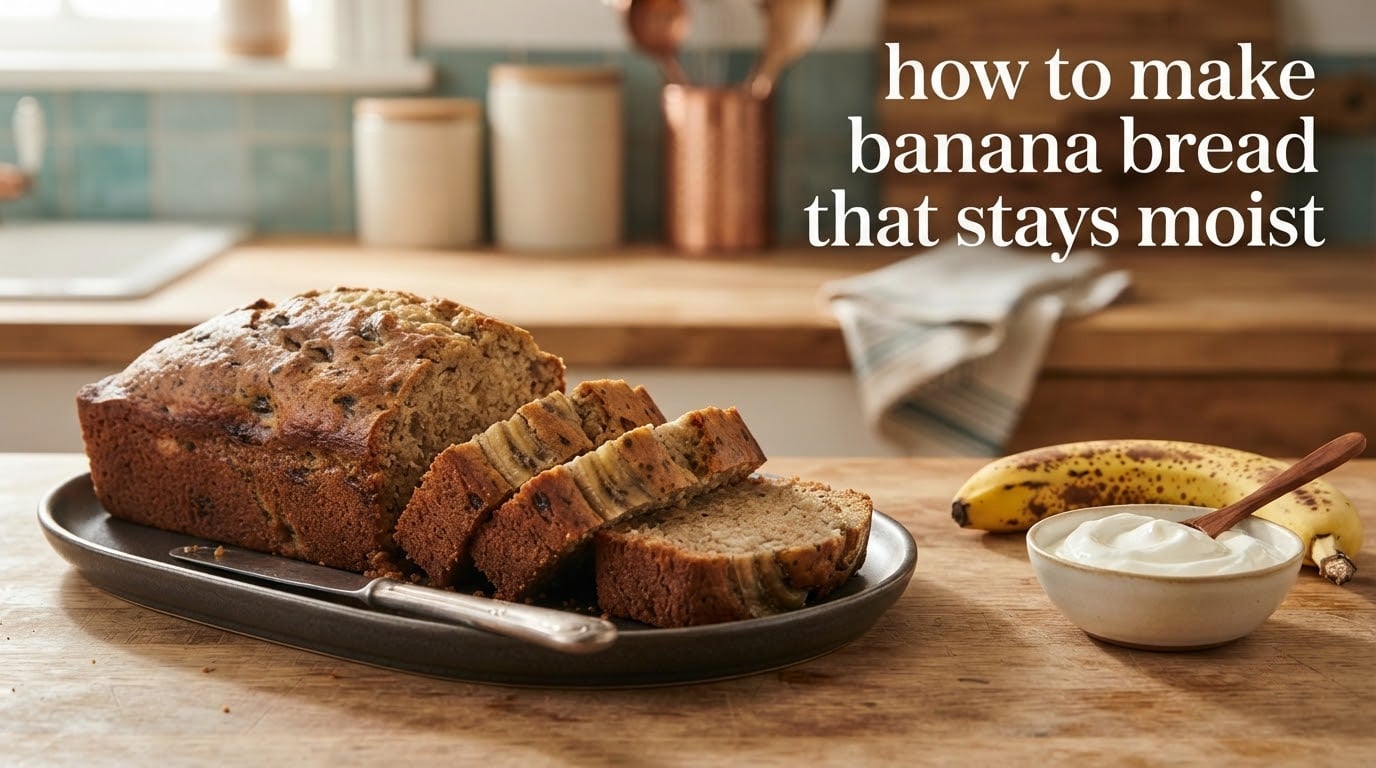
Three things make banana bread stay moist for days: very ripe spotty bananas, a generous fat ratio using both butter and oil, and folding the dry ingredients only until combined. This guide covers all three, plus how to measure, bake, and wrap the loaf so the crumb is still tender on day three.
Dry banana bread is rarely a bad recipe. It is three problems stacked on top of each other: what happens in the bowl, what happens in the oven, and what happens after the loaf cools. Fix one layer and the crumb improves. Fix all three and the loaf keeps.
Table of Contents
- The Short Answer: 5 Rules of a Moist Loaf
- Why Banana Bread Dries Out
- How Ripe Should the Bananas Be
- The Moist Banana Bread Recipe
- How to Make It: Step by Step
- Pan Size, Temperature, and the Doneness Test
- The Mistakes That Dry Out Banana Bread
- How to Store Banana Bread So It Stays Moist
- Moisture Swaps and Easy Variations
- Troubleshooting: What Went Wrong and How to Fix It
- Can You Rescue a Dry Loaf?
- Frequently Asked Questions
- What is the secret to moist banana bread?
- How do I keep my banana bread from drying out?
- What is the number one mistake made when making banana bread?
- How to add moisture to dry banana bread?
- Why is my banana bread mixture dry?
- What happens if you overmix banana bread mix?
- How to fix dried out banana bread?
- Wrapping Up
The Short Answer: 5 Rules of a Moist Loaf
- Use spotty bananas and weigh them. Aim for 1 cup (240 g) mashed, usually three medium fruit, because the moisture and sugar are the point.
- Use both butter and oil. A third cup of neutral oil keeps the crumb soft when the butter firms up.
- Add an acidic tenderizer. Sour cream, plain yogurt, or buttermilk supplies acid that keeps the gluten loose.
- Fold the dry ingredients just until combined. Wooden spoon, about fifteen strokes, then stop.
- Wrap the loaf warm, not cold. Plastic plus foil while the crumb still releases steam traps that moisture.
Those five cost about five extra minutes. Everything below explains why each one works and how to recover when a loaf goes wrong.
Why Banana Bread Dries Out
Moist banana bread depends on four cooperating things: ripe banana, fat, acid, and a loose gluten network. Weaken any one and the loaf turns dry, tough, or dense.
Gluten overdevelopment
Mixing after flour goes in aligns the gluten proteins into a tight elastic network. That is what you want in bread dough and the opposite of what you want here, so a stand mixer turns a tender quick bread into a dense, chewy brick that dries as it cools.
Moisture migrating out as it cools
Starch sets as the loaf cools and pushes water toward the surface, where the crust lets it evaporate. A slightly lower temperature and a real doneness test beat baking by the clock.
Too little fat
Fat coats the flour proteins and slows water moving through the crumb. Butter alone solidifies when the room turns cool, which is why oil alongside it keeps a loaf softer for longer.
Too long in the pan
A loaf left in the tin keeps drawing moisture out of the crumb. Ten minutes in the pan, then out onto a rack.
How Ripe Should the Bananas Be
Ripeness advice conflicts, so here is the scale I use. Yellow with no spots gives a firmer, drier crumb and mild flavor. Yellow with a scatter of brown speckles is the sweet spot, with strong flavor and plenty of moisture. All black and soft gives the most moisture and the deepest flavor, plus a fermented note that suits coffee and misses a kid’s lunchbox.
Skip bananas that are hard, green-edged, or shriveled. They carry little water and little sugar, and extra oil will not fully rescue the loaf.
To ripen fast, put bananas in a paper bag with an apple for a day, or warm them on a tray at 200F for 10 to 15 minutes. Freezing peeled bananas in portions works if you are not baking today.
The Moist Banana Bread Recipe
This is the loaf we bake most often. It uses a 9 x 5 inch pan and is deliberately wetter than most recipes because the oven takes care of the rest.
- 1 cup (240 g) mashed very ripe bananas, about 3 medium
- 1/2 cup (115 g) unsalted butter, melted and cooled slightly
- 1/3 cup (75 ml) neutral oil
- 3/4 cup (150 g) granulated sugar
- 1/2 cup (120 g) sour cream or plain yogurt
- 2 large eggs, room temperature
- 1 1/2 teaspoons pure vanilla extract
- 1 3/4 cups (220 g) all-purpose flour, spooned and leveled
- 1 1/2 teaspoons baking soda, checked for freshness
- 1/2 teaspoon fine salt
- 1 teaspoon ground cinnamon, optional
Brown sugar replaces the granulated sugar and adds moisture with a deeper flavor. Optional add-ins are 3/4 cup walnuts or pecans, 3/4 cup chocolate chips, or a cream cheese glaze over the cooled loaf.
Flour is the one ingredient worth weighing, because a packed cup changes the batter. For bananas, weight replaces the vague three-fruit instruction: 1 cup mashed is 240 g, and this pan needs that much or the loaf bakes up dry and cakey.
How to Make It: Step by Step
- Heat to 325F (165C) with a rack in the middle.
- Prepare the pan. Grease a 9 x 5 inch loaf pan and line the long sides with parchment, overhanging. The paper is a lift-out handle and keeps the loaf off the metal.
- Mash the bananas first with a fork, leaving some texture, about a third lumpy. A smooth puree makes a flat, gummy loaf. Measure the 1 cup (240 g) before it goes in.
- Whisk the wet base. Combine melted butter, oil, sugar, sour cream, eggs, and vanilla until smooth and lightly foamy.
- Add the dry ingredients on top along with the mashed banana.
- Fold, do not stir. Draw the batter from the bottom up and over, turning the bowl a quarter turn each time, until no dry streaks remain. Fifteen to twenty strokes, lumps included.
- Bake at 325F for 50 to 60 minutes until a skewer from the center comes out with moist crumbs, not wet batter.
- Cool 10 minutes in the pan, then lift onto a wire rack and cool completely before slicing.
That last step loses more moisture than most people expect. Slicing a warm loaf lets steam escape in a hurry, and the crumb never recovers.
Pan Size, Temperature, and the Doneness Test
Bake time follows batter depth, not the clock. A 9 x 5 inch pan holds more batter per square inch than an 8 x 4 inch pan, so the same recipe needs different times.
| Pan | Temperature | Bake time | Doneness cue |
|---|---|---|---|
| 9 x 5 inch loaf | 325F / 165C | 50 to 60 minutes | Skewer clean or with moist crumbs |
| 8 x 4 inch loaf | 325F / 165C | 40 to 50 minutes | Skewer clean or with moist crumbs |
| 9 x 13 inch cake pan | 350F / 175C | 25 to 32 minutes | Top springs back when pressed |
| Standard muffin tin | 350F / 175C | 18 to 22 minutes | Toothpick comes out clean |
| Mini loaf | 350F / 175C | 20 to 26 minutes | Toothpick comes out clean |
Fill muffin cups about three-quarters full. A toothpick works best for small bakes and a skewer for a full loaf. If it comes out with wet batter, give it three more minutes and retest.
The Mistakes That Dry Out Banana Bread
- Overmixing the flour. The biggest cause of a dry, tough crumb. Put the mixer away and finish with a spoon.
- Not enough banana. Two firm bananas instead of three spotty ones removes a quarter cup of water.
- Packing the flour. A packed cup runs heavier and produces a crumbly loaf.
- Baking too long. Ten minutes past done drains the crumb.
- Baking too hot. 350F browns the crust faster than the center can set.
- Cooling in the pan, or slicing hot. Both push moisture out.
The same list explains the gummy and dense failures. Too much banana, too little flour, or a short bake leaves a wet center. A weak leavener, a heavy hand, or an oversized pan leaves a loaf that never rises properly.
How to Store Banana Bread So It Stays Moist
Staling is mostly moisture moving around inside the crumb, so the goal is to slow that movement rather than fight it.
- Wrap while still warm. Thirty to sixty minutes after baking the loaf has released most of its steam, and wrapping then traps it. Wrapping a fully cooled loaf locks in nothing.
- Double wrap. Plastic wrap pressed onto the loaf, then foil or a zip bag. The plastic is the barrier; the foil is the backup.
- Counter first. Airtight at room temperature holds a loaf moist about two days.
- Refrigerate for longer. That roughly doubles to four days, though the crumb firms slightly. Warm a slice before serving.
- Freeze in slices. Wrap individual slices and thaw at room temperature. This is the best way to keep a loaf tender for weeks.
For a lunchbox, a thin butter or cream cheese layer on the cut face slows moisture loss for the few hours it sits.
Moisture Swaps and Easy Variations
| Instead of | Use | Effect |
|---|---|---|
| Half the butter | Neutral oil | Stays soft longer, less flavor |
| Sour cream | Plain yogurt or buttermilk | Same tenderness, tangier crumb |
| 1/2 cup sugar | Brown sugar | Deeper flavor, softer crumb |
| All-purpose flour | Half whole wheat flour | Nuttier and denser, add a spoon of oil |
| One egg | One extra egg plus 1 tbsp water | Denser, more binding, very moist |
| Butter and dairy | Oil and non-dairy yogurt | Dairy-free, keeps for days |
| 1 cup mashed banana | Half banana, half unsweetened applesauce | Moist, less banana flavor |
Baking soda is the right leavener, not baking powder. The acid in the sour cream and the bananas triggers it, and that reaction also keeps the crumb tender. Test the soda by stirring a spoonful into a cup of hot water; no foam means it has lost its lift.
Troubleshooting: What Went Wrong and How to Fix It
| Symptom | Likely cause | Fix |
|---|---|---|
| Dry, crumbly crumb | Too few bananas, overmixed flour, too little fat, long bake | Weigh banana at 1 cup (240 g), fold only until combined, keep the oil, pull the loaf 10 minutes early |
| Gummy or doughy center | Too wet a pan, too much banana, underbaked | Bake 5 to 10 minutes longer and retest, use a smaller pan next time |
| Dense, heavy loaf | Heavy mixing, weak baking soda, too much flour | Test the leavener in hot water, spoon and level the flour, finish with a wooden spoon |
| Cracked or domed top | Oven too hot, overbaked, not enough liquid | Drop to 325F (165C), check at 50 minutes, keep the sour cream in the batter |
| Sunken middle | Underbaked, oven door opened early, weak leavener | Bake until the skewer is clean, leave the door shut for 25 minutes |
| Will not rise | Expired leavener, overmixed batter, pan too large | Replace the soda, use the pan size the recipe calls for, stop at the first sign of combined |
| Too sweet | Ripe bananas plus full sugar | Cut sugar by a quarter cup, use less-ripe bananas next time |
Can You Rescue a Dry Loaf?
Partly. Staling pushes water around inside the crumb rather than removing it, so you can move some of it back.
- Wrap and rest. A sealed bag for several hours lets the loaf reabsorb ambient moisture and softens by morning.
- Freeze then thaw. A stale slice that is frozen and thawed comes back noticeably more tender, the fastest rescue available.
- Add a moist topping. A cream cheese glaze, a thin butter layer, or yogurt on the side covers a dry crumb.
- Warm before serving. A few minutes in a low oven re-vaporizes the moisture held in the crumb.
For the next bake, the three changes worth making are weighing the banana, folding only until combined, and wrapping the loaf while it is warm.
Frequently Asked Questions
What is the secret to moist banana bread?
Very ripe mashed bananas, a generous fat ratio using both butter and oil, and minimal mixing. The bananas supply water and pectin, the fat slows moisture loss in storage, and folding the dry ingredients only until combined keeps the gluten loose so the crumb stays tender. Add an acidic tenderizer such as sour cream or plain yogurt, and wrap the loaf warm so it holds that moisture for days.
How do I keep my banana bread from drying out?
Wrap the loaf while it is still slightly warm, about thirty to sixty minutes after baking, with plastic wrap pressed directly onto the crumb, then a layer of foil or a zip bag. Store at room temperature in that double wrap for roughly two days, refrigerate for up to four, or freeze individual slices for longer. Cool the loaf completely on a rack first, and slice only once it is fully cool.
What is the number one mistake made when making banana bread?
Overmixing once the flour goes in. A stand mixer or heavy stirring develops gluten that banana bread does not need, and the result bakes into a tight, chewy crumb that dries out as it cools. Put the mixer away, switch to a wooden spoon, and fold from the bottom up about fifteen times until no dry flour streaks remain. Lumps in the batter at that point are exactly right.
How to add moisture to dry banana bread?
Add moisture in three places next bake. Use 1 cup, or 240 g, of mashed very ripe banana, keep a third cup of neutral oil in the batter alongside the butter, and keep an acidic tenderizer such as sour cream, plain yogurt, or buttermilk. Swap half the butter for oil for a longer-lasting soft crumb. For an already-baked loaf, wrap it and rest it overnight, or freeze and thaw it to bring the crumb back.
Why is my banana bread mixture dry?
Most often the flour was packed rather than spooned and leveled, or too little banana went in. The batter should look slightly thicker than a smoothie, with a few dry lumps that disappear on the first fold. A very large pan also produces a shallow layer that dries before the center sets, and dipping the measuring cup into the flour adds up to twenty percent extra weight. Weighing the flour and the banana fixes it.
What happens if you overmix banana bread mix?
Mixing develops gluten into a tight elastic network, the same structure that gives kneaded yeast bread its chew. Banana bread has no yeast and no kneading to develop gluten, so overmixing produces a dense loaf with tunnels and a firm, slightly tough crumb that tastes dry. The batter should still show lumps when you stop folding, and folding with a wooden spoon is the most-repeated fix from home bakers.
How to fix dried out banana bread?
Wrap the loaf airtight and leave it for several hours so it reabsorbs ambient moisture. Freezing a slice and then thawing it revives a stale crumb more effectively than anything else. A cream cheese glaze, a thin butter layer, or serving it with yogurt covers a dry crumb at the table, and a few minutes in a low oven softens the texture. To prevent it next time, weigh the banana, fold only until combined, and wrap while warm.
Wrapping Up
How to make banana bread that stays moist comes down to three things in the bowl, one in the oven, and one after it cools. Weigh your bananas, use butter and oil together, keep an acidic tenderizer in, and fold the dry ingredients only until combined. Bake at 325F (165C) to a clean skewer, cool fully on a rack, then wrap while still warm.
Next time a banana goes spotty on the counter, this is the recipe to reach for. Keep a scale in the drawer and the leftover loaf will still be tender in a few days.