
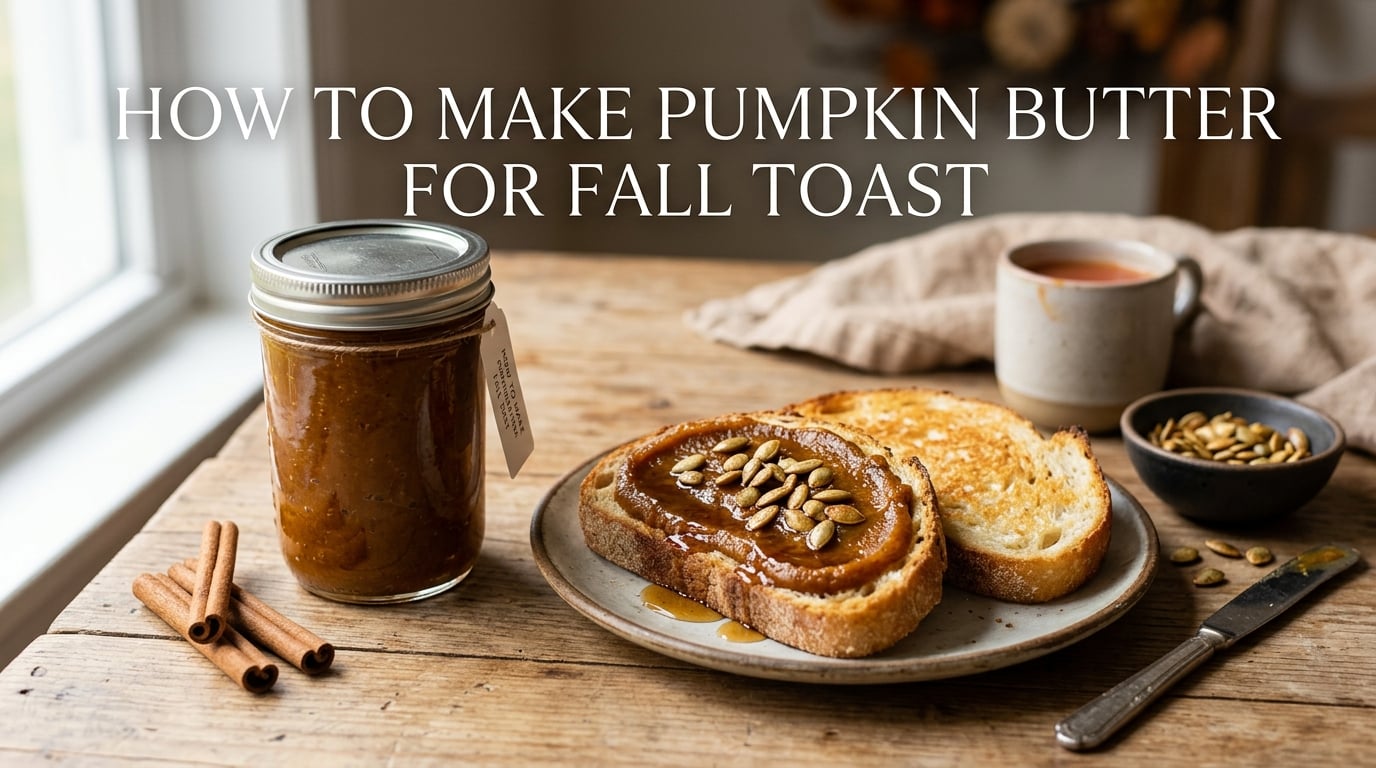
Pumpkin butter is a thick, spreadable preserve made by simmering pure pumpkin puree with apple cider, a sweetener and warm fall spices until it thickens to jam-like consistency. On the stovetop it comes together in about 25 minutes, and it is the single most useful thing you can make in early autumn if you plan to eat toast more than once a week. I make a batch most October and the jar is empty well before Thanksgiving.
This guide covers everything a home cook needs: exact quantities, the doneness test nobody else explains, how to serve it on fall toast without making the bread soggy, and a straight answer on whether you can water-bath can it. Recipe schema recommendations aside, the method itself is simple. The parts people get wrong are the sugar level and the storage, so those get their own sections.
Table of Contents
- What Pumpkin Butter Actually Is
- What You Need: Pumpkin Butter Ingredients
- How to Make Pumpkin Butter on the Stovetop
- How to Know Pumpkin Butter Is Done
- Serving Pumpkin Butter on Fall Toast
- How to Make It Less Sweet Without Ruining the Set
- Troubleshooting Pumpkin Butter
- Slow Cooker, Instant Pot and Oven Methods
- Storage, Shelf Life and Canning Safety
- Frequently Asked Questions
- Conclusion
What Pumpkin Butter Actually Is
Pumpkin butter is cooked-down pumpkin. There is no dairy and no added butter in the classic version, despite the name, which is why the same recipe works for a vegan table and for a gluten-free one.
Two things are not pumpkin butter, and search results mix them up constantly. Pumpkin-seed butter is made from roasted pepitas blended with oil, and it is nutty rather than sweet. Pumpkin pie filling is pre-sweetened, pre-spiced and thickened with starch, so it is a different product entirely. What follows is puree-based, cooked-down pumpkin.
What You Need: Pumpkin Butter Ingredients
These amounts mirror the formula most home cooks report making, and they produce roughly 1.5 cups, which is one 8-ounce jar plus a small dish for the cook who eats straight from the pot.
- 1 can (15 oz / 425 g) pure pumpkin puree, not pie mix
- 1/2 cup (120 ml) apple cider or apple juice
- 1/4 cup (60 ml) maple syrup
- 1/4 cup (50 g) light brown sugar
- 1 teaspoon ground cinnamon
- 3/4 teaspoon ground ginger
- 1/8 teaspoon ground nutmeg
- A pinch of ground cloves
- A pinch of sea salt
- Optional: 1 tablespoon apple cider vinegar, for a brighter edge
Use canned pumpkin puree, never pumpkin pie mix. Pie mix already contains sugar, spices and a thickener, so a jar of it will produce a sweet, gluey spread instead of a balanced one. If your only option is pie mix, use half a jar of puree and add your own spices.
Dark brown sugar swaps in one for one for a deeper, more molasses-forward result, and Demerara works the same way. Freshly ground spices taste noticeably better than the jarred ones, which lose their top note within a year.
How to Make Pumpkin Butter on the Stovetop
Prep is 10 minutes, cook is 25, and the whole job fits inside a half hour of active attention. The one piece of equipment that matters is a saucepan or Dutch oven with a heavy bottom; a thin pot is the fastest route to a scorched ring on the burner.
- Combine everything except the puree. Pour the apple cider, maple syrup, brown sugar, spices and salt into your saucepan and set it over medium-low heat. Stir until the sugar dissolves, about 2 minutes.
- Add the pumpkin. Stir in the puree and mix until no streaks remain. Scrape the bottom and the sides, because that is where the first scorching starts.
- Bring to a gentle simmer. Medium-low, not boiling. A rolling boil throws spatter and dries the surface unevenly, which is how you end up with a thin middle and a scorched skin. You will barely see bubbles at the edge.
- Simmer uncovered for 20 to 25 minutes. Uncovered is the point. The open lid lets water vapor escape, and water is what you are removing. A lid traps it and your butter stays soupy no matter how long you cook.
- Stir every 4 to 5 minutes. Pumpkin catches on a hot pan quickly. If you see a dark ring forming on the base, lower the heat and scrape the bottom properly before you stir again.
- Blend for smoothness, twice. Most can-style puree has a slightly fibrous, wet texture. One pass with an immersion blender at the halfway point, and one pass at the end, is the difference between pumpkin butter and a rustic puree.
- Test, then cool. Run the doneness test below, then take the pan off the heat. The butter thickens noticeably as it cools, so pull it while it looks a shade looser than you want.
Stirring and blending both matter, and neither is optional if you want a bakery texture. My batches that skipped the first blend were noticeably rougher on toast than the ones that did both.
How to Know Pumpkin Butter Is Done
The butter is done when a spoon dragged through the center leaves a clean gap that stays open for a few seconds before the edges slowly creep back. That is the primary test, and it takes about three seconds to run.
Two supporting checks:
- Clean spoon: Dip a chilled spoon in, then hold it upright over the pan. A thin, clear coat means it is ready. A thick, slow drip means it needs another few minutes.
- Coats the back: Turn the spoon over. If the pumpkin butter clings in an even opaque layer and you can still read light through the edges at a steep angle, the set is right for spreading.
Remember the sauce thickens as it cools, so aim for a consistency that is slightly softer than your target while it is hot.
Serving Pumpkin Butter on Fall Toast
This is the part most pumpkin butter recipes skip, and it matters more than the recipe. Pumpkin butter is soft and slightly tacky, so the way you apply it decides whether you get a good toast or a soggy one.
Use a warm knife and a thin layer. Pull the knife toward you rather than pressing down, which keeps the crumb intact. A thick layer on an English muffin is fine, because there is little crumb to soak. On sourdough, go thinner and add something with crunch on top.
| Bread | Spread amount | Best topping |
|---|---|---|
| Sourdough toast | Thin | Toasted pepitas, flaky salt |
| English muffin halves | Generous | Crispy sage, black pepper |
| Oatmeal | Spooned on warm | Greek yogurt, maple drizzle |
| Rye toast | Thin | Sharp cheddar, caramelized onion |
| Vanilla toast with cream cheese underneath | Thin | Candied pecans |
Beyond toast, it works on a breakfast board with yogurt, ice cream, granola and baked sweet potato, and it makes a fine hand pie filling because it is already thick enough to hold.
How to Make It Less Sweet Without Ruining the Set
Many recipes call for three-quarters of a cup to a full cup of brown sugar plus maple syrup, and that reads as cloying on toast. Sugar is not only sweetness here: it is part of what the butter is. Too little and the spread turns loose and watery.
Work down the ladder one rung at a time, tasting at each one:
- First, cut the maple syrup. Drop it from 1/4 cup to 1 tablespoon. It is the most obvious sweetener and the least structurally necessary.
- Then cut the brown sugar by a quarter. This is the safest single adjustment and usually enough.
- Next, add liquid back. If the mixture looks loose after less sugar, add apple cider a tablespoon at a time. Sugar is holding water in place, so removing it dries the spread.
- Finish with acid and salt. A teaspoon of apple cider vinegar and a slightly larger pinch of salt make the same spread read noticeably less sweet.
- Skip sugar entirely. A no-sugar version simmered slightly longer and blended very smooth works, but expect a flatter flavor. We serve that one on savory toast, not with granola.
Troubleshooting Pumpkin Butter
| Symptom | Likely cause | Fix |
|---|---|---|
| Still thin after 25 minutes | Pan too wide, so liquid evaporates slowly | Keep simmering, or pour into a narrower saucepan to increase the surface area |
| Gluey and stiff | Too much sugar, or cooked past the set | Warm it with a splash of apple cider and stir until loose |
| Grainy or fibrous | Puree not blended | Off heat, blend fully with an immersion blender, return to the pan briefly |
| Scorched on the bottom | Heat too high or stirring too infrequently | Transfer to a clean pot immediately, scraping off nothing from the burnt base; reduce heat for the rest of the cook |
| Bland | Spices cooked down too far | Stir in a fresh pinch of cinnamon and ginger off the heat |
If a batch scorched badly, the bitter flavor is not fixable. Scraping the burnt layer off and hoping is the mistake I made exactly once.
Slow Cooker, Instant Pot and Oven Methods
All three methods work because the same thing has to happen: water leaves, flavors concentrate. Only the time cost changes.
| Method | Time | Texture and effort |
|---|---|---|
| Stovetop | 25 minutes | Best control, fastest, most stirring |
| Slow cooker | 5 hours on low | Smoothest result, hands-off, stir occasionally |
| Instant Pot | 20 minutes high pressure, then uncovered simmer | Fastest batch, needs a final stovetop reduction |
| Oven | About 2 hours at 300 degrees F | Deep flavor, no stirring, slowest option |
The slow cooker is the one I use for holiday batches, because five hours of unattended simmering gives the smoothest texture I have gotten. The pressure cooker route still needs the lid off afterward; a sealed pressure-cooked puree will not reduce.
Storage, Shelf Life and Canning Safety
Pour the butter into a clean airtight jar once it is fully cool, leaving half an inch of headspace. Wipe the rim, tighten the lid, and refrigerate. Our batches kept about two weeks in the refrigerator and about one month in the freezer, which is the right window for a fall make-ahead or a hostess gift.
Freeze in small portions so you can pull out only what you need. A jar that goes into the freezer half full and comes back as a solid block is how you end up throwing most of it away.
Do not water-bath can plain pumpkin butter. Canning forums raise this question constantly because fruit spreads seem like they should be safe. Pumpkin is a low-acid vegetable, not an acid fruit, so plain puree is not an acidified product. Water-bath canning is intended for high-acid foods, and homemade pumpkin butter has not been tested as a safe water-bath candidate by an extension authority or the National Center for Home Food Preservation. A cook-down that seems thick enough does not make it shelf-stable.
Refrigeration and freezing are the right answers for a home cook. If you want genuinely shelf-stable pumpkin butter, follow a tested canning recipe from a source that publishes a processing time, and follow it exactly rather than adapting one you found on a forum.
Frequently Asked Questions
What is pumpkin butter made of?
Pumpkin butter is made from pure pumpkin puree simmered with apple cider, a sweetener such as light brown sugar or maple syrup, and warm fall spices like cinnamon, ginger, nutmeg and cloves, plus a small pinch of salt. The mixture cooks uncovered for 20 to 25 minutes until the water cooks off and the puree thickens to a jam-like, spreadable consistency. There is no dairy in the classic version.
How long does homemade pumpkin butter stay good?
Homemade pumpkin butter keeps about two weeks in the refrigerator in an airtight jar, and roughly one month in the freezer. Always refrigerate it rather than storing it on a counter, and let the jar cool completely before sealing so no condensation gets trapped. Freezing it in small portions means you can thaw only what you need for breakfast.
Should you refrigerate pumpkin butter?
Yes, refrigerate it. Because pumpkin is a low-acid vegetable, cooked-down pumpkin butter is not shelf-stable at room temperature, even when it looks thick enough to be jam. A clean airtight jar in the refrigerator keeps it safe for about two weeks, and the freezer stretches that to roughly a month.
Is canning pumpkin butter safe?
Plain pumpkin butter is not a safe water-bath canning candidate. Water-bath canning is designed for high-acid foods, and pumpkin is a low-acid vegetable that has not been tested as an acidified product. Thickening the spread in a pot does not make it shelf-stable. For home storage, refrigerate or freeze it, or follow a published tested canning recipe with a stated processing time.
Why can’t you can pumpkin puree?
Pumpkin puree is a low-acid vegetable puree, and low-acid foods are not safe for water-bath canning because the bath temperature is not hot enough to destroy the bacteria that can grow in that pH range. Even home-canned pumpkin is processed in a pressure canner for that reason. Spices and sugar added to pumpkin butter do not change this, since they are not part of a tested formulation.
Is pumpkin butter healthy?
Pumpkin itself is nutrient-dense, low in calories and rich in potassium and vitamin A, so the base of pumpkin butter is a healthy food. The sugar content depends entirely on the recipe, and most versions add a meaningful amount of brown sugar or maple syrup. The way to keep it lighter is to cut the maple syrup first, then trim the brown sugar and finish with a little vinegar and salt.
How do I make my own pumpkin seed butter?
Pumpkin seed butter is a different spread made from pepitas, not puree. Toast the raw pepitas in a dry pan until they pop and smell nutty, cool them completely, then blend in a food processor for 8 to 12 minutes, scraping down the sides, adding a spoonful of neutral oil only if the butter will not move. It will loosen from a paste to a fluid as you keep blending.
How do I know when pumpkin butter is done cooking?
Drag a spoon through the center of the pan. When the gap stays open for a few seconds before the edges slowly creep back, the butter is done. A second check is to hold a spoon upright over the pan: the butter should drip off in a thin, clear coat rather than a thick slow drip. Remember it thickens further as it cools, so pull the pan a minute early.
Conclusion
To make pumpkin butter for fall toast, simmer one can of pure pumpkin puree with apple cider, a modest amount of maple syrup and brown sugar, and warm spices over medium-low heat, uncovered, for 20 to 25 minutes. Test for doneness with a dragged spoon, blend for smoothness, then jar it and refrigerate.
Your next step is simple: make a half batch first. The method is forgiving, but knowing how much sugar your family actually wants is easier to fix in a small pot than a full one. Updated for 2026, this is the version we come back to every autumn.