
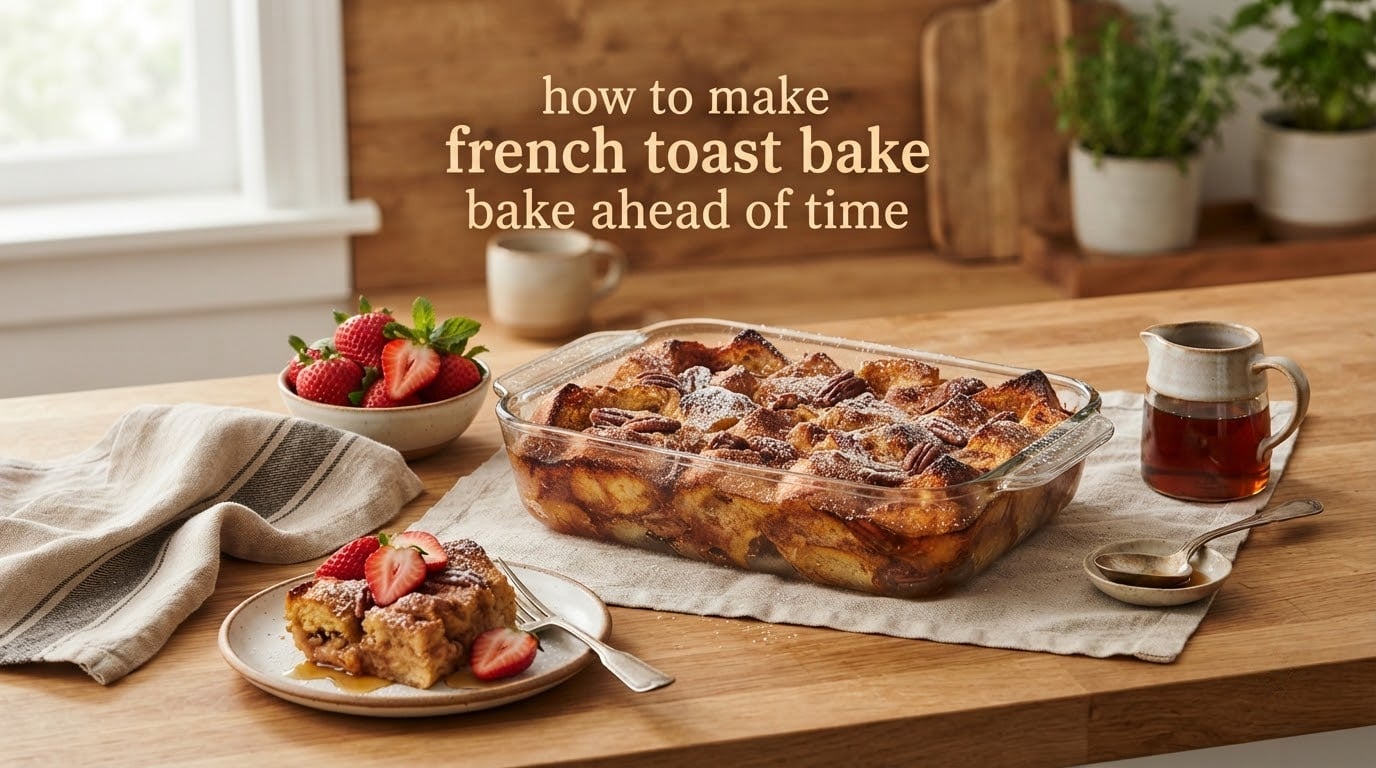
A make-ahead French toast bake turns a 45-minute morning scramble into a ten-minute task. You assemble the casserole the night before, cover it, refrigerate it, and pop it in the oven when the oven heats. This guide walks through how to make French toast bake ahead of time, including the exact refrigeration window, the bake time for a cold dish, and the one mistake that turns the center into mush.
I tested this method across several holiday and Sunday brunches, mostly on 9×13-inch dishes, and the pattern held every time: the overnight chill is what makes the custard go deep into the bread, and the topping goes on in the morning so it stays crumbly. Everything below reflects that.
Table of Contents
- What Is a Make-Ahead French Toast Bake?
- Can You Make French Toast Bake Ahead of Time?
- How to Make French Toast Bake Ahead of Time: Step by Step
- How Long Can You Prep a French Toast Bake Ahead?
- How to Keep French Toast Bake From Getting Soggy
- Bread Choices That Hold Up Overnight
- Tips for the Best Make-Ahead French Toast Bake
- How to Store, Freeze, and Reheat French Toast Bake
- Troubleshooting: Soggy Middle, Dry Edges, and a Pale Top
- Frequently Asked Questions
- Final Thoughts on Making French Toast Bake Ahead of Time
What Is a Make-Ahead French Toast Bake?
A make-ahead French toast bake is an overnight breakfast casserole. Cubed bread is soaked in an egg, milk, and sugar custard, chilled in the refrigerator for 8-12 hours, then baked at 350 degrees F the next morning until the top is golden brown and the center is set. No per-slice dipping, one pan, one oven.
Can You Make French Toast Bake Ahead of Time?
Yes. You can fully assemble a French toast bake the night before, cover it tightly, and refrigerate it for up to 12 hours before baking. Two days is also workable if the bread is day-old or slightly stale. Do not add a streusel or cinnamon sugar topping until the morning, and bake the cold dish 10-15 minutes longer than a room-temperature one.
How to Make French Toast Bake Ahead of Time: Step by Step
What you need: prep 20 minutes, bake 45-60 minutes, chill 8-12 hours, serves 8. You need about 1 loaf (10-12 slices) of day-old bread, 8 eggs, 3 cups milk, 1 cup half-and-half or heavy cream, 1/2 cup brown sugar, 2 tablespoons vanilla extract, 2 teaspoons ground cinnamon, 1/2 teaspoon nutmeg, and a pinch of salt. For the topping: 1/2 cup brown sugar, 1/2 cup flour, 1/3 cup cold butter, and 1 teaspoon cinnamon.
- Grease the pan. Butter a 9×13-inch baking dish or coat it with non-stick spray. Buttering also gives the edges a caramelized crust.
- Cube the bread. Cut the loaf into 1-inch cubes and remove the crusts if you want a softer, more custardy result. Day-old bread absorbs liquid without collapsing.
- Whisk the custard. In a large bowl, whisk the eggs, milk, cream, brown sugar, vanilla, cinnamon, nutmeg, and salt until completely smooth with no streaks of egg.
- Pour over the bread. Pour the custard evenly over the cubes, then use your hands to turn them so every piece is damp.
- Press down. Pat the cubes flat and compact with the back of a spoon. Loose cubes bake into islands instead of a single sliceable slab.
- Cover tightly. Wrap the dish directly with plastic wrap, or set a sheet of foil under the wrap so nothing touches the custard.
- Refrigerate 8-12 hours. Cold, covered, and on the bottom shelf of the fridge. The custard needs that time to penetrate the bread.
- Make the topping in the morning. Cut the cold butter into the flour, brown sugar, and cinnamon with a pastry blender or two forks until crumbly. Keep it loose, not packed.
- Top and bake. Sprinkle the crumble over the cold casserole and bake at 350 degrees F for 45-60 minutes, until the top is golden brown and the center no longer jiggles.
- Rest before slicing. Wait 5-10 minutes after it comes out of the oven. The custard finishes setting as it cools, so slicing early gives you a gooey first cut.
A metal pan conducts heat faster than glass and can shave a few minutes off the bake, which matters when the casserole goes in cold straight from the refrigerator.
How Long Can You Prep a French Toast Bake Ahead?
Here is the timing that actually holds up, based on how the custard and bread behave over time.
- Same morning. Skip the chill or shorten it to 2 hours, then bake for 40-50 minutes. Best texture, least convenient.
- 12 hours ahead. Assemble, cover, refrigerate, and bake straight from cold. Reliable for most kitchens.
- 2 days ahead. Use day-old bread only and add 5-10 minutes to the bake. Still good, slightly denser.
- Frozen unbaked. Assemble without the topping, wrap in foil plus plastic wrap, and freeze. Thaw overnight in the fridge, then top and bake. Keeps 2-3 months.
- Already baked. Cool completely, wrap into portions, and refrigerate or freeze. Reheat only what you need. Keeps 4-5 days refrigerated or 2-3 months frozen.
Raw egg custard should not sit at room temperature, so keep the window at 48 hours maximum before baking, and count the fridge hours rather than the calendar ones.
How to Keep French Toast Bake From Getting Soggy
Most soggy casseroles trace back to four things: fresh bread, too much liquid, an uncovered dish, or a topping added too early. Fix those and the center sets instead of puddles.
- Use day-old or stale bread. It drinks up custard without breaking down. Fresh bread releases water into the dish and creates a puddle at the bottom.
- Measure the liquid and stop there. If you have 1-inch cubes, roughly 10-12 slices take about 3 cups of milk and cream combined. Extra liquid pools in the middle.
- Cover the dish for the whole chill. Uncovered overnight, the surface dries out, then absorbs too much custard when it bakes.
- Press the bread flat and bake it all the way. A loose, under-baked center reads as soup. Pull it when the top is golden and the center has stopped jiggling.
- Hold the topping back. Streusel sprinkled on before refrigerating steams itself soft overnight. Add it in the morning.
- Give a cold dish extra time. Baking straight from the fridge means the middle lags the edges. Add 10-15 minutes and, if the top browns early, tent it loosely with foil.
Bread Choices That Hold Up Overnight
Not every loaf survives a night in custard. Here is how the common options behave.
- Challah. Rich and slightly sweet, and it holds together well. The braided crumb gives you great crouton-like cubes.
- Brioche. Very rich and almost custard-like on its own. Use it if you want a dessert-style bake, and cut it a day ahead so it is not already soft.
- Sourdough. Sturdy and full-flavored, with a tang that cuts the sugar. Excellent for savory-adjacent versions with cheese or apples.
- French or Italian bread. A sturdy, crusty loaf that soaks evenly. Trim the crusts for a softer center.
- Day-old sandwich bread. Surprisingly good and very forgiving, since it is already absorbing liquid readily.
- Texas toast. Thick, sweet, and slow to soak through. Cube it and let it sit in the custard longer, or reduce the cream slightly.
Tips for the Best Make-Ahead French Toast Bake
These are the details that separate a good bake from a great one, and most take under a minute.
- Take the casserole out of the fridge as the oven heats, so it loses some of its chill while the oven preheats to 350 degrees F.
- Add 1/2 cup of the milk or cream to the bread cubes first, let them sit 10 minutes, then pour the egg custard over. This cuts the mushiness noticeably.
- Layer fruit between the bread rather than on top. Apples, pears, and berries release juice into the custard instead of scorching on the surface.
- Sprinkle a little coarse sugar over the top for crunch that survives the bake.
- Check doneness in the center, not at the edge. The edge sets long before the middle does.
- For a holiday feel, swap half the milk for chai or eggnog and add a pinch of nutmeg.
How to Store, Freeze, and Reheat French Toast Bake
Refrigerate cooled leftovers in an airtight container for 4-5 days. Freeze baked portions wrapped individually for 2-3 months, or freeze the assembled casserole unbaked for the same window, which is the better option for a holiday morning.
To thaw anything frozen, move it to the refrigerator overnight rather than the counter.
Reheat method matters more than most recipes admit, because the microwave dries the custard while the oven restores the crust.
- Oven, covered: 25-30 minutes at 325 degrees F. Steamy center, soft crust, and the most even result.
- Toaster oven: 10-12 minutes at 350 degrees F. Crisp edges, good for a single portion.
- Microwave: 60-90 seconds for a slice. Fast, but it leaves the edges rubbery.
Cover with foil when reheating in the oven so the top does not dry out, and add a few minutes if you are starting from frozen.
Troubleshooting: Soggy Middle, Dry Edges, and a Pale Top
- Soggy, unset middle. The dish sat longer than 48 hours or had too much liquid. Next time, use day-old bread and pour custard slowly, stopping while the surface still looks damp.
- Custard puddle on the baking sheet. Too much liquid for the pan size. Use a 9×13 rather than crowding a small dish.
- Dry, hard edges. Bread cubes were too large to soak through, or the dish was uncovered. Cut smaller and press the cubes down.
- Pale top. The cold custard slows browning. Bake 10-15 minutes longer, or broil for the last 2 minutes with the dish watched closely.
- Top browning while the center stays loose. Tent loosely with foil after 35 minutes and keep baking until the jiggle is gone.
- Rubbery reheated pieces. You reheated too long. Warm through rather than brown, and cover in the oven.
Frequently Asked Questions
Can you prep a French toast bake the night before?
Yes. Assemble the bread and custard in a greased 9×13-inch dish, press the cubes flat, cover tightly with plastic wrap, and refrigerate for 8-12 hours. Add any streusel topping only in the morning, then bake the cold casserole at 350 degrees F for 45-60 minutes until the top is golden and the center no longer jiggles.
How do you keep French toast casserole from being soggy?
Use day-old or slightly stale bread, measure the milk and cream carefully, and pour the custard in slowly until the cubes are damp rather than swimming. Cover the dish tightly for the entire chill, press the cubes flat so they bake as one slab, and hold the streusel back until morning so it stays crumbly.
Can you make the French toast mixture ahead of time?
You can whisk the egg, milk, cream, sugar, and spice custard up to 2 days ahead and refrigerate it in an airtight container. Give it a thorough whisk or a quick blend before pouring, since the eggs and cream separate when they chill. Most bakers assemble everything together the night before for simplicity.
Can you freeze a French toast bake?
Yes, and freezing it unbaked is the better option for holiday mornings. Assemble without the topping, wrap the dish in foil plus plastic wrap, and freeze for 2-3 months. Thaw overnight in the refrigerator, add the streusel in the morning, and bake as usual. Baked leftovers also freeze well in individual portions.
How long does a French toast bake cook once it comes out of the fridge?
A casserole baked straight from the refrigerator needs 45-60 minutes at 350 degrees F, which is 10-15 minutes longer than a room-temperature one. A metal pan can shave a few minutes off. Start checking at 40 minutes and pull it when the top is golden brown and the center has stopped jiggling.
Final Thoughts on Making French Toast Bake Ahead of Time
Knowing how to make French toast bake ahead of time turns breakfast into a bake-and-serve job. Cube day-old bread, whisk the custard, cover the dish, and refrigerate it for 8-12 hours. Add the topping in the morning, bake at 350 degrees F for 45-60 minutes, and rest it 5-10 minutes before slicing.
Start with the night-before version this weekend. Once the chill, the bread, and the topping timing feel automatic, the frozen unbaked version is your next move for holiday mornings and brunches of ten or more.