
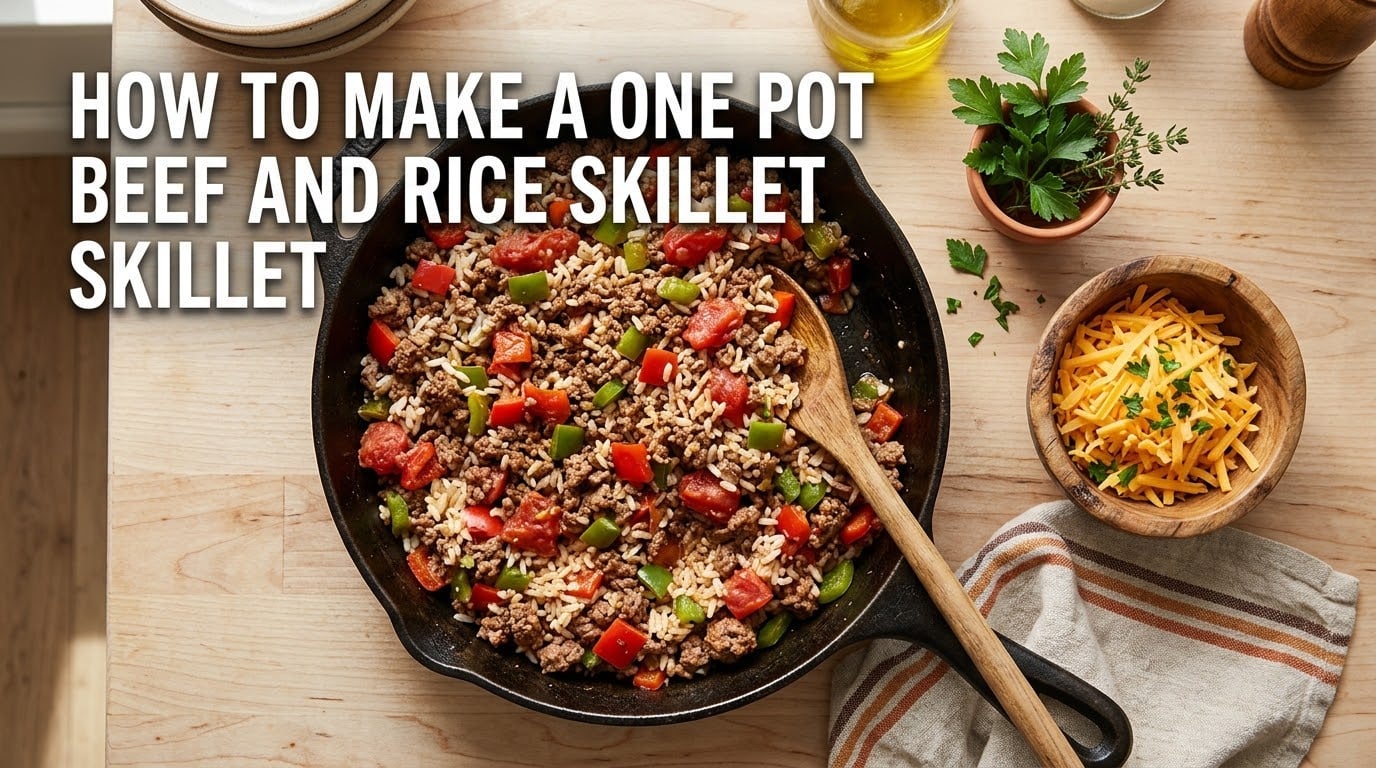
A one pot beef and rice skillet is a complete weeknight dinner made by browning seasoned ground beef, toasting raw rice in the beef fat, then simmering everything together under a tight lid with broth and tomatoes. It takes 30 to 40 minutes, uses one skillet, and produces protein, starch and vegetable in the same pan. Yes, you can cook rice and beef together, and the method below explains exactly how.
I make this on the nights when the kitchen is already a mess and nobody wants another pot to wash. There is no separate pot of rice to boil, no colander to dirty, and no timing to juggle between a stovetop burner and a saucepan. Everything cooks in a single covered skillet by absorption.
The whole thing depends on two techniques that most home cooks skip: browning the beef properly before any liquid goes in, and toasting the rice in the rendered fat before the broth arrives. Skip either one and you get grey meat sitting on top of gummy rice. Do both and the result is a skillet you can serve straight from with a salad.
Jump to the recipe if you want the numbers first. Everything else on this page explains why the numbers are what they are.
Table of Contents
- What You Need for a One Pot Beef and Rice Skillet
- How to Make a One Pot Beef and Rice Skillet: Step by Step
- Recipe Card
- Why the Rice Stays Fluffy
- Five Common Mistakes to Avoid
- Troubleshooting: What Went Wrong and How to Fix It
- Substitutions and Swaps
- Stovetop Skillet, Oven, Instant Pot, or Slow Cooker
- Make It Your Own: Four Easy Variations
- How to Cut the Sodium
- Storage, Freezing, and Reheating
- What to Serve With It
- Frequently Asked Questions
- Can I cook rice and beef together?
- What is the ratio of liquid to rice when cooking?
- What is the ratio of liquid to brown rice?
- How long should I cook ground beef and rice together?
- Why is my one pot rice mushy?
- Can I freeze a beef and rice skillet?
- What can I add to ground beef and rice to make it taste better?
- Conclusion
What You Need for a One Pot Beef and Rice Skillet
Every item below is a pantry staple or a single can. You do not need a grocery run.
Protein
- 1 pound 93% lean ground beef (80% lean works, but add a tablespoon of olive oil and expect a greasier pan)
- 1 tablespoon olive oil, only if you started with lean beef
Grain
- 1 cup long grain white rice, uncooked and rinsed
Vegetables
- 1 small yellow onion, diced
- 1 green bell pepper, diced
- 2 cloves garlic, minced
- 2 tablespoons fresh parsley, chopped (use the stems in the aromatics and the leaves for garnish)
Liquids and acid
- 1.5 cups low-sodium beef broth
- 1 can (14.5 ounces) diced tomatoes, undrained
- 1 tablespoon tomato paste
Seasonings
- 1 tablespoon Worcestershire sauce
- 2 teaspoons smoked paprika
- 1 teaspoon dried oregano
- 1/2 teaspoon chili powder
- 1 teaspoon salt, plus salt and pepper to taste
Optional finish
- 1 cup shredded cheddar or Monterey Jack
- Sour cream, pickled jalapenos, sliced green onions, or hot sauce for serving
Key Ratio: 1 cup of rice to 2 cups of liquid. For this recipe, that 2 cups comes from 1.5 cups low-sodium beef broth plus about 0.5 cup of juice drained from a 14.5 ounce can of diced tomatoes. Cook by ratio, not by eye. One cup of long grain white rice needs 2 cups of liquid every time you use the absorption method in a skillet.
Equipment. You need a 12-inch deep skillet with a tight-fitting lid, a spatula, and a fork. A thin pan is the number one reason the bottom burns while the top of the rice is still undercooked. A 9-inch skillet holds too little liquid for a 2:1 ratio. If your lid is loose, drape a layer of foil over the top and press it down; escaping steam is the number one cause of crunchy rice.
How to Make a One Pot Beef and Rice Skillet: Step by Step
Active time is about 10 minutes. The other 25 minutes are the skillet doing its job with the lid on.
- Brown the beef deeply, 5 to 6 minutes. Heat the skillet over medium-high heat until a drop of water skitters. Add the beef and press it into an even, flat layer with the back of a spatula. Leave it alone for 2 to 3 minutes so a crust forms, then break it up and continue until no pink remains and the meat is dark brown in spots. Do not drain the fat. That fat is what you are about to toast the rice in.
- Cook the aromatics in the beef fat, 4 minutes. Push the beef to the edges and add the onion and bell pepper to the bare center of the pan. Cook until the onion turns translucent and softens. Add the garlic, smoked paprika, oregano, chili powder, and salt. Stir for 30 seconds until the spices smell toasted rather than raw. This 30 seconds is the difference between a dish that tastes layered and one that tastes dusty.
- Toast the rice in the fat, 2 minutes. Stir the rice into the beef and aromatics so every grain gets coated in fat. Cook, stirring often, until the grains look slightly translucent at the edges and some have turned faintly golden. Toasting the rice does two things: it coats each grain in a thin fat barrier that slows starch release, and it begins cooking the grains before they ever meet liquid.
- Build the cooking liquid, 3 minutes. Add the tomato paste and stir it into the rice and beef. Cook for about a minute, until the paste darkens from bright red to brick and loses its raw edge. Stir in the Worcestershire sauce, then pour in the beef broth and the diced tomatoes with their juice. Scrape the bottom of the skillet as you pour; those browned bits stuck to the pan are fond, and they carry most of the flavor.
- Bring to a full boil, then cover and simmer undisturbed, 15 minutes. Stir once, level the rice into an even layer, and bring to a full boil over medium-high heat. Once it boils, drop the heat to low, cover tightly, and set the timer for 15 minutes. Do not stir. Do not lift the lid. Every peek lets steam escape, and steam is the water the rice is cooking in.
- Rest covered off the heat, 5 minutes. Take the skillet off the burner and leave the lid on for 5 full minutes. The residual heat finishes the top of the rice while moisture moves back into the center of each grain. Skipping this step is why the top layer often turns hard and dry.
- Fluff, season, and finish, 3 minutes. Remove the lid and rake through the rice with a fork, breaking up clumps and lifting from the bottom. Taste and add salt and pepper. Scatter over the parsley leaves, then add the shredded cheese if you are using it. The cheese melts against the hot grains without needing a broiler.
Serve straight from the skillet. A large spoon and a salad is a complete dinner.
Recipe Card
- Prep time: 10 minutes
- Cook time: 22 minutes
- Rest time: 5 minutes
- Total time: 37 minutes
- Yield: 4 servings
- Difficulty: Easy
- Cuisine: American, Tex-Mex inspired
- Dietary: Gluten free as written, contains dairy
Estimated nutrition per serving: roughly 520 calories, 32g protein, 46g carbohydrates, 21g fat, 5g fiber, and about 780mg sodium. These numbers are estimates from standard ingredient data, not laboratory values.
Why the Rice Stays Fluffy
Four things decide the texture of rice in a one-pot dish. None of them are complicated, and all four are easy to skip by accident.
Fat seal. Toasting the rice in beef fat before adding liquid puts a thin oil coating on each grain. Starch on the surface of a rice grain is what makes it sticky and gluey. Fat slows that release, which is why toasted rice separates and plain boiled rice clumps.
Fond recovery. Browning the beef leaves caramelized bits on the pan. When you pour in the broth and scrape, those bits dissolve into the cooking liquid. That is deglazing, and it is where most of the savory flavor comes from. Skipping it leaves flavor stuck to the skillet and the rice tastes flat.
Steam control. The liquid does not get absorbed instantly. It boils, becomes steam, and the steam cooks the rice under the lid. If the lid is loose or you lift it to check, the steam leaves and the rice dries out before the liquid is gone. That is how you get crunchy rice in the middle with wet rice at the edges.
Carryover rest. A 12-inch skillet holds heat for a while after the burner is off. The covered 5-minute rest lets that trapped heat finish the rice and lets moisture redistribute back into the grains. Fluff immediately after boiling and the top layer is still wet and sticky.
One myth worth clearing up: stirring during the simmer is not what makes rice sticky. Surface starch is. Stirring once when you add the liquid, then leaving the pan alone, is the correct method.
Five Common Mistakes to Avoid
- Draining the beef fat. Keep it. The rice toasts in it and it carries flavor into the grain. If you started with very lean beef and there is nothing in the pan, add a tablespoon of olive oil.
- Using a thin or small skillet. Under 12 inches, the liquid ratio breaks and the bottom burns before the top cooks.
- Lifting the lid while it simmers. Not once. Set a timer instead.
- Skipping the tomato paste toast. Thirty to sixty seconds in the hot pan removes the raw, tinny taste.
- Fluffing straight off the boil. The covered rest is not optional.
Troubleshooting: What Went Wrong and How to Fix It
| Problem | Likely cause | Fix |
|---|---|---|
| Rice is mushy or gummy | Too much liquid, a loose lid, or a rice blend that is not long grain | Next time use long grain white rice and measure liquid at exactly 2 cups. To rescue mushy rice now, spread it on a baking sheet and let it dry in a 350F oven for 10 minutes, fluff every few minutes. |
| Rice is crunchy in the center | Lid was loose, or liquid was added in stages over more than a few minutes | Add a half cup of hot broth, cover, and cook on low for 5 more minutes. Press a lid down with a foil seal if your lid does not fit. |
| Bottom is burnt, top is underdone | Pan too thin or heat too high under the simmer | Drop to the lowest heat the moment it boils. A cast iron or heavy stainless skillet spreads heat; a thin nonstick pan does not. If a scrape of burnt rice is stuck, lift the rest out and discard the black layer. |
| Beef tastes grey or boiled | Skillet was not hot enough, or beef was moved too early | Preheat the skillet, press the beef into a flat layer, and wait 2 to 3 minutes before breaking it up. Scrape the pan clean before the rice goes in. |
| Dish tastes bland | Skipped the spice toast or under-salted the broth | Add a teaspoon of Worcestershire sauce and a splash of the tomato juice at the end. Fresh parsley adds more than dried. Finish with a spoon of sour cream. |
| Pan is greasy | 80% lean beef, or more fat than the rice can absorb | Use 93% lean for the cleanest result, or skim excess grease from the finished dish before serving. |
Substitutions and Swaps
| Swap | Use | What to change |
|---|---|---|
| Ground turkey or chicken | A lighter version | Add 2 teaspoons Worcestershire or soy sauce to compensate for the leaner meat. Ground chicken breast goes dry; ground turkey thigh does not. |
| Bulk sausage | A richer, more seasoned bowl | Render the fat first and drain excess grease, or the rice steams in a slick instead of absorbing. |
| Chicken or vegetable broth | What you have on hand | No other change. Add half a bouillon cube if you miss the beef depth. |
| No diced tomatoes | Pantry substitution | Use 3/4 cup tomato sauce plus 1/2 cup water, or 2 tablespoons tomato paste loosened with 1.5 cups broth. |
| Different vegetables | Whatever needs using | Keep the total vegetable volume at about 2 cups. Zucchini, corn, peas, and diced carrots all work. Add frozen peas in the last 3 minutes. |
| Jasmine or basmati rice | Longer grain, nuttier flavor | No change. Both are long grain and hold up well at a 2:1 ratio. |
| Minute rice | A much faster cook | Drop to 3 cups of liquid per cup of rice and simmer only 8 minutes. Minute rice absorbs differently and will turn to paste at the standard ratio. |
| Cauliflower rice | A low-carb version | Add it after the liquid simmers for the last 5 minutes. Do not toast it, and skip the covered rest. |
Can you use brown rice in a one pot beef and rice skillet? Yes, but the 2:1 ratio does not carry over. Brown rice needs 3 cups of liquid per cup of grain, a simmer of 40 to 45 minutes instead of 15, and the lid stays on the whole time. Add the extra cup of liquid when you build the cooking liquid, keep the heat on the lowest setting so the bottom does not scorch over a long cook, and add a half cup of hot broth at the 30-minute mark if the grains still look hard. Several sources advise against brown rice in a one-pot dish because the ratio is calibrated to white. That is true for the base ratio, not for the technique. The brown rice version takes about 70 minutes end to end, which changes it from a weeknight recipe into a weekend one.
About rice cookers. A rice cooker also uses 2 cups of liquid for 1 cup of long grain white rice, and water is the usual liquid. In this skillet, broth and tomato juice replace the water, which is why the flavor is so much deeper. You can cook the rice portion in a rice cooker first and add browned beef at the end, but at that point you are making two pots, not one.
Stovetop Skillet, Oven, Instant Pot, or Slow Cooker
| Method | Time | Best for | Watch out for |
|---|---|---|---|
| Stovetop skillet | 15 minute simmer plus a 5 minute rest | Weeknight speed and the best texture control | Watch the heat after boiling; a thin pan scorches the bottom fast |
| Oven bake at 375F | 25 minutes covered, 5 minutes rest | Even cooking with no burn risk, and forgiving on a weak burner | Brown the beef and toast the rice on the stovetop first, then transfer the whole pan |
| Instant Pot | 6 minutes at high pressure, 10 minutes natural release | Hands-off cooking on a day you cannot watch the stove | Brown the beef and toast the rice before sealing, or you lose the toasted flavor. Add a cup of water if you see scorching on release. |
| Slow cooker | 3 to 4 hours on low | Meals that start before you leave the house | The long cook dries the top layer. Stir once at 2 hours and check the liquid level. |
For the oven method, keep the same ingredient quantities and the same browning and toasting steps on the stovetop. Only the simmer changes. Cover the skillet and bake at 375F for 25 minutes, then rest covered for 5 before fluffing.
Make It Your Own: Four Easy Variations
Taco rice. Swap the smoked paprika and oregano for two tablespoons of your favorite taco seasoning, add one drained can of black beans with the tomatoes, and finish with a sour cream dollop, shredded lettuce, and salsa. Kids tend to eat this version without argument.
Italian beef and rice. Skip the paprika and chili, add half a teaspoon of dried oregano and two tablespoons of marinara. Melt a half cup of mozzarella over the top after fluffing. It tastes like a skillet version of a baked rice dish.
Creamy version. After the 5-minute rest, stir in a half cup of sour cream or a quarter cup of cream cheese off the heat. The fat stays suspended in the sauce and every grain is coated. Serve this one immediately; it does not reheat as well as the plain version.
Cheesy casserole finish. Spread the finished skillet under the broiler for 2 to 3 minutes with an extra layer of cheese on top. This is the move for turning leftovers into something that looks like it took more effort than it did.
Beef and rice stir-fry path. Use the widest skillet you have, cut the bell pepper into thin strips, and add 2 tablespoons of soy sauce plus 1 tablespoon of rice vinegar in step 4. Cook over medium-high heat the whole way and cut the simmer to 12 minutes. The result is drier and more separated than the simmered version.
Stovetop stew beef. The same method works with 1 pound of cubed chuck. Sear the cubes in batches, then simmer them in the broth and tomato for 25 to 30 minutes before the rice goes in, and add the rice for the final 15 minutes. Plan on 60 to 75 minutes and expect a deeper, richer sauce.
How to Cut the Sodium
The American Heart Association recommends staying under 2,300 milligrams of sodium per day for most adults, and this dish lands near 780 milligrams per serving as written. Four swaps cut that substantially:
- Use no-salt-added diced tomatoes instead of regular. That removes about 300 milligrams per serving on its own.
- Choose low-sodium beef broth, which is roughly 40 percent lower than regular broth per cup.
- Drop the added salt in step 2 and season only at the end, after tasting. The Worcestershire sauce and the tomato paste carry plenty of saltiness.
- Use a low-sodium cheese, or skip the cheese and finish with a spoonful of Greek yogurt.
Combined, those four changes bring a serving down to roughly 400 to 450 milligrams without making the dish taste flat.
Storage, Freezing, and Reheating
Fridge. Transfer to an airtight container within 2 hours and refrigerate for up to 3 to 4 days. Rice gets stiffer as it sits, so eat it while it is young.
Freezer. Cool completely, then freeze flat in a sealed container for up to 2 to 3 months. Thaw overnight in the fridge, not on the counter. Because the dish has no dairy in the base version, it freezes and reheats cleanly.
Reheat in a pan. Add a splash of beef broth, cover, and heat on low for 5 minutes, fluffing once. This is the better method. The broth steams the rice back to soft without drying it out.
Reheat in the microwave. Cover loosely with a plate and heat in 60 second bursts, stirring between each. A splash of broth helps here too. Microwaves heat the outside of the grain faster than the center, which is exactly how reheated rice turns rubbery.
Cooking from frozen beef. You can brown ground beef straight from the freezer. Break the frozen block into the hot skillet, add a tablespoon of water, cover for 3 minutes, then uncover and let the water cook away as the beef renders. Do not add water to the actual recipe, though; it dilutes the cooking liquid and throws off your 2:1 ratio.
Zero waste. Keep a bag in the freezer for onion peels, carrot ends, celery leaves, and beef bones. Simmer it in water for an hour and strain it; that broth is better than anything from a carton and costs nothing.
What to Serve With It
This skillet is a complete meal on its own, so pair it with something that adds cold and crunch rather than more starch.
- A simple green salad with a lemon and olive oil dressing
- Garlic bread, if you want to lean into the comfort-food angle
- A dollop of sour cream, pickled jalapenos, and sliced green onions on each bowl
- Roasted broccoli or a tray of roasted peppers when you want to stretch it
Frequently Asked Questions
Can I cook rice and beef together?
Yes. Browning the beef first, toasting the rice in the rendered fat, then simmering everything covered lets the rice cook by absorption in a single skillet. Stir once when the liquid goes in, then leave the lid alone until the 15 minute timer ends.
What is the ratio of liquid to rice when cooking?
For long grain white rice cooked by the absorption method, use 2 cups of liquid for every 1 cup of uncooked rice. In this skillet that 2 cups is 1.5 cups low-sodium beef broth plus about 0.5 cup of juice from a 14.5 ounce can of diced tomatoes.
What is the ratio of liquid to brown rice?
Brown rice needs 3 cups of liquid per cup of rice, not 2. Simmer it 40 to 45 minutes on the lowest heat, keep the lid on the entire time, and add a half cup of hot broth at the 30 minute mark if the grains still look hard.
How long should I cook ground beef and rice together?
Brown the beef for 5 to 6 minutes, cook the aromatics and spices for 4, toast the rice for 2, and build the liquid for 3. Then cover and simmer for 15 minutes, followed by a 5 minute covered rest off the heat.
Why is my one pot rice mushy?
Three things cause mushy rice: too much liquid, a loose lid letting steam escape, or rice that is not long grain white. Measure the liquid at exactly 2 cups per cup of rice, press the lid down so it seals, and do not stir during the simmer.
Can I freeze a beef and rice skillet?
Yes. Cool it completely, seal it, and freeze for up to 2 to 3 months. Thaw overnight in the fridge and reheat with a splash of beef broth on low heat in a covered pan for about 5 minutes.
What can I add to ground beef and rice to make it taste better?
A tablespoon of tomato paste toasted in the pan, thirty seconds of spice blooming in hot fat, a splash of Worcestershire sauce at the end, shredded cheddar over the top, and fresh parsley all add a lot. The most common mistake is under-salting the broth rather than seasoning at the end.
Conclusion
Learning how to make a one pot beef and rice skillet teaches you two techniques that carry over to every rice dish you cook afterward: how to build real flavor with a fond, and how to control starch with fat and steam. Get those right and the ratio does the rest.
Three things are non-negotiable. Brown the beef in a hot 12-inch skillet and keep the fat. Toast the rice in that fat for two full minutes. Cover and simmer for exactly 15 minutes, then rest covered for 5 more without lifting the lid. Everything else on this page is a variation.
Cook it once this week, follow the 2:1 ratio, and tell me how the grains turned out. If they go mushy, the troubleshooting table above will tell you which of the three steps broke.