
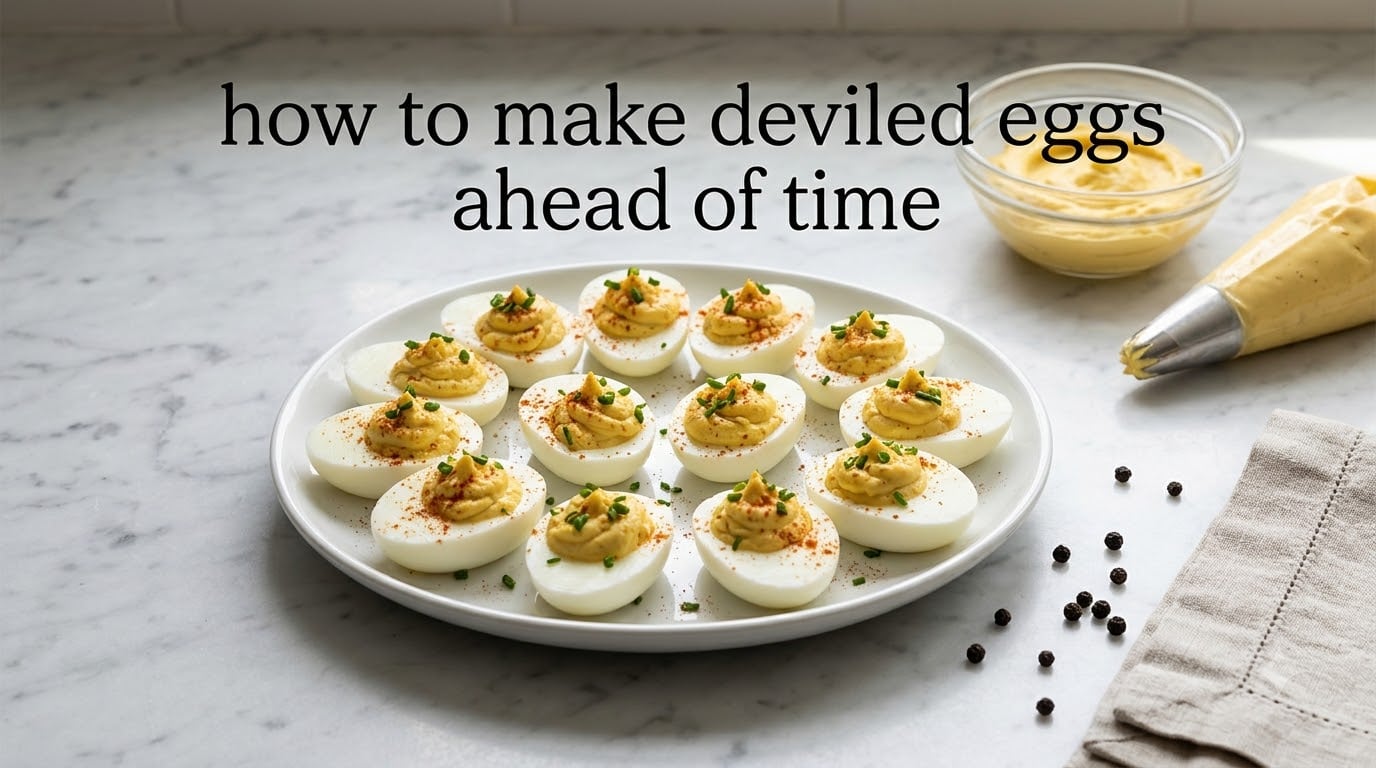
You can safely make deviled eggs up to 2 days in advance by storing the cooked egg whites and the yolk filling separately in the refrigerator, then assembling and garnishing them shortly before you serve. Boiled eggs hold 5 days peeled and refrigerated, a mayonnaise-based yolk filling holds 2 to 3 days sealed, and fully assembled deviled eggs stay at their best for about 24 hours. That split-storage method is the whole trick behind learning how to make deviled eggs ahead of time, and it means a batch of 24 no longer has to be finished the morning of a potluck.
I prep deviled eggs a day ahead for nearly every gathering we host, and the reason it works is that the two components fail in completely different ways. Egg whites sit for days without complaint, while a filled egg loses its looks within a day. Separating them lets each one get the treatment it actually needs.
Table of Contents
- How Far in Advance Can You Make Deviled Eggs?
- How to Make Deviled Eggs Ahead of Time: Step by Step
- How to Store Deviled Eggs Overnight Without Making Them Soggy
- Fix Weeping Whites and Filling That Will Not Pipe
- Common Mistakes When Making Deviled Eggs Ahead
- Food Safety, Freezing, and Transporting Make-Ahead Deviled Eggs
- Frequently Asked Questions
- How far in advance can I make deviled eggs?
- Can I make deviled eggs a day before an event?
- What is the best way to make deviled eggs ahead of time?
- Should I make deviled eggs the night before or the day of?
- How do you store deviled eggs overnight?
- Why do my deviled eggs get watery overnight?
- Can you freeze deviled eggs?
- What are common deviled egg mistakes when cooking ahead?
- Conclusion
How Far in Advance Can You Make Deviled Eggs?
Use this table to work backward from your event. The night before is the sweet spot, and 2 days out is the practical ceiling for most home kitchens.
| When | What to do | How it stores |
|---|---|---|
| 2 days out | Hard-boil the eggs, cool them in an ice bath, peel, and refrigerate whole or halved in an airtight container | Up to 5 days for boiled eggs in their shells or peeled |
| 1 day out | Halve the eggs, scoop the yolks, and mash the filling. Store whites and filling in separate containers | Filling holds 2 to 3 days sealed |
| Morning of | Let the filling soften, pipe it into the whites, and add fresh herbs, paprika, or bacon | Assembled eggs look their best within 24 hours |
One distinction matters more than the rest: fully assembled deviled eggs, meaning the filling has been piped back into the whites, are the weakest link. Past about a day, the tops of the mounds dry and crust, the whites look dull, and herbs wilt. A partially assembled batch, whites and filling in separate containers, keeps its texture and looks assembled only minutes before serving.
Another recurring question on cooking forums is whether peeled eggs should sit in water or dry in the fridge. They should go in dry, in a single layer on paper towels. Waterlogged whites turn rubbery, and standing water is what makes assembled deviled eggs weep onto the serving plate overnight.
How to Make Deviled Eggs Ahead of Time: Step by Step
Step 1: Boil and cool the eggs. Bring a pot of water to a rolling boil, lower eggs in gently, and cook large eggs for 12 to 13 minutes. Transfer them straight to an ice bath for 10 minutes so the whites set firm and the yolks stay creamy instead of rubbery.
Step 2: Peel while the eggs are still cool. Tap each end of the egg against a counter, roll it to fracture the shell all over, and peel under a thin stream of water. Eggs that have been refrigerated overnight peel far more easily than eggs peeled hours before, which is a quiet benefit of boiling two days ahead.
Step 3: Halve and separate. Slice each egg lengthwise, then lift out the yolks with a spoon and set them in a bowl. Reserve every yolk, since the whites are only edible shells at this stage.
Step 4: Make the filling. Mash the yolks with a fork until broken up, then stir in mayonnaise, a spoonful of Dijon mustard, a splash of pickle brine or vinegar, and salt and pepper. Classic quantities for 12 eggs are 6 yolks, 4 tablespoons mayonnaise, 1 teaspoon mustard, and salt to taste. Stop mixing while the filling still looks slightly loose; it firms up as it chills.
Step 5: Store the two parts separately. Lay the whites cut-side down in a single layer on paper towels inside a lidded container, with a fresh towel between layers if they stack. Press plastic wrap directly onto the surface of the filling, or spoon it into a zip-top bag and squeeze out the air. Both go in the refrigerator, and neither gets sealed airtight while still warm.
Step 6: Assemble the morning of. Take the filling out 20 to 30 minutes before serving so it softens enough to pipe. Transfer it to a piping bag or a zip-top bag with one corner snipped off, pipe into the hollows, and finish with paprika, chives, dill, or crumbled bacon.
How to Store Deviled Eggs Overnight Without Making Them Soggy
Four details keep an overnight batch in good shape. First, line the container with a single layer of paper towels and lay the whites cut-side down, since moisture collects in the hollows and any dampness in the container makes the whole egg damp. Second, cover loosely or leave the lid cracked, since a venting lid lets condensation escape rather than pool.
Third, keep the filling sealed. Plastic wrap pressed directly onto the surface blocks the drying that makes refrigerated fillings crust over, and a zip-top bag with the air squeezed out works just as well. A piping bag filled the night before is even better, because you can snip the tip and pipe straight from the bag in the morning.
Fourth, hold back anything that needs to be crisp. Fresh dill, parsley, chives, crunchy bacon, and panko or breadcrumb toppings all go on at the last minute. Bacon left in the filling overnight goes limp and greasy, and fresh herbs darken and wilt within hours of refrigeration.
Fix Weeping Whites and Filling That Will Not Pipe
If your whites still release liquid overnight, the paper towels are doing their job if you swap in dry ones before assembly. To cut the weeping at the source, blot each halved white gently with a paper towel after separating the yolks, and store them on more towel rather than plastic so condensation has somewhere to go.
Cold filling is too stiff to pipe cleanly straight from the fridge, which is the most common complaint about day-ahead deviled eggs. Set the filling out for 20 to 30 minutes, or work it back to spreadable with a teaspoon of mayonnaise. If it is still stiff, a tablespoon of pickle brine thins it quickly and adds the tang that deviled eggs usually need anyway.
When filling tops have already dried or crusted, do not scrape them. Cover the dry spots with a heavy garnish instead, such as crumbled crisp bacon, extra paprika, chopped hard-boiled egg white, or a spoonful of pimento cheese. Nobody at a potluck notices a dry patch under a garnish.
Common Mistakes When Making Deviled Eggs Ahead
- Filling the eggs the night before. This is the mistake that makes people think make-ahead deviled eggs do not work. Assembled a full day early, the filling tops dry out and the whites dull. Keep them separate until an hour before serving.
- Storing peeled eggs submerged in water. The whites absorb water and turn rubbery and bland. Refrigerate them dry on paper towels.
- Sealing a container while everything is still warm. Trapping steam in a warm container is what creates the puddle. Cool everything first, then close the lid.
- Leaving the filling uncovered. The surface dries within hours. Press plastic right onto the filling or use a sealed bag.
- Over-mixing the filling. Mayonnaise breaks down into a greasy, grainy paste with too much stirring. Mash the yolks, then fold in the wet ingredients gently.
- Garnishing too early. Herbs and crispy toppings must wait until assembly, or they wilt and soften overnight.
Boiling is also easier to get right in advance. Older eggs from the fridge peel better than fresh ones, and the ice bath step is what keeps the whites from turning rubbery, so do not skip it in a make-ahead batch.
Food Safety, Freezing, and Transporting Make-Ahead Deviled Eggs
Eggs are a perishable food, and the guidance comes down to two numbers. Keep everything refrigerated at or below 40 F, and do not leave assembled deviled eggs at room temperature for more than 2 hours, or 1 hour if the day is above 90 F. On a buffet table, set the tray over a bowl of ice rather than leaving it out.
You can freeze deviled eggs, but only the filling survives the trip well. The yolk mixture freezes fine in a sealed bag for a few months, then needs thawing in the fridge well before you plan to use it. The cooked whites do not freeze well. The texture turns spongy and rubbery once thawed, which is why a kitchen forum thread on the subject came down to freezing yolks and mixing the filling fresh on the day.
For transport to a party, skip the specialty deviled egg carrier. Nest the eggs cut-side up in a shallow dish, pack the base with shredded lettuce or a rolled towel so nothing slides, and drape plastic wrap loosely over the top so condensation cannot land on the filling. Assemble as late as you can once you arrive, and add the garnish there.
If you are prepping for weekly meal prep rather than a party, the same split method stretches five days out. Hard-boil a batch of eggs on Sunday, store the whites and filling separately, and fill and top a few each night for the week.
Frequently Asked Questions
How far in advance can I make deviled eggs?
You can make deviled eggs up to 2 days ahead by storing the whites and the yolk filling separately. Hard-boiled eggs keep up to 5 days peeled and refrigerated, and a mayonnaise-based filling keeps 2 to 3 days sealed in a bag or airtight container. Fully assembled deviled eggs stay at their best for about 24 hours.
Can I make deviled eggs a day before an event?
Yes, and the night before is the best window. Boil, cool, peel, halve, and separate the eggs, then store the whites and the mashed filling in separate containers in the fridge. Pipe the filling in and garnish a few hours before guests arrive.
What is the best way to make deviled eggs ahead of time?
Store the components separately. Keep the halved whites cut-side down on paper towels in a lidded container, and keep the filling sealed under plastic wrap pressed directly onto its surface or in a zip-top bag with the air squeezed out. Assemble and garnish the morning of the event.
Should I make deviled eggs the night before or the day of?
The night before gives you more relaxed prep time and the eggs absorb any seasoning in the filling. The day of gives you the freshest look, the brightest herbs, and the crispest garnish toppings. If you want both, prep the components the night before and do the piping and garnishing in the morning.
How do you store deviled eggs overnight?
Refrigerate them in a single layer on paper towels, cut-side down, and cover the container loosely or with a vented lid. Keep assembled eggs at or below 40 F and do not leave them at room temperature longer than 2 hours.
Why do my deviled eggs get watery overnight?
Two causes. Either the filling was not sealed and moisture got in, or condensation formed because the container was closed while still warm. Cool the eggs fully before covering, line the container with paper towels, and press plastic wrap directly onto the filling. Swap in dry towels before assembly.
Can you freeze deviled eggs?
Freeze the yolk filling rather than the whole egg. A mayonnaise-based yolk mixture freezes well in a sealed bag, then needs thawing in the fridge overnight. Cooked egg whites come out spongy and rubbery once thawed, so freeze the yolks and filling, and peel fresh eggs to serve.
What are common deviled egg mistakes when cooking ahead?
The big three are filling the eggs too early, storing peeled eggs in water, and sealing a warm container so condensation pools. Others include leaving the filling uncovered so it crusts, over-mixing the mayonnaise until it breaks, and adding herbs and bacon garnishes before serving instead of after.
Conclusion
Making deviled eggs ahead of time works when you stop treating the dish as one thing. Whites and filling are stored apart, each at its own pace, and the eggs are filled and garnished close to serving. That gives you boiled eggs up to 2 days ahead, a filling that stays creamy for 2 to 3 days, and assembled deviled eggs that still look right within 24 hours.
Pick your night before or the day of based on what matters most for your event. Prep the components the night before when the morning is busy, and reserve garnish time for the morning when presentation is the priority. Either way, keep the filling sealed, the whites dry on paper towels, and everything chilled until it is time to pipe.