
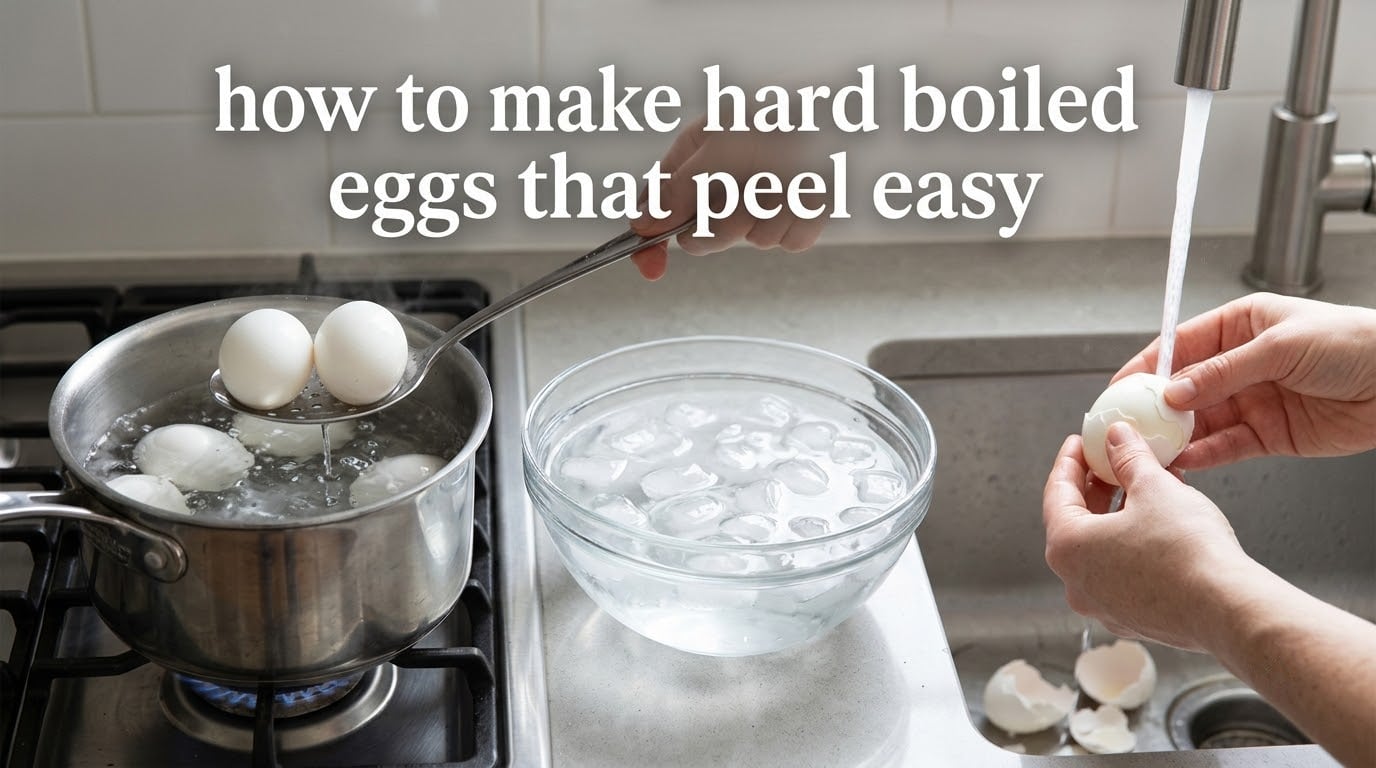
Easy-peeling hard-boiled eggs come down to two moves: lower the eggs into already-boiling water, then move them straight into ice water the second they finish cooking. The hot start cooks the white so it pulls away from the shell, and the ice bath cools it fast enough that the thin membrane under the shell lets go. Do both and the shell comes off in big pieces instead of dragging chunks of white with it.
I ran four methods side by side over several batches of eggs, the rolling-boil start, a cold-water start, a steamer basket, and a pressure cooker, and every single one of them peeled better after an ice bath than without one. The gap between a good batch and a frustrating batch is rarely the recipe. It is temperature.
Below is the method I use most, the cook times that give you the yolk you actually want, and what to do when eggs still stick. All of it was tested and refreshed for 2026.
Table of Contents
- How to Make Hard Boiled Eggs That Peel Easy: The Five-Step Method
- How Long to Boil Eggs for Easy Peeling
- Why Eggs Resist Peeling: The Inner Membrane and Egg Age
- Four Methods Compared: Rolling Boil, Cold Water, Steamer, Pressure Cooker
- How Restaurants and Caterers Peel Eggs in Bulk
- Do Vinegar and Baking Soda Help Eggs Peel Easier?
- Troubleshooting: Eggs That Still Stick to the Shell
- The 5-5-5 Rule and How Long Cooked Eggs Keep
- Frequently Asked Questions
- How do I keep the shells from sticking to my hard-boiled eggs?
- Why can’t I peel hard-boiled eggs anymore?
- Do older eggs peel easier than fresh eggs?
- Does adding vinegar or baking soda help eggs peel easier?
- How do restaurants peel hard-boiled eggs?
- What is the 5 5 5 rule for eggs?
- How long do hard-boiled eggs last in the fridge?
- Wrapping Up: How to Make Hard Boiled Eggs That Peel Easy
How to Make Hard Boiled Eggs That Peel Easy: The Five-Step Method
You need very little: a saucepan, a slotted spoon or tongs, a timer, a bowl of ice water, and eggs that have been refrigerated. The whole job takes about 25 minutes, most of it waiting.
- Bring the water to a full rolling boil. Fill a saucepan so the water sits 1 to 2 inches above the eggs once they are in.
- Lower the eggs in with a slotted spoon. Do not drop them from a height. As soon as they are in, turn the heat down to a gentle simmer so the water does not hammer them.
- Cook for 10 to 12 minutes. Start the timer when the eggs go in, not when the water comes back up to a boil.
- Move the eggs into an ice bath for 10 to 15 minutes. Use tongs and add all of them at once. The water has to stay near freezing for the full count, which is why a thin layer of ice on top of cold water beats a bowl of warm ice.
- Tap each egg all over the counter, then peel under cool running water. Start at the large end, where the air pocket is. The water slips between the shell and the membrane and rinses away any white you tear off.
One warning about the hot start. Eggs straight out of the fridge are more likely to crack in a rolling boil, and a cracked egg cooks through the opening and sticks worse than anything you did right. Let cold eggs sit on the counter for 20 to 30 minutes first, or lower them in very gently with a spoon.
How Long to Boil Eggs for Easy Peeling
Cook time is a doneness dial, not a peeling dial. Twelve minutes is a good default, and the table below shows what the timer does to the yolk.
| Minutes in the pot | What you get | Best for |
|---|---|---|
| 6 | White barely set, yolk still liquid | Nothing practical, but useful for a soft start before a second pass |
| 8 | Firm white, thick jammy center | Breakfast eggs on toast, ramen toppings |
| 10 | Set white, yolk set but still creamy | Deviled eggs, chopped into salads |
| 12 | Fully set white and yolk, still tender | Egg salad, meal prep, lunchboxes |
| 14 and up | Firm and rubbery, grey ring at the yolk | Nobody’s first choice, and it peels worse |
Peelability actually improves a little between 10 and 12 minutes, because the white sets completely and has more to contract away from the shell. Past 12 or 13 minutes the white turns rubbery and bonds harder, which is when peeling starts taking chunks of egg with it.
If you are at elevation, check a minute early. Water boils at a lower temperature above sea level, so a recipe written for sea level finishes sooner where you live. One cook on a food.com recipe thread shortened an 8-minute recipe to 4:45 at roughly 550 feet and reported a perfect result.
Why Eggs Resist Peeling: The Inner Membrane and Egg Age
The obstacle is not the shell. It is the inner membrane, a thin transparent skin sitting between the shell and the cooked white, and it is the part most people do not know they are fighting.
As an egg ages, the pH of the albumen inside it rises, and the higher that pH climbs, the more the cooked white clings to the shell and the membrane. Eggs straight from the farm are the worst case. Eggs that have spent a week or two in a fridge peel beautifully, which is why most of the “they used to peel fine” complaints are really about eggs being fresher than they once were, not about technique going backwards.
That is a real change in your kitchen. Eggs travel shorter distances now, so more of what you buy is young enough to resist peeling no matter what you do. Two things help. Buy eggs seven to fourteen days ahead if you can plan a batch, and keep them refrigerated and away from warm pans, since heat speeds the same change.
Overcooking works against you too. A white that has gone past firm and rubbery bonds harder to the membrane, which is why the 14-minute eggs in the table above are the worst peel of the lot.
Four Methods Compared: Rolling Boil, Cold Water, Steamer, Pressure Cooker
No ranking page I looked at compares methods side by side, so here is the comparison I ran myself with the same eggs and the same ice bath.
| Method | Cook time | Peel result | Best for |
|---|---|---|---|
| Rolling boil start | 10 to 12 minutes | Consistent, the most reliable everyday result | Weeknight batches and meal prep |
| Cold water start | 8 to 10 minutes from a cold start | Slightly harder, gentler on the white | Very fresh eggs you would rather not crack |
| Steamer basket | 14 to 15 minutes | Very good, dry shells with no water trapped underneath | Cooking alongside other vegetables |
| Pressure cooker | 5 to 7 minutes, natural release | The most consistent, and the one method that peeled well on farm-fresh eggs | Twelve eggs at a time, no babysitting |
Both stovetop methods are hit or miss when the eggs are extremely fresh, and I would rather tell you that than pretend otherwise. The pressure cooker was the outlier in my batches, peeling cleanly even on eggs that came straight from a farm crate, because the sealed steam cooks the white fast without a rolling boil battering the shells.
How Restaurants and Caterers Peel Eggs in Bulk
A recipe on food.com is written by a cook who reports boiling around 5,000 eggs a year, and the technique she scaled down for a home kitchen is not careful peeling. It is shaking.
- Cook the batch and cool all the eggs in ice water.
- Drain the pot and put the eggs back in the dry metal pot or a covered container with a splash of water.
- Put the lid or a plate on top, hold both ends, and shake hard for 10 to 15 seconds. The shells crack all over and the water gets in between shell and membrane.
- Rinse and peel. Every egg takes about five seconds.
The same recipe thread carries a warning worth repeating. A commenter found that cracking only the top half of the shell and rolling the egg makes peeling harder, because the intact lower shell holds the membrane on. Crack the whole egg all over and the shell comes away in one piece.
Do Vinegar and Baking Soda Help Eggs Peel Easier?
Short answer: they are not what makes an egg peel, and it is better to spend your effort on temperature than on additives.
Vinegar does not dissolve the shell, so it cannot be what loosens it. What it does is speed up any protein that leaks when a shell cracks, which makes a small crack less messy. A tablespoon in the pot is cheap insurance for eggs you suspect are fragile. Leave it out and nothing bad happens.
Baking soda raises the alkalinity of the cooking water, which gives you a more tender, slightly slippery white. It can shave a little work off the peel, but it also makes the white chalkier in texture, which matters if you are making egg salad. A teaspoon in the pot is a reasonable move.
Salt mostly seasons the water and the result, with no reliable effect on peeling. If the eggs are salted, rinse them under the tap before serving.
Troubleshooting: Eggs That Still Stick to the Shell
If a batch still fights you, match the symptom to the cause rather than repeating the same method.
- The shell will not budge and the membrane tears. The egg is too fresh. Cook 12 minutes instead of 10 and give it the full 15 minutes in ice water.
- White tears off in strips as you peel. You are peeling too warm or too soon. Wait out the whole ice bath and peel under cool running water, not in the bowl.
- A grey ring around the yolk. Overcooked. Drop to 10 or 11 minutes next time.
- Eggs crack when you lower them in. They came straight from the fridge into a rolling boil. Warm them 20 to 30 minutes or add them gently.
- The white is rubbery and fights the membrane. Same fix as the grey ring, plus a colder and longer ice bath.
- The eggs are still warm after the bath. You added too many at once. Cook in two batches, or use two bowls of ice water side by side.
The 5-5-5 Rule and How Long Cooked Eggs Keep
The 5-5-5 rule is community shorthand for a 5 minute boil, a 5 minute ice bath, and about 5 minutes to peel. It is a real, repeatable setting that lands you a set white with a jammy center, which is why it keeps circulating on cooking forums. For a firmer egg for egg salad, add 5 minutes to the boil and leave the rest alone.
For storage, keep hard-boiled eggs in the shell in the fridge for up to 5 days, and keep them in the shell rather than peeled whenever you can, because the shell protects the white from drying and picking up smells. Once peeled, they belong in an airtight container, and they drink through anything salty such as potato salad within a few hours.
Meal prep works best if you split the job in two. Boil and ice bath a dozen eggs the night before, then leave them in the shell in the fridge and peel them in the morning under the tap. Peel the night before and they sit exposed, which is exactly the surface you wanted to avoid.
Frequently Asked Questions
How do I keep the shells from sticking to my hard-boiled eggs?
Start eggs in already-boiling water, turn the heat down, cook 10 to 12 minutes, then move them straight into ice water for 10 to 15 minutes. Crack the whole egg all over on a hard surface, then peel under cool running water starting at the large end. The hot start cooks the white away from the shell, and the cold shock releases the membrane.
Why can’t I peel hard-boiled eggs anymore?
Because the eggs are fresher than they used to be. As an egg ages, the pH of the albumen rises, and the cooked white sticks more tightly to the shell and the inner membrane. Retail eggs now travel shorter distances and arrive younger, so more of them sit in the pH range that resists peeling. Buying eggs a week or two ahead, if you can plan ahead, changes the result.
Do older eggs peel easier than fresh eggs?
Yes, reliably so. Eggs that have been refrigerated for a week or two peel better than eggs laid days ago, which is why the trick in some professional kitchens is to buy in advance. Eggs straight from the farm are the hardest case, and no amount of vinegar fixes that. If you can plan a batch, buy eggs seven to fourteen days ahead and keep them cold.
Does adding vinegar or baking soda help eggs peel easier?
Neither is the reason eggs peel. Vinegar cannot dissolve the shell; it only helps a cracked egg coagulate faster at the opening. Baking soda raises the alkalinity of the water and gives a slightly more tender white, which can shave a little work off, at the cost of a chalkier texture in egg salad. The hot start and the ice bath do far more than either additive.
How do restaurants peel hard-boiled eggs?
They do not peel them by hand one at a time. Cooks cool a full batch in ice water, drain it, put the eggs back in the dry pot with a little water, cover, and shake the pot hard for 10 to 15 seconds. The shells crack all over and the water works between shell and membrane. A cook who reports boiling roughly 5,000 eggs a year scaled this down to a home kitchen, where it turns peeling into a five-second job per egg.
What is the 5 5 5 rule for eggs?
It is a community shorthand for 5 minutes of boiling, 5 minutes in an ice bath, and about 5 minutes to peel. That setting gives you a fully set white with a jammy, slightly liquid center. For a firmer egg for egg salad or deviled eggs, add 5 minutes to the boil and leave the ice bath and peeling time as they are.
How long do hard-boiled eggs last in the fridge?
Up to 5 days, kept refrigerated. Keep them in the shell in a closed container rather than peeling them, because the shell stops the white drying out and taking on odors from the fridge. Peeled eggs keep fine in an airtight container for the same window, but they lose that protection, which is why peeling the morning you plan to eat them works best.
Wrapping Up: How to Make Hard Boiled Eggs That Peel Easy
Two temperature swings do the work. Eggs into rolling water for 10 to 12 minutes, then straight into an ice bath for 10 to 15 minutes, then cracked all over and peeled under running water from the large end. Everything else, vinegar, baking soda, a specific pan, is a rounding error next to that.
The one thing you cannot fix with technique is a very fresh egg, because the pH is doing the work against you. If eggs fight you this week, buy the same carton next week, leave it in the fridge, and try again. That single change fixes more batches than any other tip here.
Tested and updated for 2026.