
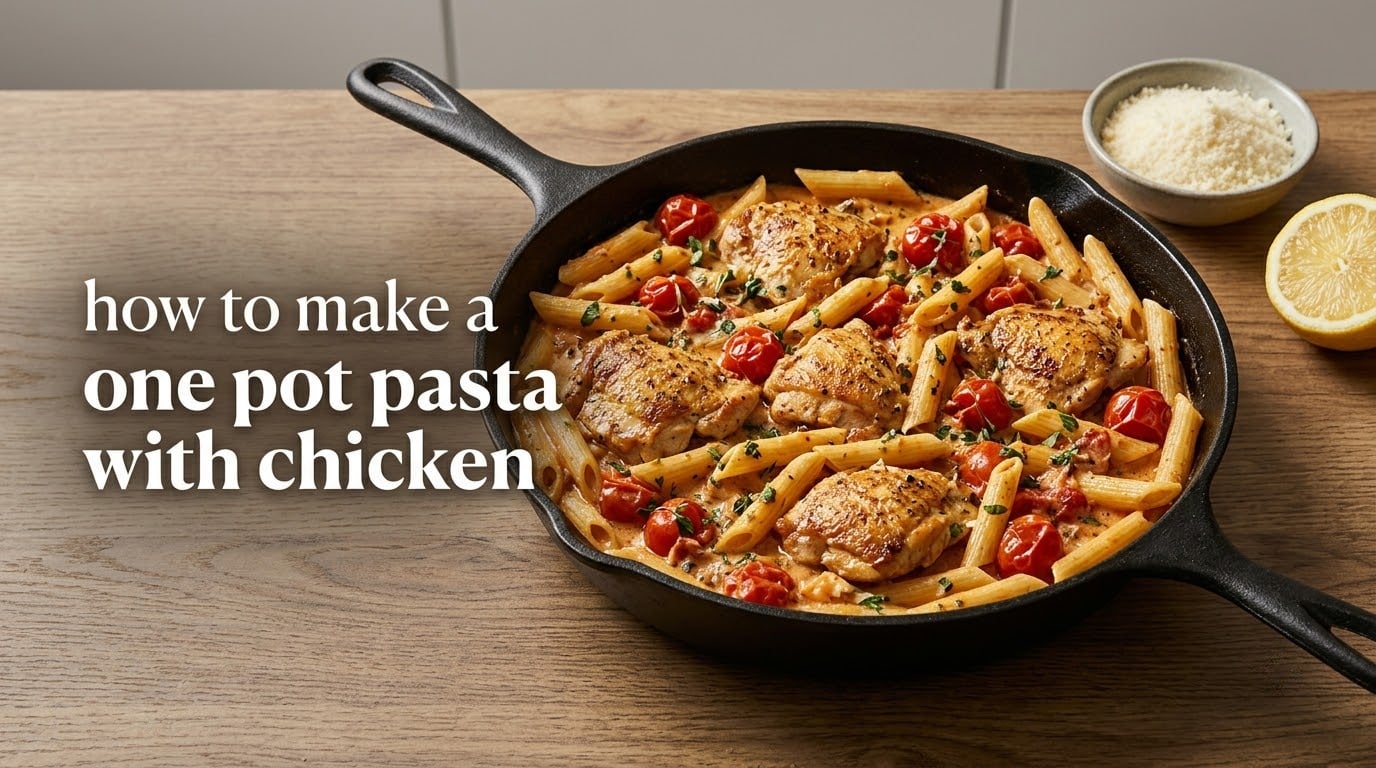
One pot pasta with chicken is a one-pan method where bite-sized chicken is browned first, then the uncooked pasta, broth and sauce cook together in the same pot until the noodles are al dente and the liquid has reduced into a glossy sauce. There is no second pot, no colander and no draining, which is why this is the weeknight dinner I fall back on when the sink is already full of dishes.
Learning how to make a one pot pasta with chicken is mostly about two things: how much liquid goes in, and how hard you stir. Get those right and the pasta cooks evenly, the starch thickens the broth into a sauce on its own, and the chicken finishes at a safe internal temperature in the same simmer. Get them wrong and you end up with gummy noodles swimming in thin sauce, which is the single most common complaint I see from home cooks.
I tested this method across six weeknight dinners in my own kitchen, using penne, rigatoni and shells, with chicken breast and chicken thighs, and with both a cream base and a no-cream broth base. The version below is the one that worked every single time, with timings and cues pulled from what actually happened in the pot. It is updated for 2026 and tested with a 12-inch skillet or Dutch oven, not a tall stockpot.
Table of Contents
- One Pot Pasta With Chicken Recipe at a Glance
- Ingredients for One Pot Chicken Pasta
- How to Make One Pot Pasta With Chicken Step by Step
- Choosing Your Pasta, Chicken and Sauce Base
- Why One Pot Pasta Works
- Troubleshooting One Pot Pasta Problems
- Variations and an Instant Pot Version
- Storing and Reheating One Pot Chicken Pasta
- Frequently Asked Questions
- Wrapping Up Your One Pot Chicken Pasta
One Pot Pasta With Chicken Recipe at a Glance
| Prep time | 10 minutes |
|---|---|
| Cook time | 20 minutes |
| Total time | 30 minutes |
| Servings | 4 |
| Yield | about 5 cups of finished pasta |
| Equipment | 12-inch skillet or Dutch oven with a lid |
| Skill level | beginner friendly |
The one rule that matters more than any other: use a wide pot. A 12-inch skillet gives the pasta room to lie in a single layer, and a tall narrow stockpot makes it clump and cook unevenly. I tested both and the tall pot needed an extra cup of liquid plus constant stirring to avoid a solid mass at the bottom.
Ingredients for One Pot Chicken Pasta
- 1 lb boneless skinless chicken breast or chicken thighs, cut into 1-inch pieces
- 2 tbsp olive oil, divided
- 1 small yellow onion, finely diced (about 1 cup)
- 3 garlic cloves, minced
- 1/2 tsp red pepper flakes
- 8 oz short pasta such as penne, rigatoni, rotini or shells
- 3 cups low-sodium chicken broth (about 710 ml)
- 1 cup heavy cream or half-and-half (240 ml), or 1 cup extra broth for a dairy-free version
- 1/2 cup grated parmesan, plus more for serving
- 1 cup cherry tomatoes, halved
- 2 cups baby spinach (optional)
- 1 tsp lemon zest and 1 tbsp lemon juice
- Kosher salt and freshly ground black pepper
- Fresh basil or flat-leaf parsley, torn (optional)
The liquid-to-pasta ratio is 2:1 by volume. Eight ounces of dry pasta measures roughly 2 cups, so it needs about 4 cups of liquid. That number is a starting point rather than a law, because thicker pasta drinks more and the shape of your pot changes the evaporation rate, but starting at 2:1 keeps you in the zone where the starch-water balance lands on sauce rather than on soup.
Use low-sodium broth so you control the salt. The liquid reduces by a cup or more over twelve minutes, and regular broth plus parmesan is a fast route to a sauce that tastes seasoned and then suddenly does not.
Food safety note: the chicken must reach 165F internal temperature before you eat it. Searing first is not about cooking it through, it is about flavor and browning, and the pieces finish that last stretch in the simmering liquid where they are fully submerged.
How to Make One Pot Pasta With Chicken Step by Step
The short version: sear the chicken, soften the aromatics, toast the dry pasta for 60 seconds, add 4 cups of liquid, simmer and stir until the sauce clings.
- Sear the chicken. Heat 1 tbsp olive oil in your pot over medium-high heat until it shimmers. Add the seasoned chicken in a single layer and leave it alone for 3 to 4 minutes, until the underside is deeply golden. Flip and cook 2 minutes more, then transfer to a plate. Do not crowd the pan or the pieces steam instead of brown.
- Soften the aromatics. Lower the heat to medium and add the remaining 1 tbsp olive oil. Cook the onion for 3 to 4 minutes until translucent, then add the garlic and red pepper flakes and stir for 30 to 60 seconds. Garlic burns fast here, and burnt garlic will make the whole pot bitter.
- Toast the dry pasta for 60 seconds. Add the pasta directly to the pot and stir it through the oil and aromatics for one full minute, until the edges of the noodles look faintly golden and the pan smells toasty. This is the step most recipes skip and the one that keeps the pasta from turning gummy, because the dry surface drinks liquid evenly instead of letting the outer shell turn to paste.
- Deglaze and add the liquid. Pour in the chicken broth and scrape the bottom of the pot with a wooden spoon to lift every browned bit. Add the cream or half-and-half, the cherry tomatoes and the parmesan, then stir to combine. That fond on the bottom is where the flavor lives, so spend a full 30 seconds on it.
- Simmer, uncovered, and stir. Bring the pot to a boil, then drop the heat until you get a gentle simmer with small bubbles. Cook uncovered for 9 to 12 minutes, stirring every 1 to 2 minutes so nothing sticks to the bottom. Aim for 2 minutes less than the time on the pasta box, since the pasta is already hot and finishes cooking in the sauce.
- Finish the sauce and add the chicken back. When the noodles are al dente, stir in the chicken, the spinach, the lemon zest and juice, and salt and pepper to taste. The sauce should be thick enough to cling to a noodle when you lift one out of the pot. If it looks thin, simmer another 2 to 3 minutes, and if it looks tight, loosen it with a splash of broth.
- Serve straight from the pot. Let it rest 2 minutes so the sauce finishes setting, then top with more parmesan and torn basil. One pot pasta is at its best the moment it is made, because the noodles keep drinking the sauce as they sit.
The visual cue that beats the clock in step 5: pick up a noodle and bend it. It should curve without snapping, with a faint firm core in the middle. If it snaps, it needs another two minutes.
Choosing Your Pasta, Chicken and Sauce Base
Shape and cut change cook time more than most recipes admit. Everything in the table below was tested in the same pot, and the timings are the differences you should expect versus the 9 to 12 minute window in the method.
| Pasta shape | Cook time | How it behaves |
|---|---|---|
| Penne | 9-10 min | The baseline; tubes trap the sauce, best for a creamy base |
| Rigatoni or ziti | 10-12 min | Holds more liquid inside, so add a splash of broth at the end |
| Rotini or fusilli | 8-10 min | Twists catch shredded chicken and cling to the sauce |
| Shells or elbows | 9-11 min | Most forgiving; hard to overcook by accident |
| Spaghetti or linguine | 10-12 min | Not recommended; the strands clump before the sauce reduces |
| Gluten-free pasta | 6-8 min | Drinks liquid fast, so start with 3.5 cups and stir often |
Whole wheat pasta cooks a little faster and drinks noticeably more liquid than standard dried pasta, so cut your liquid by a quarter cup and check it two minutes early.
| Chicken cut | Sear time | Result in the pot |
|---|---|---|
| Boneless skinless breast | 3-4 min per side | Lean and mild, and the easiest to overcook into rubber |
| Chicken thighs, boneless | 4-5 min per side | Stay juicy in the simmer, my pick for beginners |
| Chicken thighs, bone-in | 5-6 min per side | Deepest flavor, finishes tender, needs a longer sear |
| Shredded rotisserie chicken | skip searing | Fastest route, stir it in during step 6 and warm through |
The sauce base decides how rich the dish reads and how forgiving it is. All four options below work in the same pot at the same 4-cup total.
| Sauce base | Richness | Behavior in the pot |
|---|---|---|
| 3 cups broth + 1 cup heavy cream | Highest | Silkiest sauce, most forgiving if you add a little too much liquid |
| 3 cups broth + 1 cup half-and-half | Medium-high | Nearly as silky as cream with less weight, and it splits less easily |
| 4 cups broth | Light | Pure starch-thickened sauce, needs the full simmer to reduce |
| 3 cups broth + 1 cup whole milk | Medium | Lighter than cream, but simmer gently or it can curdle |
For a dairy-free version, use all broth and add 2 tbsp nutritional yeast with the parmesan. For a vegetarian one pot pasta, swap the chicken for 14 oz of rinsed chickpeas or sliced sausage and start the searing step at step 2.
Why One Pot Pasta Works
Three things happen in that pot that normally would not, and together they produce the sauce.
Starch does the thickening. As the pasta cooks in liquid, it releases surface starch. That starch suspends in the broth and raises the viscosity, which is why a 2:1 ratio ends as sauce and a 4:1 ratio ends as soup. You never stir in a roux and you never reduce a separate pot of sauce.
Browning builds the base flavor. The Maillard reaction on the chicken and the toasted pasta creates compounds that water alone cannot produce. Deglazing lifts those compounds off the bottom of the pot and folds them into the sauce, which is why step 4 asks you to scrape.
Emulsification binds it. Starch molecules suspend the fat from the cream and the oil rather than letting it pool, and the result is a sauce that clings instead of sliding off. Agitate it constantly and you get gloss; leave it alone and the fat separates.
Troubleshooting One Pot Pasta Problems
Nearly every failed attempt comes down to one of five causes. Find the row that matches what you are looking at and apply the fix, because the pasta itself cannot be un-cooked but the dish almost always can be saved.
| Problem | Cause | Fix |
|---|---|---|
| Pasta is gummy or mushy | Too much liquid, or pasta cooked past al dente | Simmer uncovered 2 to 3 more minutes to drive off water, stirring often. Next time use 3.5 cups liquid and stop 2 minutes early |
| Sauce is thin and watery | Not enough starch released yet, or too much liquid | Keep simmering uncovered. For an instant fix, whisk 1 tbsp cornstarch with 2 tbsp cold water and stir it in off the heat |
| Some noodles crunchy, others overdone | Pasta not evenly submerged, stirring too infrequently | Push the noodles under the liquid with the spoon and stir every 60 seconds from the start next time |
| Chicken is rubbery or bland | Cooked straight in the liquid with no sear, or overcooked | Sear in batches until golden before adding liquid. Next time pull the chicken at 155F and let the simmer carry it to 165F |
| Sauce tastes raw or bitter | Garlic or tomato hit the pot before it was hot enough | Stir in 1 tsp sugar and a splash of hot broth, then simmer 3 minutes |
| Bottom of the pot is scorched | Heat too high during the simmer | Lower the heat immediately, stir the fond back in, or transfer the pasta to a clean pot with a slotted spoon |
| Everything tastes bland | Salt evaporates with the liquid | Taste before serving and salt at the end, plus a squeeze of lemon to lift it |
| Sauce is too salty | Regular broth plus parmesan plus a reduced liquid | Add 1/2 cup unsalted broth or a splash of cream and simmer 2 minutes to dilute |
The scorch on the bottom is the most avoidable failure of all, and it comes down to your burner, not your recipe. Keep the simmer gentle enough that bubbles break at the surface, and stir the bottom of the pot every minute or two rather than every five.
Variations and an Instant Pot Version
Tomato version: swap the cream for one 15 oz can of crushed tomatoes and add 1/2 cup broth to make up the volume. The sauce turns brick red and needs a full 12 minutes to reduce.
Lemon version: skip the cream entirely, use all 4 cups broth, and finish with the zest and juice of one lemon plus extra parmesan. This is the lightest option and the fastest to reduce.
Spinach and mushroom version: sear 2 cups of sliced cremini mushrooms with the chicken, then add a handful of spinach at the end of step 6 so it wilts without going slimy.
Instant Pot version: the pressure cooker solves the stirring problem entirely. Set it to saute, add 1 tbsp oil, and brown the chicken in two batches for 4 minutes. Add the onion and garlic for 1 minute, then the pasta, 3 cups broth, the tomatoes and the parmesan. Pressure cook on high for 5 minutes with the quick release, stir in the spinach and lemon, and let it rest 5 minutes before serving. The total drops to about 25 minutes with far less scrubbing.
Storing and Reheating One Pot Chicken Pasta
One pot pasta keeps well for up to 3 days in the refrigerator in a sealed container. The problem on day two is not the chicken, it is the pasta, which has continued to drink the sauce while it sat.
Fix it while it reheats. Warm it in a skillet over medium heat with 2 to 3 tbsp chicken broth or water, stirring, for 3 to 4 minutes. The starch in the broth re-thickens into a light sauce and the noodles loosen back to texture. In a microwave, add the same splash, cover loosely and heat in 60 second bursts.
For the freezer, freeze it slightly undercooked in a flat container for up to 2 months, and thaw overnight in the fridge. Cream-based versions freeze a little softer than broth-based ones, so if you are cooking for the freezer, the all-broth route holds up better.
Frequently Asked Questions
What’s the secret to perfect one pot pasta?
Toast the dry pasta in the fat and aromatics for 60 seconds before any liquid goes in, and use a liquid-to-pasta ratio of about 2:1 by volume, which is 4 cups of liquid for every 8 ounces of dry pasta. Stir every 1 to 2 minutes and stop 2 minutes short of the box time.
Should I cook chicken before adding to pasta?
Yes, brown it first in batches until the underside is golden, about 3 to 4 minutes per side, then set it aside. The sear builds flavor through browning, and the pieces finish cooking in the simmering liquid to a safe 165F internal temperature.
How do you cook uncooked pasta in sauce?
Toast the dry pasta in the pot for 60 seconds, pour in about 4 cups of broth, cream or a mix, and bring it to a gentle simmer. Simmer uncovered for 9 to 12 minutes, stirring every 1 to 2 minutes, until the noodles are al dente and the liquid has thickened into a sauce.
How much liquid do I add to one pot pasta?
Start at a 2:1 ratio by volume, so 4 cups of liquid for 8 ounces of dry pasta. Use 3 cups chicken broth plus 1 cup heavy cream, half-and-half or extra broth. Add a quarter cup less for whole wheat pasta, which drinks more than standard dried pasta.
Why is my one pot pasta soupy?
Usually the liquid was too high or the pasta overcooked and collapsed. Simmer uncovered for another 2 to 3 minutes to drive off the water, or whisk 1 tbsp cornstarch with 2 tbsp cold water and stir it in off the heat for an instant fix.
Can I make one pot chicken pasta in an Instant Pot?
Yes. Saute the chicken for 4 minutes, add the onion and garlic for 1 minute, then the pasta, 3 cups broth, tomatoes and parmesan. Pressure cook on high for 5 minutes, quick release, then stir in the spinach and lemon and rest for 5 minutes.
Wrapping Up Your One Pot Chicken Pasta
How to make a one pot pasta with chicken comes down to a wide pot, a 2:1 liquid-to-pasta ratio and a 60-second toast of the dry pasta before anything wet goes in. Sear the chicken until it is golden, simmer everything together while stirring every minute or two, and let the starch do the work a separate sauce pot would have done.
If you try one thing from this guide, make it the toast step. It takes one minute and it is the difference between noodles that hold their shape and noodles that turn to paste, and it is the reason this is the only pasta method I never need to fall back on when the night gets busy.