
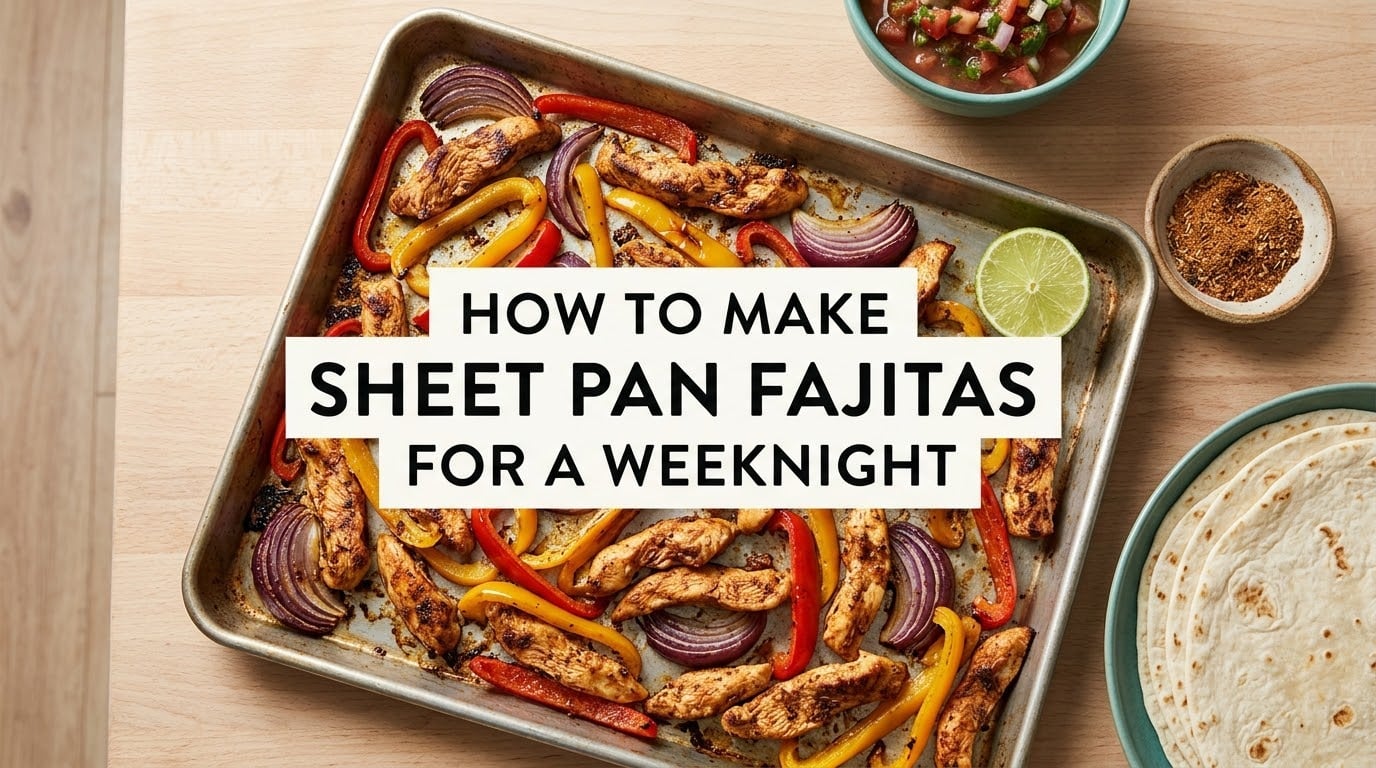
Sheet pan fajitas cook on one rimmed half sheet pan at 425 F for 15 to 20 minutes. You toss sliced chicken, bell peppers, red onion, olive oil and fajita seasoning together, spread them in one uncrowded layer, and roast until the edges caramelize. A squeeze of lime at the end finishes it.
I make this on the nights when the stove is already occupied. There is no stirring, no separate skillet of peppers, and only one pan to wash. Prep takes 10 to 15 minutes, the oven handles the rest, and dinner is on the table in 25 to 35 minutes.
Sheet pan fajitas are a one-pan Tex-Mex dinner built on dry heat. A preheated hot oven plus a single uncrowded layer of food is what turns peppers and onion caramelized instead of merely cooked, and that one detail decides whether the pan is great or disappointing.
Below is the method I use, followed by the diagnostics I wish I had the first few times I made it. The troubleshooting sections matter as much as the recipe, because sogginess and dryness are the two failure modes people hit most.
Table of Contents
- What You Need for Sheet Pan Fajitas
- Homemade Fajita Seasoning
- How to Make Sheet Pan Fajitas
- Temperature and Time by Protein
- Parchment, Silicone Mat, Foil, or Bare Pan
- Bake vs Broil: When to Use the Broiler
- Why Sheet Pan Fajitas Come Out Soggy
- Why Chicken Fajitas Go Dry and How to Keep Them Juicy
- Symptom-to-Fix Troubleshooting
- Substitutions for Protein, Vegetables, Seasoning, and Tortillas
- Make-Ahead, Storage, Freezing, and Reheating
- Serving Ideas and Ways to Use Leftovers
- Sheet Pan Fajitas Recipe Card
- Frequently Asked Questions
- Conclusion
What You Need for Sheet Pan Fajitas
Everything lands on one pan, so quantities stay small. This list serves four people as a main with tortillas and toppings.
Protein
- 1 to 1.5 pounds boneless skinless chicken breast or thigh, sliced 1/2 inch thick
- Flank steak, skirt steak, or sirloin also work, sliced 1/4 inch thick against the grain
Vegetables
- 2 bell peppers, any color, sliced into strips
- 1 red onion, cut into wedges or strips
- Optional: 1 jalapeno, sliced, and 1 zucchini, cut into half-moons
Seasoning
- 2 tablespoons homemade fajita seasoning (recipe below), or one 1.5 ounce packet
- 1 teaspoon sea salt and 1/2 teaspoon black pepper, if your blend is not already salted
Fat and acid
- 2 tablespoons olive oil or avocado oil
- 1 lime, cut into wedges, plus 1 tablespoon juice for finishing
For serving
- Eight small flour or corn tortillas, warmed
- Sour cream, guacamole, pico de gallo, salsa, shredded cheese, fresh cilantro, and avocado slices
Homemade Fajita Seasoning
A homemade blend costs almost nothing and tastes brighter than the packets, which lean heavily on salt and starch. Stir these together and keep the jar in the pantry.
- 2 tablespoons chili powder
- 2 teaspoons ground cumin
- 2 teaspoons smoked paprika
- 1 teaspoon garlic powder
- 1 teaspoon onion powder
- 1 teaspoon dried oregano
- 1/2 teaspoon cayenne pepper
- 1 teaspoon sea salt
Use two tablespoons of that blend for a pan serving four. A store-bought fajita packet works in the same amount, and plain taco seasoning is a close stand-in. One reader on a competitor recipe page made this with taco seasoning and lemon juice instead of lime, and reported it worked, which tells you how forgiving the seasoning step is.
How to Make Sheet Pan Fajitas
- Heat the oven and the pan. Set a rimmed half sheet pan in the oven and preheat to 425 F. A cold pan starts the food slowly, which is the first step toward steaming. This takes about 10 minutes of oven time and runs while you prep.
- Slice everything to the same thickness. Cut the chicken to 1/2 inch, the peppers to 1/2 inch strips, and the onion to 1/4 inch wedges. Mismatched thicknesses are why some pieces char while others stay raw. Doneness cue: every piece should look like it will take the same minute.
- Toss with oil and seasoning. Combine the protein, peppers, onion, oil, fajita seasoning, salt and pepper in a large bowl and toss with your hands until every surface is coated and lightly glistening.
- Spread in one layer. Use a hot, oiled pan and spread the food out so no pieces touch or overlap. Use two pans rather than crowding one. Doneness cue: you should see bare metal between the pieces.
- Roast, then finish with lime. Roast at 425 F for 15 to 20 minutes, then squeeze lime juice over the pan and serve with warm tortillas. Doneness cue: the chicken reaches 165 F inside, the vegetables are tender with browned edges, and a thick piece is no longer pink.
If your oven runs cool, or your pieces are thicker than half an inch, give it 20 to 25 minutes and check with a thermometer rather than the clock.
Temperature and Time by Protein
All of these cook at 425 F. The only variables are slice thickness and cook time, and the thermometer, not the timer, is the final word.
- Chicken breast, 1/2 inch slices: 15 to 20 minutes, pull at 165 F internal temperature
- Chicken thighs, 1/2 inch slices: 20 to 25 minutes, pull at 165 F
- Flank, skirt, or sirloin steak, 1/4 inch slices: 15 to 18 minutes, pull at 145 F for medium-rare, 160 F for medium
- Shrimp, peeled and deveined: 8 to 10 minutes, pull when opaque and curled, about 145 F
- Portobello mushrooms, 1/2 inch slices: 18 to 20 minutes, pull when browned and tender
Shrimp cooks roughly 5 to 7 minutes faster than chicken, so on a mixed pan the shrimp goes on later or the chicken comes out dry.
Parchment, Silicone Mat, Foil, or Bare Pan
You do not need parchment paper, and a bare oiled pan browns best. Here is how the four options compare.
- Bare pan with oil: Best browning, since the food touches hot metal directly. Watch for sticking, especially on an older pan with a worn surface.
- Aluminum foil: Browns nearly as well as a bare pan, and it is the answer for a scratched or non-stick-worn sheet pan. Fold the edges up to form a rim so rendered liquid has somewhere to go.
- Parchment paper: Prevents sticking and makes cleanup a matter of throwing the sheet away, but it insulates the food slightly, so edges brown less.
- Silicone baking mat: The easiest cleanup, the poorest browning. Use it when the pan is heavily worn and sticking is the bigger problem.
A flat, rimless cookie sheet is not a good substitute. Fajitas release liquid as they cook, and a rimmed pan keeps that liquid away from the food so it roasts instead of simmers.
Bake vs Broil: When to Use the Broiler
Bake is the default and it is what cooks the protein safely. Broil is a finishing step only, and it never replaces the full cook time. Pull the pan 2 to 3 minutes early, switch the oven to broil, and watch it for 2 to 3 minutes until the edges char slightly. Moving the pan out of the oven and back in takes nearly as long, so broil from the start and you are watching the food instead of walking away.
Why Sheet Pan Fajitas Come Out Soggy
This is the most common complaint about the dish, and a long-running r/Cooking thread titled around wet sheet pan fajitas shows it is not a one-off. Sogginess is a physics problem: trapped steam has nowhere to go, so the food cooks in its own moisture and the browning never happens.
- Spread in a single layer. No pieces touching or overlapping. If they overlap, use a second pan. This is the fix that matters most.
- Use a hot, preheated pan. A pan straight from the fridge or a cold oven gives the food time to release water before the surface gets hot enough to sear.
- Cook at 425 F, not 350 F. A hotter oven drives moisture off quickly. The extra 25 degrees is the difference between roasted and steamed.
- Dry the vegetables first. Pat peppers and onion dry, and let the chicken sit on a towel for 10 minutes after slicing. Surface water has to evaporate before browning can start.
- Do not cover, and do not add sauce early. Skip the foil tent and hold the salsa, sour cream and any wet sauce until serving.
If liquid pools in the pan at the end, drain it before serving. A dry sheet of fajitas is the whole point.
Why Chicken Fajitas Go Dry and How to Keep Them Juicy
Dry chicken is a thickness and timing problem, not a temperature problem. Recipes across the search results range from 15 to 30 minutes, and guessing in the middle of that range is how people overshoot.
- Cut to a uniform 1/2 inch. Uneven pieces are the reason the same pan has both rubbery and charred chicken.
- Coat the chicken in oil before the seasoning. Oil on the surface slows moisture loss in a hot oven.
- Give the pan space. Crowding drops the pan temperature, extends the cook, and dries the meat.
- Use the chicken as the doneness cue, not the peppers. The vegetables can look right while the chicken is still tough, and wait for the opposite and you have dry chicken.
- Pull at 165 F. Take the pan out the moment the thickest piece reads 165 F with an instant-read thermometer.
- Rest 3 minutes, then add lime off the heat. Resting lets the juices redistribute, and the acid added at the end seasons without drying the surface.
One reader described dry fajitas after 15 minutes on a cooking forum, and the pattern in that thread matches: uneven cuts plus a clock instead of a thermometer.
Symptom-to-Fix Troubleshooting
Match what came out of the oven to the fix.
- Pale and wet: The pan was crowded or the oven was cool. Spread to a single layer next time and verify the oven actually reaches 425 F.
- Dry and tough: Overcooked. Check thickness, and pull at 165 F for chicken rather than cooking to a fixed time.
- Some pieces raw: Mismatched cut sizes. Slice the protein, peppers and onion to the same thickness and spread the small pieces away from the thick ones.
- Tastes flat: Seasoning went on before the pan was hot, or the lime was added too early. Season again after roasting, and finish with fresh lime and cilantro at the table.
- Sticking to the pan: Dry pan or dry vegetables. Use a preheated oiled pan, pat produce dry, and switch to foil for an older sheet pan.
Substitutions for Protein, Vegetables, Seasoning, and Tortillas
Protein. Skirt steak, sirloin, and New York strip all work, sliced 1/4 inch against the grain. Freeze the steak 15 minutes before slicing for a cleaner cut. Pork tenderloin or chops can share a pan with chicken, and one reader did exactly that and reported it was delicious.
Vegetables. Zucchini and mushrooms stand in for bell peppers when someone at the table will not eat them, which was a real question from readers. Corn and summer squash also work, added partway through so they do not overcook. Mushrooms release water, so give them a head start in the pan or add them after the peppers.
Seasoning. One packet of fajita seasoning, or taco seasoning with a small amount of low-sodium soy sauce, both work. One reader used an El Paso packet with a little soy and it landed well.
Tortillas. Flour tortillas are soft and fold easily for loaded fajitas. Corn tortillas are the traditional choice, and gluten-free wraps exist for anyone avoiding wheat. Warm them directly over a gas flame or in a dry skillet for a few seconds.
Vessel. A cast iron skillet works with the same seasoning and the same heat. The technique is the point, not the pan.
Make-Ahead, Storage, Freezing, and Reheating
You can prep this in the morning and bake at night. Slice the protein, cut the vegetables, and mix the seasoning, then keep each component separate in the fridge and combine right before the pan goes in. Do not toss and refrigerate the raw mixture, and do not oil the pan until you are about to bake, since a wet mixture sitting on a greased surface goes slick and gray.
Cooked fajitas keep 3 to 4 days in an airtight container in the fridge. Freeze them in a zip bag for up to 3 months, laid flat so they freeze as one piece. Thaw in the fridge overnight rather than in the pan.
Reheat in a hot skillet with a splash of oil for 3 to 4 minutes, or spread on a sheet pan under the broiler for 2 to 3 minutes. A microwave works, but the peppers turn soft rather than browned.
Serving Ideas and Ways to Use Leftovers
Set out the toppings in bowls and let everyone build. Sour cream, guacamole, pico de gallo, salsa, shredded cheese, sliced avocado, fresh cilantro, and lime wedges cover everything from mild to hot. One reader ate hers over cauliflower rice while her husband used tortillas, so splitting the base is an easy way to serve one pan to different preferences.
Cook once and eat twice. The next day, fold the leftovers into quesadillas in a skillet, stuff them into wraps with rice and beans, or build bowls over rice or cauliflower rice with pickled onion and salsa. Sheet pan fajita nachos work too: chips on a tray, fajitas on top, cheese until it melts.
Sheet Pan Fajitas Recipe Card
Prep time: 10 to 15 minutes
Cook time: 15 to 20 minutes
Total time: 25 to 35 minutes
Yield: 4 servings
Ingredients
- 1.5 pounds boneless skinless chicken breast or thigh, sliced 1/2 inch thick
- 2 bell peppers, sliced into 1/2 inch strips
- 1 red onion, cut into 1/4 inch wedges
- 2 tablespoons olive oil or avocado oil
- 2 tablespoons fajita seasoning
- 1 teaspoon sea salt and 1/2 teaspoon black pepper
- 1 lime, in wedges plus juice for finishing
- 8 small flour or corn tortillas, warmed, for serving
Instructions
- Preheat the oven to 425 F with a rimmed half sheet pan inside.
- Slice the chicken, peppers and onion to even thicknesses.
- Toss everything with the oil, fajita seasoning, salt and pepper.
- Spread in a single uncrowded layer on the hot pan.
- Roast 15 to 20 minutes until the chicken hits 165 F and the edges brown.
- Squeeze lime over the pan and serve with warm tortillas and toppings.
This recipe was tested and updated for 2026. Scaling it is simple: use a second pan rather than doubling the pile on one, and the timing stays the same.
Frequently Asked Questions
How long does it take to make sheet pan fajitas?
Prep takes 10 to 15 minutes and roasting takes 15 to 20 minutes, so you are eating in 25 to 35 minutes start to finish. The oven does the work, so most of that is hands-off.
What temperature and how long do you bake sheet pan chicken fajitas?
Bake at 425 F for 15 to 20 minutes for 1/2 inch slices of chicken breast. Pull the pan when the thickest piece reads 165 F on an instant-read thermometer, since oven temperature and slice thickness vary.
How do you keep sheet pan fajitas from getting soggy?
Spread the food in a single layer with no pieces touching, use a pan that is already hot, cook at 425 F rather than lower, pat the vegetables dry before seasoning, and do not cover the pan or add wet sauce until serving.
Should I use parchment paper for sheet pan fajitas?
You do not need it. A bare oiled pan browns best, and foil is the next best option for a worn sheet pan. Parchment prevents sticking and simplifies cleanup, but it insulates the food slightly and gives you less browning on the edges.
Is it better to bake or broil fajitas?
Bake is the default and it cooks the protein safely. Broil is a finish only: pull the pan 2 to 3 minutes early, broil for 2 to 3 minutes, and watch closely until the edges char slightly.
Why is my chicken dry in the oven?
Uneven thickness, a crowded pan, and cooking to a fixed time instead of a temperature. Cut the chicken to a uniform 1/2 inch, coat it in oil, give it pan space, and pull it at 165 F rather than waiting for the clock.
Conclusion
How to make sheet pan fajitas comes down to four things: 425 F, a single uncrowded layer, even 1/2 inch cuts, and a thermometer instead of a timer. Follow those and the pan is ready in 25 to 35 minutes with caramelized edges and chicken that stays juicy.
Start tonight with the basic chicken version, then use the temperature list to swap in steak, shrimp, or mushrooms once you trust the timing. Keep the troubleshooting list nearby for the night the pan comes out pale.