
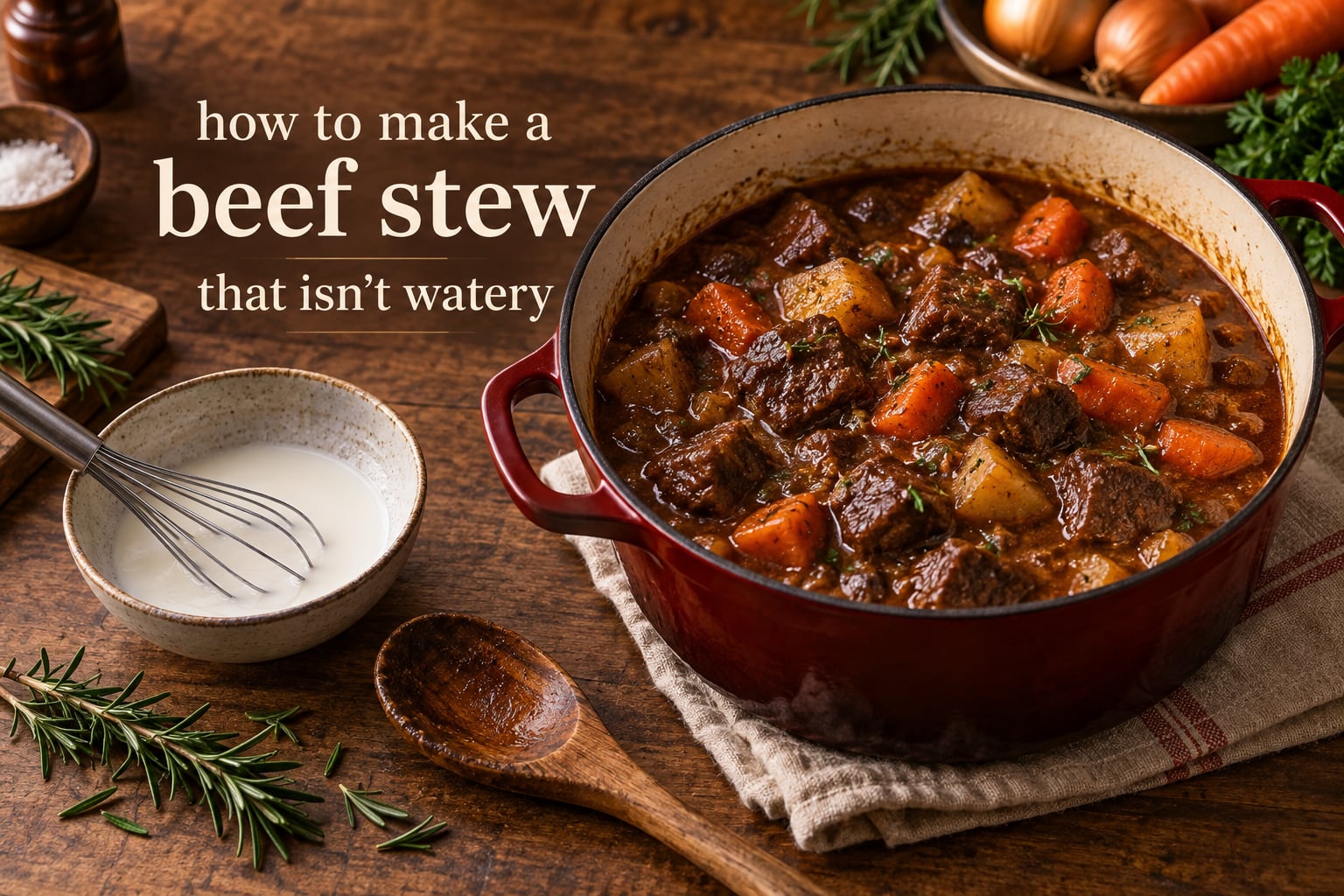
A watery beef stew is one where the liquid never reduced or thickened enough to coat the meat, and that almost always comes down to two things: more liquid went into the pot than the cooking time could boil off, and nothing was used to thicken what remained. If you know how to make a beef stew that isn’t watery, the whole fix fits in one line: control the liquid going in, then thicken what’s left.
The short version: use about 1½ cups (360 ml) of stock per pound of beef, just enough to barely come partway up the meat. Simmer it gently with the lid off so water can escape as steam, add the root vegetables late so their starch does not cloud the broth, and finish with a cornstarch slurry whisked in cold liquid.
I’ve cooked this more times than I care to count, and every bad batch traced back to the same two places: too much stock, or the lid on. Once you control both, thickness stops being a coin flip.
Table of Contents
- Why beef stew goes watery: four mistakes
- How much liquid to use: the ratio rule
- Does stew thicken with the lid on or off?
- How to thicken beef stew that is already too thin
- Cornstarch vs. flour vs. reduction: thickener comparison
- A thick beef stew recipe with the technique built in
- Too thick, or thin again tomorrow
- Frequently Asked Questions
- Conclusion
Why beef stew goes watery: four mistakes
Thin stew is almost never a mystery. It is one of these four things, and often the first two together.
- Too much liquid going in. This is the most cited cause in the cooking forums I read. A beginner on r/cookingforbeginners put 2.5 cups of water on 1 lb of beef and called it soupy. The same thread’s fix was the right one: enough to cover the meat about three-quarters of the way, not all the way.
- Lid on, or heat too high. A covered pot is a closed system. Steam condenses on the lid and drips straight back in, so nothing escapes. Boiling hard makes it worse by splashing liquid up the sides and boiling it away faster than you can control.
- Every vegetable added at once, at full volume. Potatoes, parsnips and carrots release water as they cook, so a pot packed with raw veg adds liquid you never measured. Stage the root vegetables in for the last 45 minutes.
- No thickening step at the end. Braising liquid is thin liquid. Even a correctly proportioned pot usually needs a finishing move, either reduction or a slurry.
One more detail that catches people: flour dusted on the meat for browning is not your thickener. It browns and largely cooks off in the fat, and a thin film of it will never gel the broth.
How much liquid to use: the ratio rule
About 1½ cups (360 ml) of beef stock or broth per pound (450 g) of beef, and only enough to come roughly three-quarters of the way up the meat. Meat, not vegetables, is what the liquid has to cover, since vegetables shrink as they cook.
That figure sits well below the 2 to 3 cups most printed recipes call for, and that gap is exactly where the soupiness comes from.
Different methods need different amounts, because sealed methods barely evaporate anything.
| Cooking method | Stock per pound of beef | Lid | How to get thickness |
|---|---|---|---|
| Stovetop pot or Dutch oven | 1½ cups (360 ml) | Off or ajar | Natural reduction plus a final slurry |
| Oven braise at 325°F | 1¾ cups (420 ml) | On | Stir a slurry in at the end |
| Slow cooker / crock pot | 1½ to 1¾ cups (360 to 420 ml) | On while cooking, off to finish | Slurry or roux, never evaporation alone |
| Pressure cooker / Instant Pot | 2 cups (480 ml) | On, sealed | Slurry only, plus a quick uncovered boil |
Pressure cookers need the most liquid because there is zero loss, and their short cook time leaves the meat under-tender. Treat the liquid as something you boil off afterwards, not something you reduce during.
Does stew thicken with the lid on or off?
A stew thickens by evaporation, so the lid has to come off. A gentle uncovered simmer is the correct target: a lazy bubble every second or two, not a rolling boil. Boiling drives liquid off too fast, reduces the sauce unevenly, and keeps the meat tough.
Here is where the slow cooker argument gets interesting. The most common advice online is leave the lid off and let it reduce, and for a crock pot that advice is mostly wrong. A slow cooker lid is designed to seal and hold pressure so the food cooks gently, which means the steam has nowhere to go. One Mumsnet user made exactly that objection, pointing out that removing the lid defeats the low-temperature cooking the appliance is built for.
There is a real cost to leaving a slow cooker lid off: with less retained heat, the cook takes noticeably longer. Most cooks settle on keeping the lid on through the cook, then taking it off for the last 20 to 30 minutes to stir, which gives both tender meat and some evaporation. Errant Dreams makes the opposite call, ladling out the finished broth to thicken it separately, because the lid seal is what actually cooks the meat.
How to thicken beef stew that is already too thin
Ranked by how fast they work. Pick the first one that fits the time you actually have.
1. Cornstarch slurry: 5 minutes
Whisk 1 tablespoon cornstarch with 2 tablespoons cold water or cold broth until smooth, then stir it into the simmering stew. Let it bubble for 60 to 90 seconds, then test. Use roughly 1 tablespoon of cornstarch per 2 cups of thin liquid.
The cold liquid is the whole trick. Cornstarch dumped into a boiling pot clumps instantly, because the outside of each granule gelatinises before the inside hydrates. Cold water disperses it evenly before any of it heats.
2. Mash or purée the vegetables: 5 minutes
Lift out a few spoonfuls of the cooked potatoes and carrots and mash them right in the pot, or blend them smooth and stir them back. The starch is already cooked, so this thickens instantly and adds body rather than a starchy coating. Instant mashed potato flakes work the same way, but use them sparingly since they mute flavor.
3. Roux: 15 minutes
Melt 1 tablespoon butter or oil in a small pan, whisk in 1 tablespoon all-purpose flour, and cook it for a minute or two until it smells nutty. Ladle in about a cup of hot stew liquid, whisking constantly, then pour the pan back into the pot.
Keep the roux pale. The lighter it is, the more thickening power it has, because a dark roux has already cooked away some of its starch. On a 1:1:1 ratio, one tablespoon of butter to one tablespoon of flour to one cup of hot liquid is a solid starting point for a pot of stew.
Mix the paste with hot stew liquid rather than cold water, so you keep the flavor in the dish instead of diluting it.
4. Ladle out and reduce: 20 minutes
Scoop out about two cups of the hot liquid into a saucepan and boil it hard until it drops by half, then pour it back. Reduction concentrates flavor, not just volume, so it improves the dish rather than masking it. Readers on Errant Dreams’ old post describe this as the step that produced a glossy gravy rather than a thickened soup.
5. Strain the solids and reduce separately: 30 minutes
For a very thin pot, strain the stew, keep the solids aside, and simmer the liquid alone until it holds a slight coat on the back of a spoon, then return it. You can also save the excess and turn it into a separate gravy.
Cornstarch vs. flour vs. reduction: thickener comparison
Cornstarch gives you the fastest, clearest thickening with no flour taste. Flour adds a little body and a rustic flavor but needs longer cooking to hide the raw taste. Reduction improves flavor the most and takes the longest.
| Method | Amount per cup of thin liquid | Time to thicken | Gluten-free | Flavour effect | Best for |
|---|---|---|---|---|---|
| Cornstarch slurry | 1 Tbsp cornstarch in 2 Tbsp cold liquid | 2 to 5 minutes | Yes | Neutral, glossy | Last-minute rescue, clear sauce |
| Flour roux | 1 Tbsp flour with 1 Tbsp butter, plus 1 cup hot liquid | 10 to 15 minutes | No | Slight nuttiness | Hearty stews, gluten-free diners skip it |
| Reduction | Nothing added | 20 to 40 minutes | Yes | Concentrates everything | Best flavor, stovetop only |
| Mashed potato or purée | 2 to 3 Tbsp mashed, stirred in | 2 minutes | Yes | Mellows the sauce | Using up veg, gluten-free |
| Instant mash flakes | 1 Tbsp per cup | 1 minute | Yes | Slightly bland | Slow cooker rescue, no pan to wash |
| Arrowroot or rice flour | 1 Tbsp per cup, same slurry method | 3 to 5 minutes | Yes | Very neutral | Gluten-free and dairy-free |
For gluten-free and dairy-free thickening, a cornstarch or arrowroot slurry works well, and so does a potato purée. A roux made with olive oil instead of butter keeps it dairy-free.
A thick beef stew recipe with the technique built in
This is the method I use, with the thickening embedded in the steps rather than bolted on afterwards. It serves 6.
- Brown the beef first. Pat 3 lb (1.4 kg) of beef chuck roast, cut into 2-inch chunks, completely dry, then sear in batches in a hot Dutch oven until deeply browned on all sides. Set aside. Browning is about flavor, not thickness, and it is where most of the deep stew flavor starts.
- Deglaze, then measure carefully. Pour in 4½ cups (about 1.1 liters) of beef stock and scrape the fond off the bottom. Note the quantity, because it is the number that determines the final consistency. Return the beef.
- Add aromatics now, root vegetables later. Throw in onion, garlic, a spoon of tomato paste, and your herbs. Add the potatoes, carrots and parsnips only for the last 45 minutes, so they cook through without turning the broth cloudy and starchy.
- Bring up to a bare simmer, lid on. Once it just begins to bubble, put the lid on and hold it at around 185°F (85°C) for two to three hours, until a spoon slides into the meat with no resistance. That gentle temperature is what breaks down collagen.
- Take the lid off and let it walk down. Uncover, drop to a medium-low simmer, and let the liquid reduce for 15 to 20 minutes. Taste and season harder than feels right, because the sauce is still thinner than it will be once it thickens.
- Finish with a slurry. Whisk 3 tablespoons cornstarch with 6 tablespoons cold stock in a cup, stir it in, and let it bubble for a full minute.
- Run the spoon-drag test. Drag the back of a spoon across the bottom of the pot. If it leaves a clear channel that stays open a second or two before closing, the consistency is right: it coats the meat and holds together on the plate. If the channel fills in instantly, add more cold slurry in small doses. If it leaves almost no channel, loosen with a tablespoon of hot stock at a time.
How long is too long to simmer a stew? Four hours of uncovered hard simmering is where you start losing volume you did not plan for, and where the sauce can go gluey from over-reduced starch. Two to three hours at a bare simmer is the sweet spot for chuck.
Too thick, or thin again tomorrow
The reverse error is the one almost nobody covers. If a stew is now too thick to spoon, add hot stock a tablespoon at a time and stir; you can always take it back out, but you cannot remove starch once it has dispersed. Small amounts of water also loosen a sauce, and a slurry of water and starch loosens without thinning the flavor.
Reheat low and uncovered, on the stovetop or in a wide pan. Microwaving heats unevenly and the steam has no route out, so a stew that was right can come back thinner the next day. Stews freeze flat in a sealed container for up to three months and thaw overnight in the fridge.
Frequently Asked Questions
How do I thicken the liquid in beef stew?
Whisk 1 tablespoon cornstarch with 2 tablespoons cold broth, stir it into the simmering pot, and let it bubble for 60 to 90 seconds. Use about 1 tablespoon of cornstarch for every 2 cups of thin liquid, and always mix the slurry in cold liquid first so it does not clump.
Is it better to thicken beef stew with cornstarch or flour?
Cornstarch. It thickens faster, leaves no raw flour taste, and makes a clear, glossy sauce. A flour roux is more traditional and adds a little body and nuttiness, but it needs 10 to 15 minutes of cooking to cook off the raw taste.
Does stew thicken with the lid on or off?
Off. Thickness comes from evaporation, and a lid returns the steam to the pot as condensation. Hold a gentle uncovered simmer rather than a rolling boil, since hard boiling reduces the sauce unevenly and keeps the meat tough.
How much liquid in a crock pot for beef stew?
About 1½ to 1¾ cups (360 to 420 ml) of stock per pound (450 g) of beef, enough to come three-quarters of the way up the meat. A slow cooker barely evaporates anything, so plan to thicken the finished stew with a slurry or roux.
What should I do if I added too much liquid to my crock pot?
Ladle out the excess into a saucepan and boil it down by about half, then pour it back. If you are short on time, whisk 1 tablespoon cornstarch with 2 tablespoons cold broth per 2 cups of thin liquid and stir it into the hot stew.
Can I use cornstarch slurry to thicken beef stew?
Yes, and it is the fastest fix. The only rule is to whisk the cornstarch into cold water or cold broth rather than adding it dry, and to stir it in while the stew is at a simmer instead of a hard boil.
Conclusion
To make a beef stew that isn’t watery, hold the line on two numbers: about 1½ cups of stock per pound of beef, and a bare uncovered simmer for the last 20 minutes. Stage the potatoes in late, and finish with a cornstarch slurry mixed in cold liquid. If a batch still comes out thin, mash some of the veg back in, then thin the sauce with stock rather than the other way round.
Next time you start a pot, put the stock measure in your hand and ask whether the meat is only three-quarters covered. That single check ends the problem for good.