
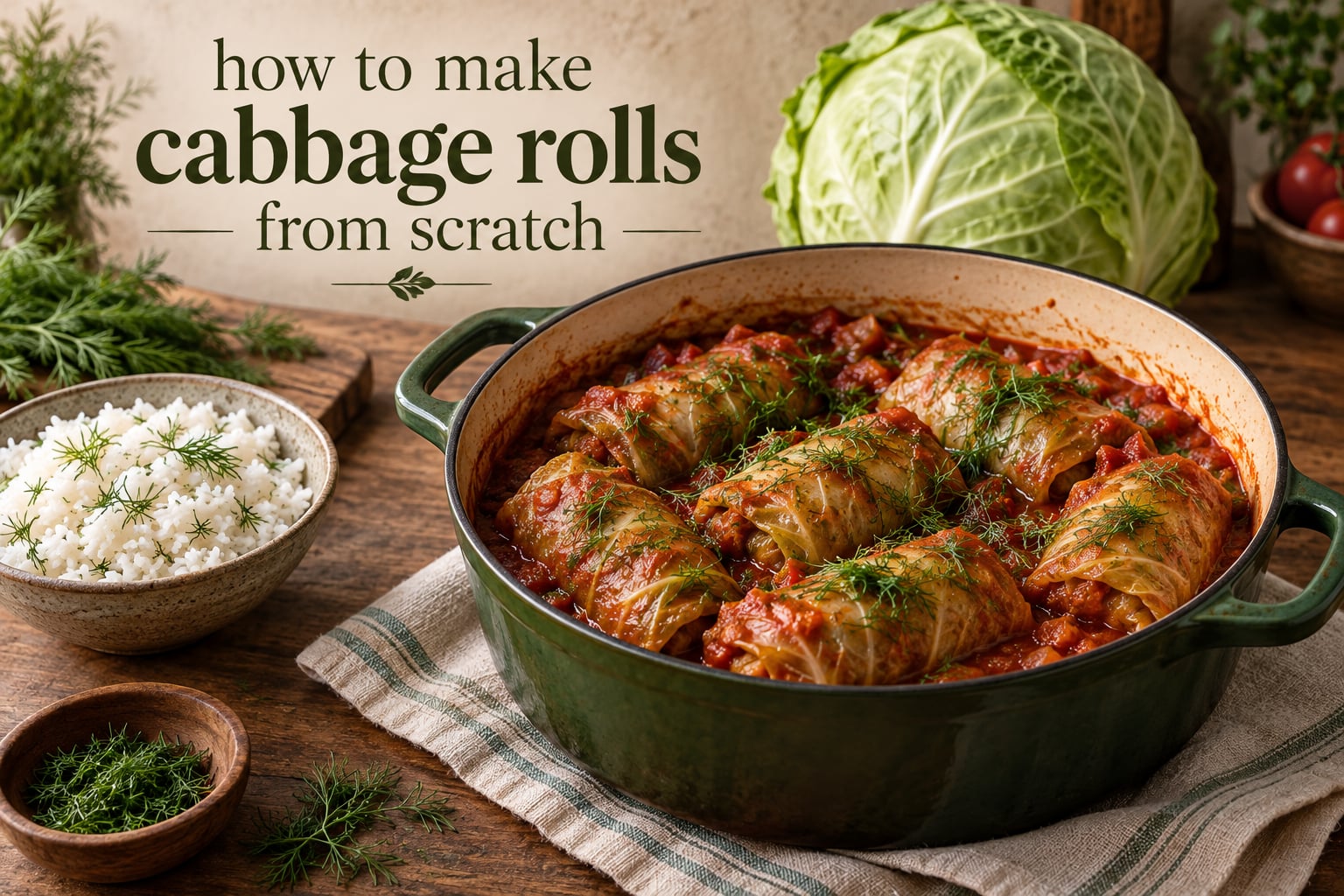
Cabbage rolls are leaves of green cabbage rolled around a filling of ground meat, cooked rice, onion and egg, then braised gently in a tomato sauce until the leaf goes tender and the filling is cooked through. Learning how to make cabbage rolls from scratch takes about two hours, most of it unattended, and the whole thing happens in one pot.
Exactly what does “from scratch” mean here? No pre-cooked convenience rice, no canned soup as the sauce base, no jarred leaves. You soften the cabbage yourself, cook the rice yourself and build the sauce from tomato sauce and tomato paste. It costs a little more attention and it tastes noticeably better than the shortcut version.
Before you start, here is the one decision that decides whether the batch works. You are not trying to cook the cabbage until it is tender. You are trying to soften the outer leaves just enough that they bend without snapping. Cook them too long and they shred into strings the moment you try to roll them. Get that one step right and the rest is straightforward.
I have made this recipe more than a dozen times, and the failure mode is always the same: over-softened leaves, then tight rolls, then a pot of loose filling and flat cabbage. The method below is the one I return to, and I updated the timings for 2026 after testing it with both a large and a small head of cabbage.
Table of Contents
- What You Need and Why Each Ingredient Matters
- The Secret Ingredient in Cabbage Rolls
- How to Soften the Cabbage Leaves
- How to Make Cabbage Rolls from Scratch
- Cooking Methods Compared
- Troubleshooting: Why Cabbage Rolls Fall Apart
- Variations and Substitutions
- Storage, Freezing and Reheating
- Frequently Asked Questions
- What is the secret ingredient in cabbage rolls?
- Do you boil the cabbage before making stuffed cabbage?
- How do you keep cabbage rolls from coming apart?
- How many cabbage rolls can you make from one head of cabbage?
- What is the secret to good cabbage rolls?
- How long do you cook stuffed cabbage rolls?
- Can I freeze cabbage rolls?
- Why is my cabbage watery or mushy?
- Conclusion
What You Need and Why Each Ingredient Matters
One large head of green cabbage makes roughly 18 to 24 rolls depending on leaf size, which is enough to feed six people as a main with sides. The ingredient list splits cleanly into the filling and the sauce.
For the filling
- 1 large head green cabbage, outer leaves on
- 1 pound ground beef
- 1/2 pound ground pork
- 1 cup long-grain rice, cooked and cooled
- 1 egg, lightly beaten
- 1 small onion, finely diced
- 3 cloves garlic, minced
- 2 tablespoons tomato paste
- 1 tablespoon Worcestershire sauce
- 1 1/2 teaspoons salt, divided
- 1 teaspoon black pepper
- 1 teaspoon dried thyme or 1 teaspoon dill seed
For the tomato sauce
- 2 tablespoons olive oil or butter
- 1 large can (28 ounce) tomato sauce
- 1/2 cup water or broth
- 1/2 cup sour cream
- 2 bay leaves
- 1 tablespoon Worcestershire sauce
Here is what each key piece actually does. Ground pork adds fat and moisture, and the mix stays tender long after the beef alone would turn dry. Cooked, cooled rice is an extender that stretches the meat and absorbs the braising liquid. Egg is the binder, and it is the single most-skipped ingredient. Tomato paste seared with the aromatics is what gives the sauce a deep, cooked flavor rather than a canned one. Sour cream stirred in at the end adds tang and rounds out the acidity of the tomato.
Prep time: 45 minutes. Cook time: 1 hour 15 minutes. Total: about 2 hours. Yield: 18 to 24 rolls, serving 6.
The Secret Ingredient in Cabbage Rolls
There is no single secret ingredient, but three things separate good rolls from average ones. The beaten egg binds the filling so it stays inside the leaf. The cooled rice keeps the meat juicy instead of letting it shrink. And the tomato paste cooked with the onion and garlic for a full minute before anything else goes in the pan is the flavor secret that almost nobody mentions.
The technique secrets matter just as much: trim the thick rib, pack the filling snug rather than tight because rice swells, lay every roll seam-side down, and keep the pot at a bare simmer so nothing jostles the rolls apart.
How to Soften the Cabbage Leaves
Yes, you soften the leaves before rolling, and no, you are not cooking the head of cabbage until it is tender. Two to three minutes in boiling salted water is enough for the leaves to bend without snapping, which is the standard method. Freezing the head first works too and needs no boiling at all.
| Method | Time | Resulting texture | Best for |
|---|---|---|---|
| Boiling water | 2 to 3 minutes per batch of leaves | Soft, pliable, holds shape when rolled | Same-day cooking, the most predictable result |
| Freeze then thaw | Freeze overnight, thaw 30 to 45 minutes | Very soft, almost satin | Batch cooking, or when a whole head needs using up |
| Microwave | 45 to 60 seconds on high per leaf | Warm and bendable, uneven at the rib | Small batches when boiling feels wasteful |
The freeze method is the one experienced home cooks keep rediscovering and almost no recipe writes down. Freezing breaks down the cell walls in the leaf, so a thawed leaf is soft and rollable with no heat at all. One user on r/povertykitchen described making a hundred rolls at a time, freezing them flat in zip-top bags, and thawing them as needed.
To blanch, bring a large pot of water to a rolling boil and salt it like pasta water. Lower the whole head in, cook 2 to 3 minutes, then move it to cold water so the cooking stops. Peel the leaves off from the outside in, keeping the core intact. Repeat with the cored head for another 2 to 3 minutes, cutting into the core a little deeper each round.
Pat every leaf dry on a towel. Standing water on the leaf makes the roll slippery and it will unravel in the pot. Then slice the thick rib out of the bottom of each leaf with a sharp knife or the spine of a spoon, cutting a shallow V so the leaf stays whole.
Warning: work in batches of five or six leaves. A crowded pot cools fast and the timing falls apart. If the water stops boiling, add leaves only after it comes back up.
How to Make Cabbage Rolls from Scratch
The best cabbage rolls have a tender leaf, a juicy filling, seasoning tasted and adjusted, and a sauce that reduced rather than dried out. Nine steps deliver all four.
- Cook and cool the rice. Boil 1 cup long-grain rice in salted water for 12 minutes, drain, and spread it on a plate so it cools completely. Warm rice melts the egg and turns the filling gluey, so this step comes first.
- Brown the meat and aromatics. Heat 1 tablespoon olive oil in a large skillet over medium-high. Add the beef and pork, break it up, and cook without stirring for 3 minutes so it browns. Add the onion and garlic and cook 2 minutes more, then the tomato paste, stirring constantly for 1 minute until it darkens from red to brick.
- Season and test the filling. Turn off the heat. Stir in the cooled rice, the beaten egg, the Worcestershire sauce, 1 teaspoon of the salt, the pepper, and the thyme. Now do the thing almost nobody does: fry a spoonful in a hot pan and taste it. Adjust the salt before you roll twenty of them.
- Line the pot. Shred any cabbage leaves too small to roll and scatter them in the bottom of a Dutch oven or heavy pot. They form a bed that the rolls sit on, they stop the sauce from scorching, and nothing gets thrown away.
- Add a layer of sauce. Warm 2 tablespoons olive oil in the pot, add 2 cups of the tomato sauce with 1/2 cup water, the bay leaves and the remaining Worcestershire. Bring it to a gentle simmer, then turn it down low while you roll.
- Fill each leaf. Lay a leaf rib-side up. Add 2 tablespoons of filling in a neat strip about an inch from the base. Too much filling is the number one reason rolls burst, so measure the first few with the same spoon.
- Roll snug, not tight. Fold the near edge of the leaf up over the filling, tuck in both sides, then roll the rest of the leaf over the top and pinch the seam. Snug means firm, not compressed, because the rice expands as it cooks and a tightly packed roll splits its seam.
- Arrange seam-side down. Nestle the rolls in the pot, cut side down, in concentric circles. The seam is the weak point, so putting it on the bottom and anchoring it in the sauce is what keeps the rolls intact. A second layer on top works if you have room.
- Simmer gently for 75 minutes. Spoon the remaining sauce over the rolls so the tops are just covered, drizzle in 1/2 cup water, cover the pot, and cook over the lowest heat that still shows a bubble every second or two. A hard boil is what shakes the rolls apart. Check at 40 minutes and add hot water if the sauce has gone thicker than you like.
When the 75 minutes are up, the filling should reach 160 degrees at the center and the leaves should give to a spoon with no resistance. Slide the sour cream in off the heat and stir it into the sauce directly, or spoon it over each roll at the table.
Serve with a spoonful of sour cream and fresh dill, or with mustard and a rye bread. A spoonful of the braising liquid over everything is the move that makes people ask for the recipe.
Cooking Methods Compared
The stovetop method above is the most reliable, but a Dutch oven, a slow cooker, a pressure cooker and a regular oven all work. Only the heat level and the time change.
| Method | Heat | Time | Notes |
|---|---|---|---|
| Stovetop pot | Lowest simmer | 75 to 90 minutes | The reference method, easiest to control |
| Dutch oven, oven-safe | 325 degrees | 75 to 85 minutes | Even heat, minimal stirring, closest to stovetop |
| Slow cooker | Low or high setting | 4 to 5 hours low, 3 high | Set-and-forget; add the water late so the sauce does not scorch |
| Pressure cooker | High pressure | 25 to 30 minutes, 10 minute release | Fastest route; reduce the liquid by a third first, it does not evaporate as fast under pressure |
| Oven in a casserole dish | 350 degrees | 60 to 70 minutes | Browns the exposed roll tops, tightens the seams further |
Troubleshooting: Why Cabbage Rolls Fall Apart
Runs come apart for four predictable reasons, and in the order you should check them.
- The leaves were over-softened. If they fall apart in your hands instead of bending, the water cooked them too long. Next time pull them at 2 minutes rather than 3, and shock them in cold water immediately.
- The rolls were packed too tight. Rice absorbs liquid and swells, so a compressed roll pushes its own seam apart. Roll snug and leave room for expansion.
- The seam was not anchored. Always lay the rolls seam-side down and make sure the sauce comes partway up them so they stay wet where they sit.
- The pot boiled hard. A rolling boil makes the rolls jostle and the seams give. Use the lowest heat that still bubbles occasionally.
To stop leaves tearing while you peel them, cool the head in ice water after blanching so the outer leaves stop cooking, and cut into the core a little deeper on each pass instead of yanking at the leaf. The most repeated complaint I saw from home cooks is exactly this tearing, and cold shocking fixes nearly all of it.
If the filling falls out while rolling, the egg ratio is off or the meat is too lean. Add a second beaten egg to the bowl, and use pork rather than pure 90 percent lean beef.
If the sauce dries out mid-cook, add a splash of hot water or more tomato sauce rather than turning the heat up. One cooking group post I read described that same fix, and it is the right move: more liquid and gentler heat, not more heat.
If the finished rolls taste watery, you probably packed them too tight. Steam and fat could not escape, and the result is a soggy center rather than a tender one.
Variations and Substitutions
Swaps are easy, and a few of them change the dish more than you would expect.
| Instead of | Use | What changes |
|---|---|---|
| Long-grain rice | Quinoa or bulgur, cooked | Nuttier and more absorbent, gluten free |
| Beef and pork | Ground turkey plus 2 tablespoons olive oil | Lighter, drier, so keep the sauce loose |
| Tomato sauce | Canned crushed tomatoes, less water | Rustic, more textured sauce |
| Sour cream | Creme fraiche or more Greek yogurt | Sharper tang, still creamy |
| Green cabbage | Red cabbage | Prettier and slightly peppery, but it dyes the sauce purple |
| Fresh dill | Fresh parsley or chives | Lighter, less anise note |
For a Polish style version, skip the tomato paste and add caraway, allspice and a tablespoon of dill seed. For Romanian sarmale, use a sour cream and tomato sauce base with a little rice vinegar.
For sweet and sour rolls, swap the tomato sauce for 1 cup tomato sauce, 1/2 cup brown sugar, 1/2 cup red wine vinegar and 1 teaspoon mustard, then simmer the sauce on its own for 10 minutes before it goes over the rolls.
For vegetarian stuffed cabbage, skip the meat and add a second egg plus 1 cup of cooked mushrooms, 1/2 cup grated Parmesan and 1/2 cup cooked lentils. Cook them for only 60 minutes, since there is no raw meat to bring through.
For an Asian style version, fill with ground pork, water chestnuts, shiitake and ginger, then braise in a sauce of soy sauce, rice vinegar, brown sugar and water until the liquid reduces. Skip the sour cream entirely.
Storage, Freezing and Reheating
Cooked cabbage rolls keep 4 days in the refrigerator in a sealed container, and they reheat better than most leftovers because the sauce travels with them.
For freezing, cool the cooked rolls fully, lay them in a single layer in a freezer bag or container, and keep 3 months. Users freeze them in batches of 20 to 30 and thaw only what the week needs.
To reheat from frozen, cover the rolls with a little sauce or water in a baking dish and warm at 325 degrees for 35 to 40 minutes, or on low in a covered skillet for 20 minutes with a splash of water. Reheating gently matters: a hot pan dries the sauce out fast.
Uncooked rolled cabbage also freezes, laid seam-side down in a single layer for 30 minutes to flash-freeze, then transferred to a bag. Give them an extra 20 minutes of cooking time from frozen.
Frequently Asked Questions
What is the secret ingredient in cabbage rolls?
There is not one secret, but three things matter most. The beaten egg binds the filling so it stays inside the leaf, the cooked and cooled rice extends the meat and keeps it juicy, and the tomato paste cooked with the onion and garlic for a full minute gives the sauce a deep cooked flavor instead of a canned one.
Do you boil the cabbage before making stuffed cabbage?
You soften the leaves, but you do not cook the head until it is tender. Two to three minutes in boiling salted water softens the outer leaves until they bend without snapping, then cold water stops the cooking. Freezing the head overnight and thawing it works too and needs no boiling at all.
How do you keep cabbage rolls from coming apart?
Four things prevent unraveling. Do not over-soften the leaves, roll them snug rather than tightly compressed, lay every roll seam-side down in the pot, and keep the heat at the lowest simmer that still bubbles now and then. Too little egg in the filling and too lean a meat are the other two common causes.
How many cabbage rolls can you make from one head of cabbage?
One large head of green cabbage makes roughly 18 to 24 rolls depending on leaf size. The outer leaves are the biggest and the inner ones shrink as you cut deeper into the core. Small heads usually give 12 to 15, and any leaf too small to roll is worth shredding into the pot as a bed under the rolls.
What is the secret to good cabbage rolls?
Technique, not a hidden ingredient. Trim the thick rib, pack the filling snug rather than tight, brown the meat before mixing, taste a spoonful of filling before rolling the batch, and keep the pot from boiling hard so the rolls stay still. Most people skip the seasoning test and most overcook the leaves.
How long do you cook stuffed cabbage rolls?
About 75 minutes at the lowest simmer for a covered stovetop pot. A 325 degree oven takes 75 to 85 minutes, a slow cooker takes 4 to 5 hours on low, and a pressure cooker takes 25 to 30 minutes with a 10 minute release. The filling should reach 160 degrees at the center.
Can I freeze cabbage rolls?
Yes, both cooked and uncooked. Cooked rolls cool fully, freeze in a single layer, and keep 3 months, then reheat covered at 325 degrees for 35 to 40 minutes. Home cooks report batching 100 rolls at a time, freezing them flat and holding them for the better part of a year.
Why is my cabbage watery or mushy?
Over-softened leaves turn to strings, and rolls packed too tightly trap steam so the liquid cannot escape. Pull the leaves from the water at 2 minutes rather than 3, roll snug instead of compressed, and leave the lid slightly ajar for the last 10 minutes so moisture can escape.
Conclusion
Knowing how to make cabbage rolls from scratch comes down to one skill and four habits. Soften the leaves just enough, bind the filling with egg, roll snug with the seam facing down, and simmer low until the filling reaches 160 degrees.
Plan roughly two hours, expect 18 to 24 rolls from a large head, and taste your filling before you commit to the batch. Once you have made it once, the pot becomes a weekend project and a freezer staple rather than something you only cook for a holiday.