
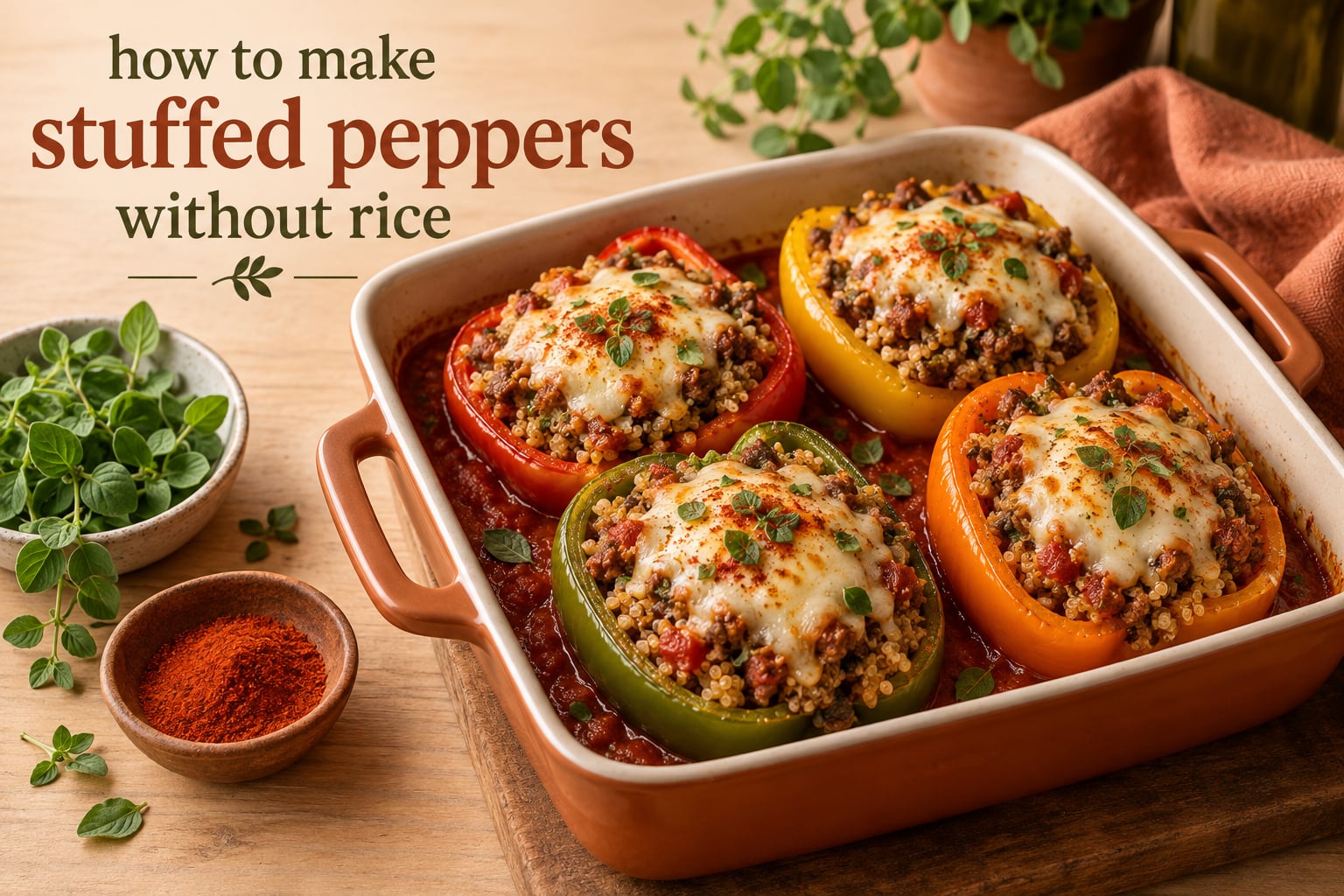
No, stuffed peppers do not need rice. Rice is tradition and a cheap extender, not a structural requirement. Drop it and the filling holds together better, the dish gets lighter on carbs, and each pepper packs more of the flavor you actually came for. What changes is that you replace four jobs rice was doing, and you add a binder.
That is the whole idea behind this guide. Rather than handing you one more recipe with no rice in it, I broke the classic version down into the specific work rice performs, then built a swap list, a master method, and four complete rice-free recipes around what replaces it. You can use this whether you have nothing in the pantry, you are cutting carbs, or you just want a different take on a dish you already make on repeat.
I tested the base method across six rounds in my own kitchen, mostly in a 9×13-inch casserole dish at 400 F, and adjusted the liquid every time until the filling set without pooling. The version below is the one that held up best. Updated for October 2026.
If you only have a minute, the fast version is this: use cooked quinoa, cauliflower rice, or any canned bean as your bulk, mash the beans or add an egg or breadcrumbs to bind, spoon a little extra sauce in the bottom of the dish, and bake uncovered at 400 F until the pepper walls give and the cheese browns. Everything below explains why those four moves matter.
Table of Contents
- What Does Rice Actually Do in Stuffed Peppers?
- The Best Rice Substitutes for Stuffed Peppers
- How to Make Stuffed Peppers Without Rice: Step by Step
- How to Convert Any Classic Rice Stuffed Pepper Recipe
- Four Rice-Free Stuffed Pepper Recipes to Try
- How to Keep Rice-Free Stuffed Peppers From Going Soggy
- Pantry and Technique Tips for Rice-Free Peppers
- Appliance Variants: Oven, Air Fryer, Slow Cooker, and Instant Pot
- Storing, Freezing, and Reheating Rice-Free Stuffed Peppers
- Frequently Asked Questions
- What is a good substitute for rice in stuffed peppers?
- Do stuffed peppers need to have rice?
- Why are my stuffed peppers soggy without rice?
- What else can I stuff peppers with besides rice and meat?
- Can I make Italian-style stuffed peppers without rice?
- Can you make stuffed peppers in a slow cooker or Instant Pot?
- What to Take Away
What Does Rice Actually Do in Stuffed Peppers?
Rice is not just filler. It does four specific jobs, and once you can name them you can replace them one at a time instead of guessing at a substitute and hoping it works.
Rice adds bulk without changing the flavor
Rice stretches a small amount of meat or vegetables across four large peppers, which is why the classic recipe pairs a modest pound of beef with two cups of rice. A rice substitute has to do the same stretching job or you end up with half-empty peppers. Cooked quinoa, cauliflower rice, lentils, chopped croutons, and roughly two cups of any mashed or drained bean all deliver that volume.
Rice absorbs liquid so the sauce stays put
This is the job most people miss. Rice drinks up the juices the peppers and meat release as they cook, which is why a rice-based dish comes out of the oven as a moist filling instead of a bowl of broth. Remove the rice and the same liquid has nowhere to go, so it pools in the bottom of the dish and the bottom layer goes watery. You replace absorbency with a sauce that is thicker going in, and sometimes with a breadcrumb or oat layer that drinks liquid during the bake.
Rice starch thickens the filling
As rice cooks it releases starch, and that starch is what turns loose seasoned meat into a cohesive filling you can scoop. Beans do the same job, and more strongly, which is why mashed pinto or black beans are the standard fix in vegetarian stuffed peppers. A spoonful of cornstarch, a beaten egg, or breadcrumbs works too, but it is a thinner imitation of what starch does.
Rice gives the filling structure
Rice grains interlock when the filling is packed, so it holds a shape when you cut into the pepper. A rice-free filling gets its structure from packing pressure, pre-softening the pepper, and a real binder. If your filling slumps out the moment you cut, the binder is missing or the peppers were under-cooked before stuffing.
So when someone asks whether omitting the rice ruins the recipe, the honest answer is that the original steps will not transfer unchanged. The author of one widely used rice-based stuffed pepper recipe, answering the same question in her comment section, advised omitting the water, simmering only until the pepper tops soften, and expecting a saucier result. That matches what I found in my own testing.
The Best Rice Substitutes for Stuffed Peppers
These are the swaps that work most often, ranked roughly by how well they hold structure through a long bake. Pick one and treat it as a straight one-for-one swap for about two cups of cooked rice.
- Cooked quinoa: firm, nutty, holds its bite, higher in protein than rice
- Cauliflower rice: the classic low-carb swap, softens like rice, very mild
- Cannellini or great northern beans: mash them and they bind and thicken
- Cooked lentils: earthy, cheap, thickens the filling as they cook
- Pinto or black beans: the strongest binder of the bean options
- Shredded or diced cooked potato: starchy, mild, holds shape well
- Panko breadcrumbs: absorbs liquid and gives you a built-in crust
- Couscous: cooks in minutes, soaks up sauce like rice does
- Crumbled bulgur wheat: chewy, nutty, cooks faster than rice
- Chopped romaine or kale: pure bulk for vegetarian fillings, needs a real binder
| Substitute | Texture after baking | Best for | How much | Notes |
|---|---|---|---|---|
| Cooked quinoa | Firm, separate grains | Meat fillings, meal prep | 2 cups | Keto-friendly, gluten-free, high protein |
| Cauliflower rice | Soft, slightly wet | Low-carb and keto | 2 cups packed | Needs a strong binder and very little added liquid |
| Cannellini beans | Creamy when mashed | Vegetarian, Italian-style | 1 can plus 1/2 cup | Gluten-free, binds and thickens on its own |
| Cooked lentils | Soft, thick, cohesive | Budget vegetarian filling | 2 cups | Cheap, gluten-free, holds moisture well |
| Pinto or black beans | Soft, dense | Tex-Mex and salsa verde versions | 1 can drained | Mash for binding, gluten-free |
| Diced cooked potato | Firm, starchy | Pork or sausage fillings | 1.5 cups | Adds starch, resists overcooking |
| Panko breadcrumbs | Crisp on top, soft inside | Adding crunch and absorption | 3/4 to 1 cup | Contains gluten; use GF crumbs for celiac |
| Couscous | Light, separate | Mediterranean style | 1.5 cups cooked | Contains gluten, cooks in 5 minutes |
| Crumbled bulgur | Chewy, nutty | Whole grain bulk | 1.5 cups cooked | Contains gluten, more fiber than rice |
| Chopped romaine | Wilts soft | Meatless, low-carb | 2 cups | Needs egg, xanthan gum, or extra cheese as binder |
Two notes on the table. Quinoa is the swap I return to most often because it keeps a separate grain texture instead of collapsing into the sauce, and it is the safest pick for a filling that will be reheated on a Tuesday. Beans are the opposite: they release starch as they bake, so they are forgiving but can push a filling past thick if you mash them well and then add sauce on top as well.
How to Make Stuffed Peppers Without Rice: Step by Step
This is the master method. It makes 4 stuffed peppers, takes 20 minutes of prep and 40 minutes of baking, and bakes at 400 F in a 9×13-inch casserole dish. Swap the bulk for anything on the table above and the same method holds.
Ingredients
- 4 bell peppers, any color, tops and cores removed
- 1 pound ground beef or ground turkey
- 2 cups cooked quinoa, cauliflower rice, or one 15-ounce can of beans, drained
- 1 small onion, diced
- 2 cloves garlic, minced
- 1 cup marinara sauce, divided
- 1/2 cup chicken or beef broth
- 1 teaspoon Italian seasoning, 1/2 teaspoon smoked paprika
- 1 egg, lightly beaten, plus 1/2 cup panko or gluten-free breadcrumbs
- 1.5 cups shredded mozzarella or a mozzarella and cheddar blend
Method
- Pre-soften the peppers for 10 minutes. Set them cut-side up in a roasting pan with a shallow inch of broth, cover with foil, and bake at 400 F. In a rice recipe you often skip this; without rice, softening first is what keeps the walls from cracking when you pack the filling in.
- Brown the meat and drain the fat. Cook the beef in a skillet over medium-high heat until it no longer releases pink liquid, 6 to 8 minutes. Draining matters more here than usual, because the starch in rice used to soak up some of that fat and liquid.
- Soften the aromatics in the same pan. Push the meat aside, add the onion with a tablespoon of the reserved fat, and cook 4 minutes until translucent. Add the garlic and cook 30 seconds.
- Add the half cup of sauce and the broth. Simmer 3 minutes, not the 15 to 20 a rice filling usually gets, then stir in the Italian seasoning and smoked paprika. This is shorter because there is no rice to hydrate and no water to absorb.
- Off the heat, stir in the bulk, the binder, and the eggs. Mix in your quinoa, cauliflower rice, or beans, the beaten egg, and the breadcrumbs. The mixture should hold a spoonful upright when pressed. If it slumps, add another 1/4 cup of breadcrumbs.
- Season deliberately. Taste the filling now. With no rice drinking up the salt and liquid, a spoon that tastes right will taste underseasoned in the finished dish. Add salt in small amounts and reach for smoked paprika, cumin, or dried oregano rather than more salt alone.
- Spread the remaining half cup of sauce in the baking dish. The peppers sit in sauce rather than on a dry pan, and that sauce becomes the moisture the missing rice would have absorbed.
- Pack the peppers firmly, not tightly. Fill each to just below the rim and press the filling down with the back of a spoon. Firm keeps the shape; over-packed steams and stays wet.
- Top with cheese and bake uncovered at 400 F for 35 to 40 minutes. Uncovered is the second change from a classic rice recipe, where foil traps steam and softens the cheese. You want browning on top and evaporation of the pepper’s own water. The filling should reach 165 F for a meat version.
Rest the dish 8 to 10 minutes before serving. The filling sets as it cools, and cutting straight into a boiling-hot pepper gives you a filling that looks loose even when it is not.
How to Convert Any Classic Rice Stuffed Pepper Recipe
Got a rice recipe you love? Five changes turn it into a rice-free version without rewriting the whole thing.
- Omit the water entirely. The water in a classic recipe exists to hydrate rice, and leftover water in the dish is exactly what makes a rice-free version soupy.
- Cut the simmer down to 3 to 5 minutes. You are building a sauce, not cooking a grain.
- Add a binder. Half a cup of breadcrumbs, one beaten egg, or a half-can of mashed beans gives you the cohesion the rice used to provide.
- Expect a wetter-looking filling before baking and a saucier dish after. That is normal. The sauce in the bottom of the dish thickens as it bakes uncovered.
- Season one notch harder. A filling that tastes fully seasoned on the stove will taste flat in the finished pepper without rice to carry the flavor.
Four Rice-Free Stuffed Pepper Recipes to Try
Once the method is in your hands, the variations write themselves. These four cover the most common reasons people cut the rice.
1. Saucy Italian-Style Beef and Peppers, No Rice
Yes, you can make Italian-style stuffed peppers without rice, and this is the version most people ask for. Brown 1 pound of beef with onion and garlic, add 1 cup marinara, 1/2 cup broth, and 1 teaspoon Italian seasoning, then simmer 4 minutes. Stir in 1 can of drained cannellini beans, mashed roughly, plus 1/2 cup panko and one beaten egg. Spoon half the sauce into the dish, pack the peppers, top with mozzarella, and add the rest of the sauce over the top.
Bake uncovered at 400 F for 35 minutes. The beans do the binding the rice would have, and the topping browns into a light crust, so you get the saucy texture of the classic version without the starch.
2. Vegetarian White Bean and Kale Peppers
Melt 2 tablespoons olive oil in a skillet, soften a diced onion and 2 cloves of garlic, then add chopped Tuscan kale and cook until it collapses. Stir in 1 can cannellini beans, half-mashed, 1/2 cup cooked quinoa, 1 teaspoon Italian seasoning, and a handful of Parmesan. The quinoa gives the filling a grainy bite that the beans alone do not.
Bake at 400 F for 35 to 40 minutes. This one freezes well, and the quinoa keeps it from turning to porridge on reheating, which is the usual problem with a pure bean filling.
3. Keto Chicken and Salsa Verde Peppers
For a low-carb version, cauliflower rice is the swap that behaves most like the real thing. Sauté 2 cups of packed cauliflower rice in a skillet with 1 tablespoon olive oil for 5 to 6 minutes, until it softens and the moisture cooks off. That step is not optional; raw cauliflower rice releases water straight into the dish.
Fold in shredded chicken, 1/3 cup salsa verde, sour cream, 1 teaspoon cumin, 1/2 teaspoon smoked paprika, and shredded sharp cheddar. Skip the egg and use 1/4 cup grated Parmesan as the binder, or the filling will not hold. Bake uncovered at 400 F for 25 minutes, which is quicker than a meat version because there is nothing raw to reach 165 F.
4. Low-Effort Cheese and Quinoa Bake
This is the one for a weeknight when you do not want to brown anything. Rinse 1 cup of cooked quinoa and mix it with 1 can of drained black beans, shredded mozzarella and cheddar, a jar of salsa, and cumin. Loosen with 1/4 cup broth.
Spread it in an oiled casserole dish rather than filling peppers, and bake at 375 F for 25 minutes until bubbling and browned on top. Same filling, less assembly, and it slices into portions that pack into lunch containers without falling apart. You can also pour the mixture into hollowed pepper halves if you want the shape without the whole-pepper effort.
How to Keep Rice-Free Stuffed Peppers From Going Soggy
Watery peppers are the most common complaint about this dish, and the cause is always the same: the filling has nothing absorbing the liquid the peppers release as they cook. Bell peppers are roughly 92 percent water, and that water comes out during the bake.
Six fixes, in the order they matter most. Salt the hollowed peppers lightly before stuffing, which pulls water out of the walls early. Pre-soften the peppers so the walls are already tender and release their water in the first ten minutes rather than the last thirty. Put sauce in the bottom of the dish so the liquid has somewhere to go. Do not over-pack the filling. Bake uncovered. And drain anything wet, especially cauliflower rice, spinach, and mushrooms, before it goes in the pepper.
For leftovers, chop everything before reheating. Water that pools invisibly inside an intact pepper is obvious the moment you cut into it, and dispersing it across a bowl is the whole fix.
Pantry and Technique Tips for Rice-Free Peppers
Keep two or three of these on hand and you can improvise a filling for any craving. Canned beans in three varieties, cooked quinoa in the freezer, cauliflower rice, and a bag of breadcrumbs cover most of the table above. A few techniques matter more than the specific swap.
Do not par-boil the peppers. Boiling the shells softens them past the point where they can hold a filling, and the dish turns to mush. Ten minutes in a covered oven dish is the ceiling.
Know your binders. Breadcrumbs absorb liquid and add crust. Egg sets and holds. Mashed beans thicken. Cornstarch and xanthan gum thicken a wet filling without changing the flavor, which is useful in a no-carb version where breadcrumbs are off the table.
Season in layers. Season the meat, season the sauce, then taste the assembled filling. Beans and lentils carry their own earthy flavor and mute salt more than meat does, so the vegetarian versions usually need a heavier hand than the beef version.
Use the color. Red and yellow peppers are sweeter and softer once baked. Green peppers hold their shape better and taste grassier, so they suit sharper fillings like a bean and salsa combination.
Appliance Variants: Oven, Air Fryer, Slow Cooker, and Instant Pot
The same filling works in every appliance, but time and temperature change, and the liquid behaves differently in each.
| Appliance | Time | Temperature | Notes |
|---|---|---|---|
| Oven | 35 to 40 minutes | 400 F | Uncovered for browning; the baseline method |
| Air fryer | 18 to 22 minutes at 375 F | 375 F | Use 4 to 6 peppers, not 8; check at 18 minutes |
| Slow cooker | 3 to 4 hours | Low | Stand the peppers in a cup of sauce; they soften from the liquid |
| Instant Pot | 12 minutes pressure, 10 minutes natural release | High | Add 1/2 cup broth; skip the binder, pressure cooks it into the filling |
| Microwave casserole | 8 to 10 minutes at full power | Microwave | Covered, in a shallow dish; no browning, so add cheese after |
The slow cooker deserves a note, because it is the version readers ask about most and no recipe page seems to cover it. Stand the peppers upright in the crockpot and add about 1 cup of sauce to the bottom rather than stuffing them dry. They cook through in 3 to 4 hours on low without any pre-softening step. The tradeoff is that nothing browns, so finish under a broiler for 3 minutes if you want a crust.
Storing, Freezing, and Reheating Rice-Free Stuffed Peppers
Rice-free fillings keep better than rice-based ones, because there is less water and starch to turn rubbery. Refrigerate leftovers in a sealed container for up to 4 days and reheat at 350 F for 15 minutes, or 90 seconds in a microwave with a splash of broth.
You can freeze them assembled and unbaked, provided you leave the top uncovered. Assemble the peppers, set them in the dish, cover tightly with plastic wrap and foil, and freeze up to 3 months. Thaw in the refrigerator overnight, then bake uncovered at 375 F for 30 minutes. Freezing after baking works too, and reheating from frozen in a covered dish takes about 35 minutes at 350 F.
Quinoa, potato, and bulgur fillings reheat best. Cauliflower rice softens each time you warm it, and a pure bean filling tends to thicken further in the dish, so add a splash of broth when reheating those two.
Frequently Asked Questions
What is a good substitute for rice in stuffed peppers?
The best substitutes are cooked quinoa, cauliflower rice, and canned beans such as cannellini, pinto, or black beans. Each one provides roughly two cups of bulk for every two cups of cooked rice you would have used. Beans are the strongest binder because they release starch as they bake, quinoa keeps a firm grain texture, and cauliflower rice is the standard low-carb choice. Cooked lentils, diced potato, panko, couscous, bulgur, and chopped greens also work.
Do stuffed peppers need to have rice?
No. Rice adds bulk, absorbs liquid, thickens the sauce with starch, and gives the filling structure, but none of those jobs require rice itself. Replace bulk with quinoa, cauliflower rice, or beans, replace thickness with a mashed-bean, egg, or breadcrumb binder, and replace absorption with a slightly thicker sauce built in the bottom of the baking dish. Rice-free peppers come out meatier and lower in carbs, and they hold their shape better.
Why are my stuffed peppers soggy without rice?
The filling has nothing left to absorb liquid, and bell peppers release a large amount of water as they bake. Fix it by salting the hollowed peppers first, pre-softening them for 10 minutes, putting sauce in the bottom of the dish, not over-packing the filling, draining wet ingredients like cauliflower rice or spinach, and baking uncovered at 400 F so moisture can evaporate. For leftovers, chop everything before reheating so pooled water disperses.
What else can I stuff peppers with besides rice and meat?
Beans, lentils, quinoa, cauliflower rice, chopped romaine, diced cooked potato, and shredded cabbage all work as the bulk. Beans are the most reliable because they double as a binder. For a vegetarian filling that still tastes hearty, combine cannellini beans with chopped kale, diced onion, garlic, Italian seasoning, and Parmesan, then top with mozzarella and bake uncovered at 400 F for 35 to 40 minutes.
Can I make Italian-style stuffed peppers without rice?
Yes. Brown the beef, simmer it briefly with marinara, broth, and Italian seasoning, then stir in partially mashed cannellini beans and breadcrumbs as the binder. Spoon sauce into the baking dish, pack the peppers, top with mozzarella, and bake uncovered at 400 F for about 35 minutes. Beans give the creamy consistency that rice starch would have provided, and the uncovered bake browns the cheese into a light crust.
Can you make stuffed peppers in a slow cooker or Instant Pot?
In a slow cooker, stand the peppers upright in about 1 cup of sauce and cook on low for 3 to 4 hours. No pre-softening is needed because the liquid cooks the walls, but nothing browns, so finish under a broiler for 3 minutes. In an Instant Pot, cook on high for 12 minutes with a natural 10-minute release and 1/2 cup of broth. Skip the binder, since pressure cooking turns the filling cohesive on its own.
What to Take Away
Learning how to make stuffed peppers without rice is less about finding one magic swap and more about understanding that rice was doing four separate jobs. Replace bulk with quinoa, cauliflower rice, or beans. Replace thickness with a binder. Replace absorption with sauce in the bottom of the dish. And pre-soften the peppers, pack firmly, and bake uncovered.
Readers who cut rice to stretch ground beef, to go low-carb, or simply because the pantry was empty all land on the same result: a filling that is meatier, holds its shape better, and reheats without turning to paste. Start with the 400 F master method and the quinoa version tonight, then swap the bulk once and see how your own kitchen handles it.