
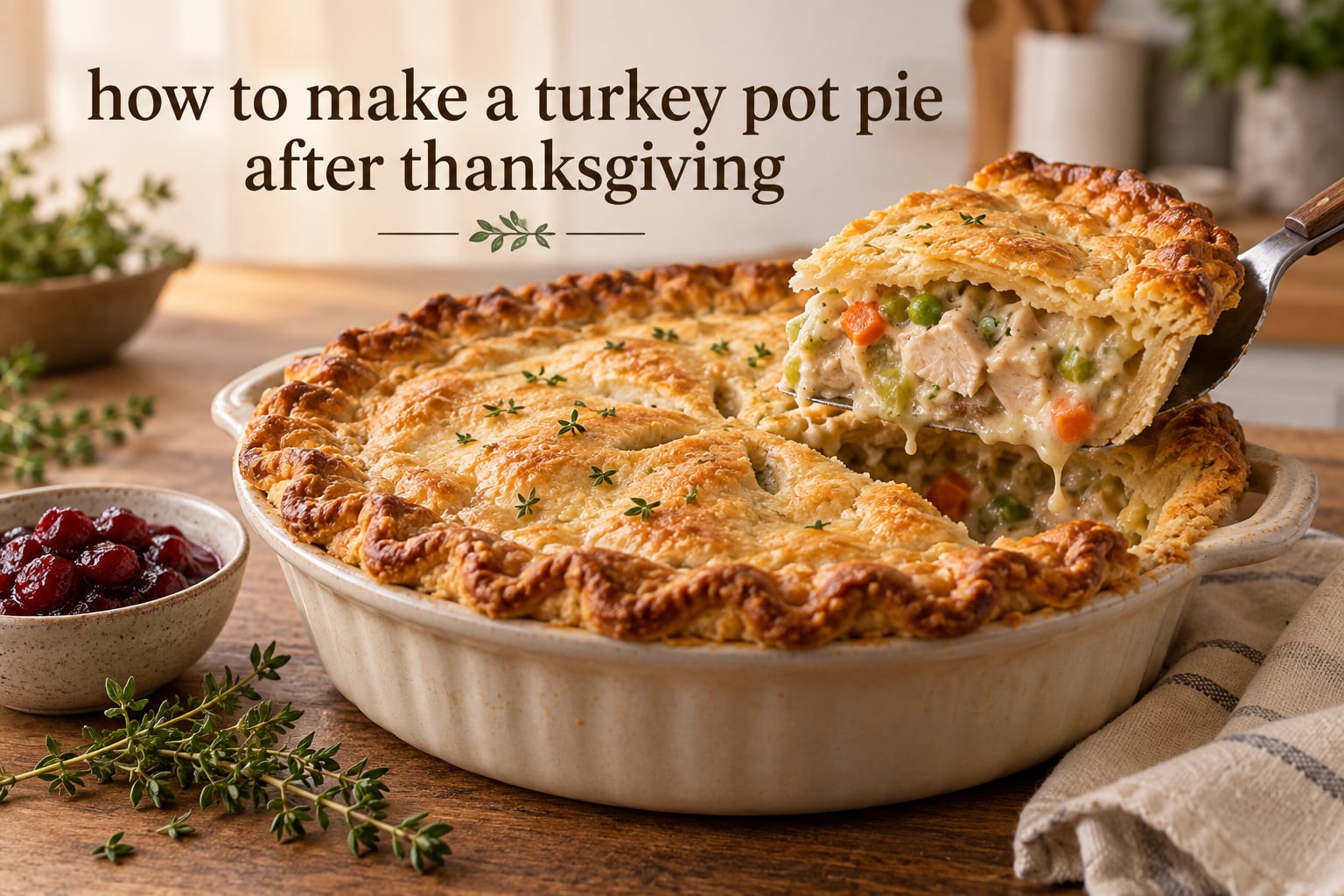
Learning how to make a turkey pot pie after Thanksgiving is the single best way to rescue the pile of turkey sitting in your fridge on Friday afternoon. Shredded turkey, a handful of vegetables, a thick creamy sauce, and a flaky crust turn three days of leftovers into a meal that tastes like it took far more work than it did. In our kitchen we make this pie every holiday season, and it is the dish that gets emptied first.
This guide covers everything from how much turkey to save to which crust to buy, how to keep the bottom from going soggy, and how to freeze the pie for a later weeknight. Updated for October 2026, every step below uses plain supermarket ingredients and standard oven temperatures.
Table of Contents
- Why Turkey Pot Pie Works So Well With Leftovers
- What You Need: Turkey Pot Pie Ingredients
- Choosing The Right Pie Crust For Your Pot Pie
- How To Make Turkey Pot Pie
- Step 1: Shred the turkey and prep the vegetables.
- Step 2: Melt the butter and soften the aromatics.
- Step 3: Cook the roux.
- Step 4: Whisk in the liquids slowly.
- Step 5: Simmer and thicken.
- Step 6: Add the turkey, vegetables, and seasonings.
- Step 7: Blind bake the bottom crust.
- Step 8: Fill the crust.
- Step 9: Top, crimp, vent, and egg wash.
- Step 10: Bake until deeply golden.
- Step 11: Check the temperature.
- How To Use Leftover Turkey Gravy In The Filling
- Thanksgiving Pot Pie Prep Timeline
- Individual Turkey Pot Pies In A Muffin Tin
- Common Turkey Pot Pie Mistakes And How To Fix Them
- How To Freeze And Reheat Turkey Pot Pie
- What To Serve With Turkey Pot Pie
- Frequently Asked Questions
- Conclusion
Why Turkey Pot Pie Works So Well With Leftovers
Leftover turkey is drier than you’d like, which sounds like a problem. It is actually the reason pot pie works so well, because the filling sits in a rich sauce that brings moisture back to every bite.
Four things make this recipe reliable year after year.
- It uses up the whole bird. Dark meat and breast can be combined in one filling, so nothing goes to waste.
- The sauce does the heavy lifting. A roux-thickened broth turns pan juices and a splash of cream into a bechamel-style coating that clings to the turkey.
- It freezes well. Assemble it unbaked and freeze it, then bake from frozen weeks later with no loss in texture.
- It feeds a crowd. One 9-inch deep-dish pie serves six generously, and muffin-tin versions portion it out for lunches.
The technique behind the dish is a roux-based white sauce, the same base used in cheese sauce and béchamel. Cook butter and flour together, whisk in liquid slowly, and the mixture thickens into something glossy that suspends the vegetables rather than letting them sink.
What You Need: Turkey Pot Pie Ingredients
A standard turkey pot pie needs shredded turkey, a thickener, a liquid, fat, and aromatics. Here is what goes in ours and why each piece is there.
The Filling
- 3 cups shredded cooked turkey — roughly 1 pound of meat. Shred it while the bird is still warm for the best texture.
- 4 tablespoons unsalted butter — forms the roux and adds richness. Unsalted is better because broth and stock powder already bring salt.
- 1/3 cup all-purpose flour — thickens the sauce. More flour gives you a denser, more sliceable filling.
- 2 cups turkey broth or chicken broth — use the drippings from the roasting pan if you saved them, diluted with a little water.
- 1 cup whole milk — softens the flavor of the broth and lightens the color of the sauce.
- 3 cups assorted vegetables — frozen peas and carrots, or a mirepoix of diced onion, celery, and carrot. Both work.
- 1 teaspoon poultry seasoning — the herb blend that reads as “holiday” without any single flavor taking over.
- 1 teaspoon dried thyme — a classic match for poultry, and it rehydrates during the simmer.
- 1/2 teaspoon freshly ground black pepper
- 1 tablespoon Dijon mustard — a small amount sharpens the cream and keeps the filling from tasting flat.
- 1/2 cup shredded cheddar or Monterey Jack — optional, but it melts into the sauce and adds color.
The Crust and Finishing Touches
- 2 refrigerated pie crusts or 1 homemade double crust
- 1 egg beaten with 1 tablespoon of water — the egg wash that gives the top its shine
- Coarse salt and flaky salt for the crust edges
Any leftover roasted vegetables from the meal work too. Squash, sweet potato, or brussels sprouts all hold their shape in the sauce and add sweetness that balances the savory sauce.
Choosing The Right Pie Crust For Your Pot Pie
Traditional pie crust is the most common choice, but it is not the only one that works, and each option changes the bake time and the result. Here is how the popular choices compare.
- Refrigerated pie crust — the fastest route. Two crusts, no rolling, and the most reliable flakiness because the butter stays cold. Best for weeknights.
- Homemade pie crust — more control over flavor and flakiness, and it lets you season the dough. Add an egg white for height if you want dramatic layers.
- Puff pastry — the shiniest, crispest option. It puffs above the rim of the dish and shatters when you cut it. Bake at the higher temperature your oven allows, around 425F, for the best rise.
- Refrigerated crescent roll dough — pressed into the dish and overlapped at the seams, it browns quickly and is very forgiving for first-time bakers.
- Refrigerated biscuits — cut in half and arranged over the filling, they bake into a chewy, tall topping. Add two minutes to the bake time.
- Cheesy garlic bread topping — torn bread tossed with butter, garlic, mozzarella, and parmesan. This skips the bottom crust entirely and cuts the prep time by nearly half.
Does turkey pot pie need a bottom crust? No. Many home cooks make it as a topper only, which saves time and removes the most common failure point. A single top crust over a deep dish is the most forgiving setup we use, because the filling cannot leak out sideways.
Puff pastry needs a different temperature than pie crust, and crescent dough needs less time. Whatever you pick, keep it cold until it goes in the oven, and chill the assembled pie for 15 minutes before baking so the butter does not melt before the crust starts to set.
How To Make Turkey Pot Pie
These steps make one deep 9-inch pot pie, about 6 servings. Prep takes 25 minutes and the bake takes 40.
Step 1: Shred the turkey and prep the vegetables.
Pull the meat off the carcass and shred it with two forks. Measure 3 cups. If you are using fresh vegetables, dice 1 cup each of onion, celery, and carrot into small even pieces.
Step 2: Melt the butter and soften the aromatics.
Melt 4 tablespoons of unsalted butter in a large skillet over medium heat. Add the diced onion and celery with a pinch of salt and cook 5 to 7 minutes until soft and translucent. Add the carrots for the final 3 minutes.
Step 3: Cook the roux.
Stir 1/3 cup of flour into the pan and keep stirring for 2 minutes. You are watching for the point where it smells faintly like toasted biscuit and the color shifts from pale yellow to a light tan. Cook it past that point and the sauce will taste bitter.
Step 4: Whisk in the liquids slowly.
Pour in 1 cup of the broth and whisk hard until the mixture is smooth with no lumps. Add the milk and the remaining broth, stirring constantly. Scrape the bottom of the pan as you go, because the roux sticks there first.
Step 5: Simmer and thicken.
Lower the heat and simmer for 5 to 8 minutes, stirring often, until the sauce coats the back of a spoon. Add water a tablespoon at a time if it gets thicker than you want. Taste and adjust the salt at this point, since the sauce is more concentrated than the final dish.
Step 6: Add the turkey, vegetables, and seasonings.
Fold in the shredded turkey, the remaining 2 cups of vegetables, the poultry seasoning, the thyme, the black pepper, and the Dijon mustard. Stir until everything is evenly coated. Simmer 3 more minutes so the seasoning absorbs.
Step 7: Blind bake the bottom crust.
Roll the chilled bottom crust to a 12-inch round and press it into a 9-inch deep pie dish, crimping the edges. Dock it all over with a fork, line it with foil, and bake at 400F for 10 minutes. Remove the foil and bake 5 more minutes until the surface looks dry and lightly colored. This step is what prevents a soggy bottom.
Step 8: Fill the crust.
Spoon the hot filling into the blind baked crust and spread it into an even layer, leaving a 1-inch border at the rim. Pouring the filling while it is still hot sets it against the warm crust rather than creating a layer of condensation.
Step 9: Top, crimp, vent, and egg wash.
Roll the second crust to a 12-inch round, lay it over the top, and press the edges down with your thumbs. Crimp by pinching the dough between thumb and forefinger all the way around, or fold the edge into a rope for a neater finish. Cut four to six vent slits in the center, about 1 inch long, so steam can escape. Brush the top with egg wash and sprinkle with coarse salt.
Step 10: Bake until deeply golden.
Place the pie on a baking sheet to catch any drips and bake at 400F for 35 to 40 minutes, until the crust is golden brown and the filling bubbles up through the vents. Let it rest 15 minutes before cutting. The sauce is molten straight out of the oven and needs those minutes to firm up.
Step 11: Check the temperature.
If you want a numeric check rather than a visual one, the filling should hit 165F in the center. Cooled leftovers reheated to that temperature are safe to serve to guests.
How To Use Leftover Turkey Gravy In The Filling
Yes, you can use turkey gravy in turkey pot pie, and it is the easiest flavor upgrade available. Thickened gravy is already a seasoned starch-thickened sauce, so it replaces part of your butter and flour.
Use 1 cup of gravy in place of 1 cup of broth and reduce the flour to 3 tablespoons. Add it after the roux has cooked, whisking it in with the milk. Scrape the bottom of the roasting pan with a little water and stir that in too, since those browned bits carry the most flavor. Thin gravy works, but add an extra tablespoon of flour to thicken it back up.
Our rule is 1 cup of gravy, 1 cup of broth, and 1 cup of milk. That gives you the savory depth of the gravy without the pie tasting like a bowl of it.
Thanksgiving Pot Pie Prep Timeline
Most of the work for this pie can happen while the turkey is resting on Thanksgiving day itself, and that is how we avoid a Friday-night kitchen rush. Here is the sequence that works.
- While the turkey rests — Shred 3 cups of meat and store it in an airtight container. Shredding warm meat is faster and gives a better texture than shredding it cold.
- While the oven is still on — Roast a sheet pan of extra vegetables at 425F for 20 minutes if you want roasted filling instead of frozen.
- After dinner, 30 minutes in — Strain the pan drippings into a jar and refrigerate them. They thicken into a jelly overnight and give you free broth the next day.
- The next morning — Simmer the turkey carcass in water with a few onion halves and bay leaves for 2 hours to make broth, or save the carcass in the freezer for a weeknight batch.
- Day two or three — Assemble the pie. The flavors need a couple of days for the seasoning to settle into the sauce.
- Day four — Make a second pie and freeze it unbaked for the weeks after the new year.
How much turkey should you save? Plan on 1 pound of cooked meat for the pie, plus 1/2 cup per person for sandwiches and soup. If you are unsure, buying a bird one size up is cheaper than running out, though a store rotisserie chicken shredded fine works just as well.
Individual Turkey Pot Pies In A Muffin Tin
Individual pot pies solve two problems at once: uneven cooking in the center of a large pie, and portion control for lunches and guests. A standard 12-cup muffin tin makes 12 small pies, and a deep-dish large pie makes about the same total volume.
Use the same filling, portioned at roughly 2/3 cup per muffin cup so it does not spill over during the bake. Press pie crust dough into each cup, fill, top with a small round of dough, and crimp with a fork. The venting matters more in small pies, so cut two slits in each one. Bake at 400F for 22 to 28 minutes. Start checking the crust color at 20 minutes, since muffin cups brown on the edges faster than a deep dish does.
Ramekins work the same way with a single crust round each, and they are easier to portion for freezing.
Common Turkey Pot Pie Mistakes And How To Fix Them
Almost every pot pie problem traces back to one of five things: an underbaked bottom crust, a sauce that did not thicken enough, a filling poured too hot, a top crust that browned before the center cooked, or turkey that stayed dry. Here is how to fix each one.
1. The bottom crust is soggy
Blind bake the shell before adding the filling, and always fill with hot filling rather than cold. A wet, chilled filling drops temperature in the pan and creates condensation under the crust.
2. The filling is too runny
Simmer longer. If the sauce falls off the spoon in a stream, it needs another 3 to 5 minutes. You can also finish it off-heat with a slurry of 1 tablespoon cornstarch mixed with 2 tablespoons cold milk, stirred back in off the burner so it never gets grainy.
3. The filling is too thick and gluey
Add warm broth a quarter cup at a time until the sauce drapes rather than clumps. Too much flour is the usual cause, and it cannot be undone except with liquid.
4. The edges burn before the center cooks
Wrap the rim in strips of aluminum foil after 25 minutes. The edge is thin enough to color long before the center of the filling is hot, so shielding it is the standard fix, not a trick.
5. The turkey tastes dry
Fold the meat in off the heat once the sauce is done, and keep the sauce a touch looser than you think. Shredded dark meat is more forgiving than breast, so if you are using breast only, stir in 2 tablespoons of sour cream or a splash of heavy cream at the end.
6. The sauce is lumpy
Whisk the milk into the roux in stages. The lumps come from dumping cold liquid into a hot thick mixture all at once, and adding it gradually while whisking prevents them from forming.
7. The crust is pale
Skip the sugar and add an egg wash. Some ovens run cool, so if your pie browns slowly, give it 5 extra minutes or use puff pastry, which browns faster and at a higher temperature.
8. The filling leaks out the side
Leave a 1-inch border when you fill the shell, and crimp the edges firmly. If the dough was too warm when you crimped, the seal relaxes in the oven. Chilling the assembled pie for 15 minutes before it bakes makes the seal hold.
9. Vegetables stay crunchy
Add frozen vegetables straight from the freezer into the simmering sauce. Thawing them first waters down the filling, and raw fresh vegetables need the full 7 minutes in the butter to soften.
How To Freeze And Reheat Turkey Pot Pie
Freezing unbaked is the better option, since you get a fresh-from-the-oven result with a longer oven start. Many home cooks prefer it for exactly that reason. Assemble the pie, wrap it tightly in plastic wrap and then foil, and freeze for up to 3 months. Thaw it in the refrigerator overnight, or go from freezer straight to oven.
Baking from frozen works well and needs no thawing, but give it extra time: bake at 375F rather than 400F for 50 to 60 minutes, and keep the foil rim shield on the whole way through. Dropping the temperature keeps the crust from browning long before the middle is set.
Freezing a baked pie is also fine. Cool it completely, wrap it the same way, and expect a slightly softer crust after reheating. Cover it in foil while it reheats so the pastry does not dry out.
Refrigerated leftovers keep for 4 days. Reheat a whole pie at 350F for 25 to 30 minutes, or a single slice for 10 minutes. A microwave works in 2 to 3 minutes on 70 percent power, though the crust will not stay crisp. For the best of both, reheat in the oven and finish uncovered for the last 5 minutes.
What To Serve With Turkey Pot Pie
Turkey pot pie is a heavy dish, so the best pairings add something sharp, cold, or fresh. A simple green salad with a vinegar dressing cuts through the sauce more than anything else on the table.
- Cranberry sauce or a sharp chutney, which adds the tartness the savory filling lacks
- A crisp green salad with lemon vinaigrette
- Roasted Brussels sprouts or green beans with balsamic
- Warm dinner rolls or biscuits with salted butter
- A small glass of dry cider or sparkling water with lemon, since the carbonation cuts the richness
What ingredients go in a turkey pot pie? The core four are shredded turkey, a thickener, a liquid, and vegetables. Seasoning is where recipes diverge, and poultry seasoning, thyme, black pepper, and a touch of Dijon is the combination we return to every year.
Frequently Asked Questions
Can I make a pot pie with leftover turkey?
Yes, and it is one of the best uses for it. Shred 3 cups of cooked turkey for a 9-inch deep pie, fold it into a thickened broth and vegetable sauce, then bake under a top crust. Older leftover turkey works fine as long as it has been refrigerated within two hours of cooking and kept cold.
What ingredients go in a turkey pot pie?
The four core components are shredded cooked turkey, a thickener such as flour or cornstarch, a liquid such as broth or gravy, and vegetables. Seasoning usually includes poultry seasoning, thyme, black pepper, and sometimes Dijon mustard. Cheese, sour cream, and cream are common additions that make the sauce richer.
Can you use turkey gravy in turkey pot pie?
Yes. Thickened gravy replaces 1 cup of broth and cuts the flour to 3 tablespoons, and the pan drippings from the roasting pan add even more flavor. Thin gravy needs an extra tablespoon of flour to thicken the filling back up.
Does turkey pot pie have a bottom crust?
No, not necessarily. A top crust only is faster and removes the most common failure point, since there is no side seam to leak. If you do use a bottom shell, blind bake it at 400F for 10 to 15 minutes so the filling does not soak through.
What type of pastry is best for making turkey pot pie?
Refrigerated pie crust is the most reliable choice for a weeknight because the butter stays cold and the dough never cracks. Puff pastry gives the crispest, shiniest top and browns best at 425F. Crescent dough and biscuits are the easiest, and a cheesy garlic bread topping skips the pastry entirely.
Can you freeze turkey pot pie before baking?
Yes, and it is the better option. Wrap the unbaked assembled pie in plastic wrap and foil and freeze for up to 3 months. Bake from frozen at 375F for 50 to 60 minutes with foil on the rim, or thaw overnight in the refrigerator and bake at 400F as usual.
What are common pot pie mistakes?
The most frequent problems are a soggy bottom crust from skipping the blind bake, a runny filling from not simmering the sauce long enough, and a filling that leaks from an overfilled or loosely crimped edge. Shredded turkey also dries out when the sauce is too thick, so loosen the filling before it goes in the dish.
Conclusion
How to make a turkey pot pie after Thanksgiving comes down to three things: shred the meat, thicken the broth into a proper sauce, and protect the bottom crust. Master those and the rest is timing. Cook the filling until it coats a spoon, blind bake the shell, fill it hot, and vent the top. Freeze a second pie unbaked before the holiday is over, and you will have a turkey dinner on a Wednesday in January that nobody expects.