
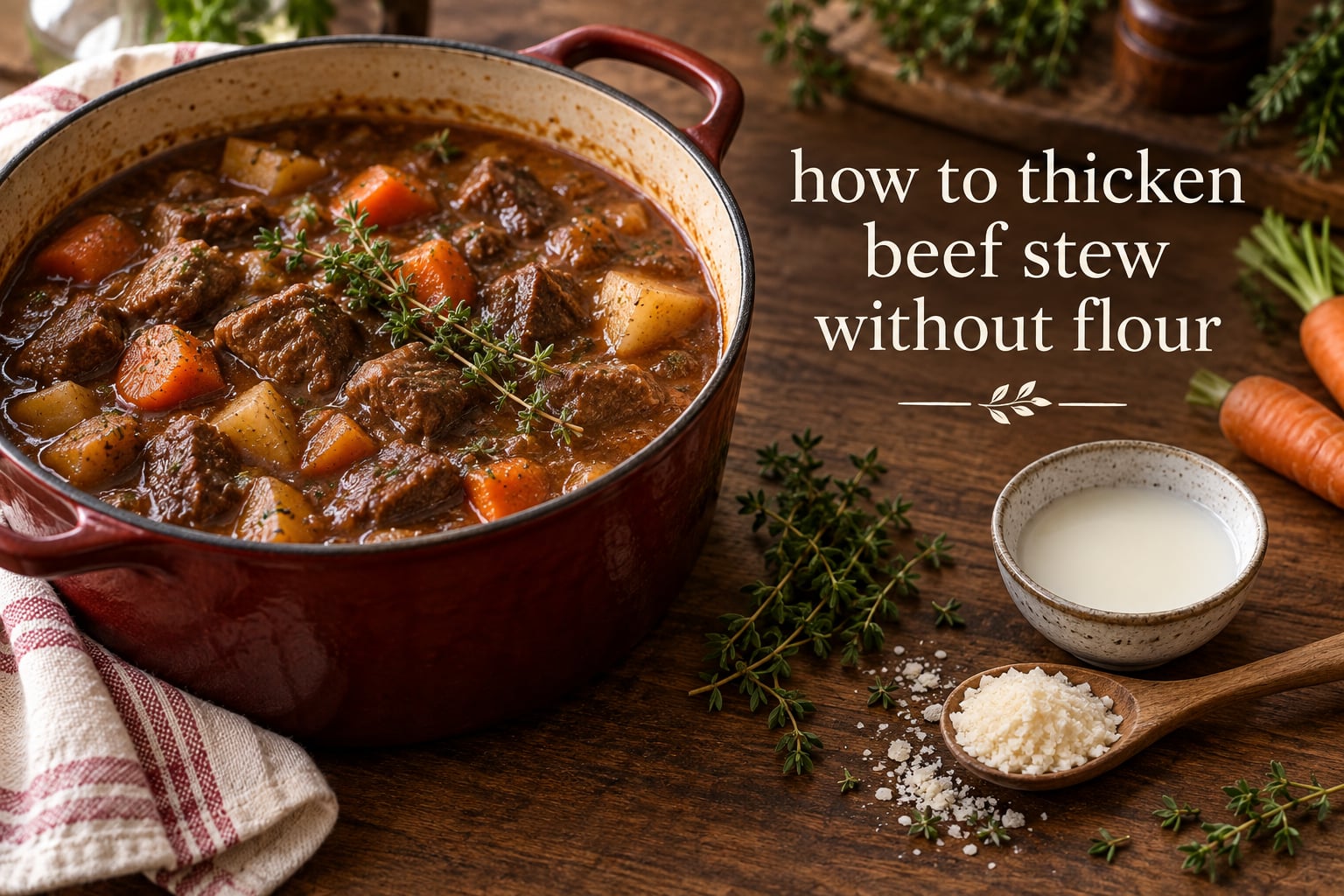
To thicken beef stew without flour, use a cornstarch slurry, stir in 1/8 to 1/4 cup of instant mashed potato flakes, or puree cooked vegetables into the pot. A cornstarch slurry is the fastest fix: mix 1 tablespoon cornstarch with 1 tablespoon cold water, pour it in while you stir, and simmer for 1 to 2 minutes until the broth coats the back of a spoon.
I test stew recipes in a 6-quart Dutch oven, usually a chuck roast braise, because that is the pot size most home cooks actually use. This guide covers the ratios for a full 4- to 6-quart batch rather than a single ladleful, and it covers the failure modes that send people back to the stove at 9pm wondering why their stew now tastes like glue.
Nobody wants to restart dinner because the broth ran thin. Thickening is a two-minute fix once you know which lever to pull, and most of the time the answer is starch suspended in cold water rather than anything more exotic.
Table of Contents
- Why Your Beef Stew Came Out Watery
- The Fastest Fixes First
- How to Thicken Beef Stew Without Flour: 9 Methods
- Thickener Comparison Table
- How to Know When Your Stew Is Thick Enough
- Troubleshooting Thin, Lumpy, and Gluey Stew
- Thickening Beef Stew in a Slow Cooker or Instant Pot
- Which Thickener Should You Use?
- Freezing and Reheating Thickened Stew
- Frequently Asked Questions
- Conclusion
Why Your Beef Stew Came Out Watery
Beef stew is thin for reasons that have nothing to do with your thickener. Chuck and other braising cuts hold a lot of water, and heat forces it out of the muscle fibres and into the pot. A pot that sat covered the whole cook traps every drop of that liquid and keeps it in circulation instead of letting it cook away.
Three other things cause a thin pot: too much liquid in the recipe to begin with, a pan too wide and shallow so the sauce has no depth, and a lean cut of beef in place of something marbled. None of these are failures. They just mean the broth needs thickening or reducing before it reaches the table.
Worth knowing: the collagen in a proper chuck braise turns into gelatin as it cooks, which is what gives a long-cooked stew its natural body. A stew that tastes thin after four hours is usually short on collagen or short on reduction, not short on thickener.
The Fastest Fixes First
When the pot is already on the stove and dinner is twenty minutes away, work down this list from the top.
| Method | Amount per quart of stew | Time | Best for |
|---|---|---|---|
| Cornstarch slurry | 1 tbsp cornstarch mixed with 1 tbsp cold water | 1-2 min simmer | Fastest, neutral flavor, gluten-free |
| Instant mashed potato flakes | 2 tbsp per quart, up to 1/4 cup for the whole pot | 5 min simmer | No starch slickness, no raw-flour taste |
| Reduction | Nothing added | 20-40 min uncovered | Free, concentrates flavor, no additives |
| Pureed vegetables | 1/2 cup puree per quart | 5 min simmer | Adds body, color, and vegetables |
| Starchy cooking water | 1/2 cup per quart | 3 min simmer | Zero cost, pantry leftover |
How to Thicken Beef Stew Without Flour: 9 Methods
1. Cornstarch slurry
Mix 1 tablespoon cornstarch with 1 tablespoon cold water in a bowl until smooth, then drizzle it into the simmering stew while stirring constantly with a whisk or spoon. Let it bubble for 1 to 2 minutes, then test the consistency. For a 6-quart pot you will need roughly 6 tablespoons of cornstarch suspended in 6 tablespoons of cold water, added in two or three rounds.
The cold water matters. Dumping dry cornstarch into hot liquid cooks the outside of each grain first, which is what creates the grainy bits people complain about. Suspending it in cold water first keeps every grain surrounded and disperses evenly.
Home cooks on cooking forums describe the gradual drizzle while the pot simmers as the single step that decides whether the batch turns silky or lumpy. They also stress simmering a couple of minutes after the thickener goes in, because cornstarch tastes distinctly starchy until the starch has fully gelatinized and cooked off.
2. Potato starch, tapioca, or arrowroot
These starches behave like cornstarch but with slightly different strengths. Potato starch is the most neutral of the three and thickens fast, so use a little less: 1 teaspoon per quart mixed with 1 teaspoon cold water. Tapioca starch gives a glossier, slightly stickier result, and arrowroot is the most forgiving under long cooking but loses thickness if it boils hard for more than an hour.
All three are gluten-free, which makes them the safe pick for celiac cooking. Arrowroot and potato starch both tolerate reheating better than cornstarch, which is worth remembering if you freeze the batch.
3. Instant mashed potato flakes
This is the method most home cooks have seen on social video, and it is the one that answers the raw-flour-taste complaint directly. Sprinkle 2 tablespoons of instant mashed potato flakes into the simmering stew per quart, so 1/8 cup for a 4-quart pot and up to 1/4 cup for a 6-quart batch, and whisk well.
The flakes absorb broth rather than suspending in it, so the result is a thicker, slightly matte body with no glaze and no raw starch flavor. Simmer for about 5 minutes so the powder hydrates fully, and taste it before adding more, because the flakes keep swelling as the pot cools off the heat.
People on the cooking forums call this the most-shared trick for thickening soup and stew without a raw flour taste, and several note it survives reheating better than a cornstarch-thickened batch.
4. Reduce the liquid
Take the lid off, raise the heat to a steady simmer, and do not stir more than once every few minutes. Twenty to forty minutes of uncovered simmering will noticeably tighten a broth, and the flavor concentrates as the water goes, which no additive can fully replicate.
The main risk is scorching. Use a wider pot than you think you need, keep the heat at a bubble rather than a rolling boil, and stir the bottom frequently in the last ten minutes. If the sauce starts catching, drop the heat and add a splash of cold water, then continue.
Reduction is the only free method on this list, and it is the one that makes the dish taste more like a stew rather than a thickened soup.
5. Pureed vegetables
Cook the vegetables longer than usual, then blend about half of them with a ladle of the cooking liquid and stir the puree back into the pot. Roughly 1/2 cup of puree per quart adds noticeable body. Potato, sweet potato, carrot, parsnip, butternut squash, and cauliflower all work, and each one carries its own color and flavor into the sauce.
The most popular approach in home kitchens is to puree a ladleful of the stew itself, vegetables and all, in a blender rather than blending a separate batch. It is smoother, less messy, and there is nothing extra to wash.
You can also drop a few cooked vegetables in a blender with broth and hit the pulse setting twice. Leave a little texture, since a completely smooth puree reads as baby food rather than stew.
6. Starchy pasta or potato cooking water
The cloudy water remaining after boiling salted potatoes or pasta is loaded with released starch and costs nothing. Stir in 1/2 cup per quart, bring to a simmer, and cook for about 3 minutes. It thickens gently and leaves a rounded, silky texture with a very faint note of the pasta water.
Save this water deliberately next time you cook. Home cooks mention it constantly as a zero-cost trick, and it works just as well in chili and soup.
7. Mashed beans and lentils
Mash 1/2 cup of cannellini, butter beans, or red lentils per quart and stir them in with about a third of a cup of the stew liquid to loosen them before adding. Let it simmer for 10 minutes. The result is a hearty, thick stew with added protein and fiber, and it does not taste like a thickener at all.
Red lentils dissolve almost completely if you cook them long enough, so they are the least noticeable option. Mushy canned beans are the fastest route, and no blending is required.
8. Cream, yogurt, or nut butter
Stirring in heavy cream softens and enriches a thin stew without making it truly thick, so pair it with a starch if you need real body. To avoid curdling dairy, warm a ladleful of the stew first, whisk the cream or Greek yogurt into it off the heat, then stir that tempered mixture back into the pot.
For a dairy-free version with the same creamy effect, stir in a spoonful of nut butter, cashew butter, or tahini. Nut butter is the traditional English method for thickening a stew, and a tablespoon or two per pot adds body and a warm, nutty depth.
9. Gelatin, or the set-and-slice approach
Unflavored gelatin is a clean, neutral option that sets rather than gels, which makes it the best choice if you want a sliceable pot pie filling. Bloom 1 packet in 1/4 cup cold broth, heat it until dissolved, and stir it back into the stew near the end of the cook.
For an instant set, dissolve a small pinch of gelatin in cold broth, bring it just to a boil in a separate pan, and pour it into the hot stew. Use very little, because more than a pinch gives the finished dish a faint rubbery chew.
Thickener Comparison Table
| Method | Per quart | Cook time | Flavor impact | Gluten-free | Freeze-thaw |
|---|---|---|---|---|---|
| Cornstarch slurry | 1 tbsp + 1 tbsp cold water | 1-2 min | Neutral if simmered | Yes | Thins slightly on reheating |
| Potato starch | 1 tsp + 1 tsp cold water | 1-2 min | None | Yes | Holds well |
| Arrowroot | 1 tsp + 1 tsp cold water | 1-2 min | None | Yes | Holds, avoid hard boil |
| Instant potato flakes | 2 tbsp | 5 min | Slight potato note | Yes | Holds well |
| Reduction | None | 20-40 min | Concentrates flavor | Yes | Holds well |
| Pureed vegetables | 1/2 cup | 5 min | Adds vegetable flavor | Yes | Holds well |
| Starchy water | 1/2 cup | 3 min | Very faint | Yes | Holds well |
| Mashed beans | 1/2 cup | 10 min | Earthy, hearty | Yes | Holds well |
| Gelatin | 1/2 packet | 3 min | None | Yes | Sets on chilling |
How to Know When Your Stew Is Thick Enough
Use the spoon-coat test. Dip a cool spoon into the pot, hold it upright for a second, then tilt it. The sauce should cling in a thin, even film that leaves a clean line across the spoon as it falls. That is the consistency of a good stew.
The ribbon test works the same way for a larger batch. Ladle some stew into a bowl, tilt it, and watch how it runs. A slow, continuous ribbon that mounds slightly before sliding off is exactly right. If it runs flat like milk, it needs more. If it sits in a stiff mound, you have gone too far and can loosen it with hot broth.
Test, do not guess. Thickening is never recoverable except by adding liquid, and liquid is far easier to add than starch is to remove.
Troubleshooting Thin, Lumpy, and Gluey Stew
The stew is still watery after adding slurry. You most likely did not give it time. Cornstarch needs 1 to 2 minutes of active simmering to reach full thickness, and it thickens a little more as the pot cools. Check again after five minutes before adding a second round.
There are lumps in the pot. The starch went in dry or the slurry was not whisked smooth first. You can rescue a lumpy batch by blending the whole pot with an immersion blender, which breaks the lumps down and turns them into the sauce.
The stew turned gluey or pasty. Too much thickener, or it boiled hard after the starch went in. Cornstarch and flour both break down and go rubbery under aggressive boiling, and an over-thickened batch will not loosen with water alone because the starch has already hydrated. The fix is to add hot broth a quarter cup at a time, stir, and simmer gently.
The stew is thin again the next day. Cornstarch loses thickness on a long cool cycle, and starch-thickened sauces keep absorbing liquid as they sit, which is why the pot looks soupier on day two. Thicken only the portion you are about to eat rather than the whole batch.
It tastes raw or pasty, not of flour. This is the most common complaint on cooking forums, and it is almost always a temperature problem rather than a thickener problem. Flour needs longer cooking, and cornstarch needs a full minute or two of bubbling to clear. Simmer gently and keep the spoon moving.
Flavor now tastes flat or oversalted. Thickening concentrates everything, so taste again after the last addition. A spoon of tomato paste, a splash of vinegar, or a pinch of sugar does more than any amount of additional thickener.
Thickening Beef Stew in a Slow Cooker or Instant Pot
A covered slow cooker is a closed system, so reduction is nearly impossible until you take the crock out. To reduce, move the stew to a saucepan on the stove, simmer it uncovered for 20 to 40 minutes, and thicken it there. Thickening inside the crock itself works fine, but stir the slurry in through the lid rather than pouring it in at the side, and give it a full 5 minutes on high before tasting.
An Instant Pot has the same closed-system problem, and pressure cooking makes it worse because water cannot escape at all. Turn the pressure cooker to saute, remove the lid, and simmer for 10 to 15 minutes to cut the liquid. Add a slurry in this order: keep the pot open, add the slurry while stirring, seal back up, and run a manual high-pressure cook for 5 minutes to blend the starch in.
For a crock pot, choose potato flakes or arrowroot over cornstarch. Both survive the long low-temperature cook without turning grainy, which is a common problem with cornstarch in slow cookers.
Which Thickener Should You Use?
Start with flavor neutrality. Cornstarch, potato starch, and arrowroot leave nothing behind, so they suit a beef stew where the braised meat and aromatics should stay in charge. Instant potato flakes add a faint potato note that reads as comfort rather than error, and pureed vegetables bring their own flavor, which is a feature if you planned for it.
Next, check the gluten-free and dietary tags. Every method on this list except a wheat-based roux is gluten-free, including instant potato flakes, which matter if anyone at the table has celiac disease. Dairy methods such as cream and yogurt are the only ones that rule out a dairy-free or vegan pot, and nut butter is the substitute that keeps the creamy body.
Then consider freezing. Reduction, pureed vegetables, mashed legumes, and instant potato flakes all survive a freeze-thaw cycle. A cornstarch-thickened stew thins noticeably in the freezer and needs a quick re-thicken on the stove, so if you batch cook, reach for the flakes.
Finally, think about reheating. Potato starch and arrowroot hold their thickness through repeated reheating, while cornstarch creeps. And if the stew is destined for a pot pie, gelatin is the only option on this list that sets into something you can slice.
Freezing and Reheating Thickened Stew
Freeze stew that is slightly thinner than you want it, because starch-thickened sauces firm up as they cool. Cool it uncovered on the counter, then refrigerate it within two hours to let the fat rise and skim off before it goes in.
When reheating from frozen, thaw overnight in the refrigerator and warm on the stove over low heat with a splash of broth. Stir the bottom often, since a cold stew heats unevenly and the part against the pan cooks much faster than the rest. A sauce that looks thin coming out of the freezer usually just needs five minutes and a stir.
Reheat only what you plan to eat. Thickening a whole batch to fix one bowl is the most common way people end up with a pot of gluey stew on day three.
Frequently Asked Questions
What do I do if my beef stew is too watery?
Start with reduction: take the lid off, simmer the pot uncovered for 20 to 40 minutes, and stir often to prevent scorching. If you need it thicker faster, make a cornstarch slurry with 1 tablespoon cornstarch and 1 tablespoon cold water, drizzle it in while stirring, and simmer for 1 to 2 minutes. Test with the spoon-coat method before adding more.
What can I use instead of flour to thicken beef stew?
The most reliable alternatives are cornstarch, potato starch, tapioca starch, and arrowroot, all used as a slurry of starch to cold water. Instant mashed potato flakes absorb broth directly, pureed vegetables add body and flavor, and beans or lentils thicken without any starch at all. Simply reducing the liquid uncovered works too and costs nothing.
How can I thicken my beef stew without flour or cornstarch?
Reduce the liquid by simmering the stew uncovered for 20 to 40 minutes, which concentrates flavor and needs no additive. Stir in 1/8 to 1/4 cup of instant mashed potato flakes for a 4- to 6-quart pot and simmer 5 minutes. Pureed potatoes or squash, mashed beans, a cup of starchy pasta water, or a spoonful of nut butter all thicken a stew with no grain starch at all.
How to thicken a stew with instant mashed potatoes?
Sprinkle instant mashed potato flakes into the simmering stew and whisk until no dry powder remains, using about 2 tablespoons per quart, so 1/8 cup for a 4-quart pot and up to 1/4 cup for a 6-quart batch. Simmer for 5 minutes so the flakes hydrate fully, then taste before adding more because they keep swelling as the pot cools.
What is the best thickener for stew?
Cornstarch slurry is the best all-round choice for speed, neutral flavor, and gluten-free status, mixing 1 tablespoon cornstarch with 1 tablespoon cold water per quart. For stew that will be frozen, instant mashed potato flakes hold their thickness best. For a pot pie filling that needs to set, use unflavored gelatin. Reduction is the best method when you have time.
Why did my stew turn out gluey after I added cornstarch?
Gluey texture almost always means too much cornstarch or a hard boil after it went in. Starch that boils vigorously breaks down and turns rubbery, and once the starch has fully hydrated it cannot be loosened with water alone. Add hot broth a quarter cup at a time, stir, and simmer gently to bring the consistency back.
Conclusion
Knowing how to thicken beef stew without flour comes down to one rule: add gradually, stir constantly, and simmer to finish. A cornstarch slurry in cold water is the fastest path, instant mashed potato flakes give the cleanest texture and no raw taste, and uncovered reduction costs nothing while deepening the flavor of the braise.
Whichever method you pick for a thin pot of beef stew, taste it after the simmer and again after it cools. Thickening is easy to add and hard to undo, and the spoon-coat test is the only honest way to know you are finished.