
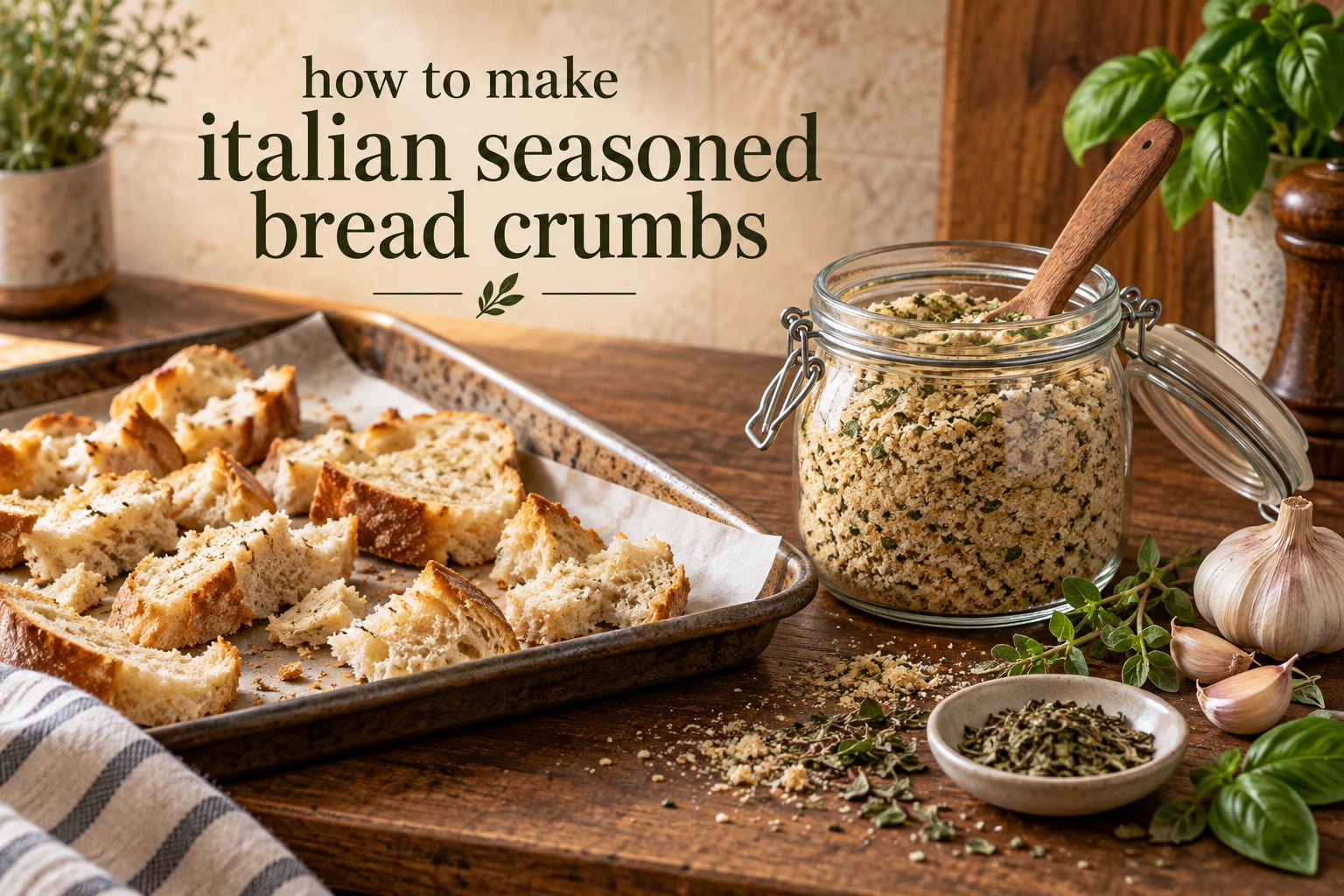
Short answer: For every 1 cup of plain breadcrumbs, add 1 teaspoon Italian seasoning, 1/4 teaspoon garlic powder, and 1/2 teaspoon kosher salt. Toss until the crumbs look evenly speckled, then use them right away or store them airtight. That single ratio is all you need to turn a box of plain crumbs into a jar of Italian breadcrumbs good enough for chicken Parmesan.
Learning how to make Italian seasoned bread crumbs takes about five minutes if you start with store-bought plain crumbs, and about twenty minutes if you build the whole thing from a loaf of bread. Both routes end in the same place: seasoned breadcrumbs that carry garlic, oregano, basil, and salt instead of the stale, faintly sweet flavor of crumbs that have been sitting in a warehouse aisle.
Most home cooks make seasoned breadcrumbs for one of three reasons: breading (chicken Parmesan, air fryer shrimp), binding (meatballs, meatloaf, veggie burgers), or topping (baked pasta, casseroles). The batch sizes below are sized for all three, and the storage section tells you how long a finished jar holds up in the pantry, the fridge, or the freezer.
Table of Contents
- What Goes Into Italian Seasoned Bread Crumbs
- Method 1: How to Make Italian Breadcrumbs Out of Regular Breadcrumbs
- Method 2: How to Make Italian Seasoned Bread Crumbs From Scratch
- Method 3: Air Fryer and Microwave Drying
- How to Choose Your Bread
- Coarse Crumbs, Fine Crumbs, or Panko
- Ways to Use Your Italian Breadcrumbs
- Troubleshooting Soggy, Clumpy, or Bland Breadcrumbs
- How to Store Breadcrumbs and How Long They Last
- Frequently Asked Questions
- What are the ingredients in Italian breadcrumbs?
- How much Italian seasoning to add to regular breadcrumbs?
- How to make Italian breadcrumbs out of regular breadcrumbs?
- What can I use instead of Italian seasoned bread crumbs?
- Do Italian bread crumbs go bad?
- How long will homemade bread crumbs last?
- How should I store bread crumbs?
- Can I save leftover bread crumbs?
- Do I need to bake breadcrumbs twice?
- Why are my breadcrumbs soggy?
- Conclusion
What Goes Into Italian Seasoned Bread Crumbs
Seasoned breadcrumbs are just breadcrumbs plus a dried herb and spice blend. There is no flour, no egg, no oil in the jar itself. The crumb supplies the structure and the seasoning supplies the flavor, which is why the ratio matters more than the brand of spice blend you reach for.
Seasoning blend (per 1 cup of crumbs)
- 1 teaspoon Italian seasoning
- 1/4 teaspoon garlic powder
- 1/2 teaspoon kosher salt
- 1/8 teaspoon red pepper flakes (optional)
- 1/3 cup finely grated Parmesan or Pecorino Romano (optional)
The crumbs themselves
- 1 cup plain breadcrumbs, homemade or store-bought
- For the from-scratch method: 4 to 6 slices of stale bread, torn rather than sliced
If you want to build your own blend instead of using a jar, combine 2 parts dried oregano, 2 parts dried basil, 2 parts dried parsley, 1 part dried thyme, 1 part dried rosemary, 1 part garlic powder, and 1 part red pepper flakes. One tablespoon of that mix stands in for the 1 teaspoon of commercial Italian seasoning called for above, so add it a little under the stated amount to keep the salt math the same.
Hold the cheese if you are storing long-term. Parmesan and Pecorino add real savoriness, but added cheese drops the shelf life of a crumb jar from weeks to days in warm conditions. Season the batch with herbs and salt, then stir grated cheese in only as you use the crumbs.
Method 1: How to Make Italian Breadcrumbs Out of Regular Breadcrumbs
This is the shortcut method, and it is the fastest answer to the question of how to make Italian breadcrumbs out of regular breadcrumbs. No oven, no food processor, five minutes of measuring. It works because the crumbs are already dry and already processed. All you are doing is adding what the commercial Italian-brand bags add.
- Measure 1 cup of plain breadcrumbs into a wide bowl. A wide bowl matters here, because the seasoning distributes faster across a shallow layer than in a tall mound.
- Add 1 teaspoon Italian seasoning, 1/4 teaspoon garlic powder, and 1/2 teaspoon kosher salt. If the breadcrumbs are unsalted, use the full 1/2 teaspoon. If you are not sure, taste one plain crumb first; store-bought plain crumbs vary a lot.
- Rub and toss with your fingers for 30 seconds so the powders coat the crumbs evenly rather than sitting in the bottom of the bowl.
- Taste, then adjust. Need more punch? Add a pinch of red pepper flakes or another 1/4 teaspoon of the blend. Transfer to a jar and keep it airtight.
Scale it the same way. Three cups of crumbs take 3 teaspoons of Italian seasoning, 3/4 teaspoon garlic powder, and 1 1/2 teaspoons salt, which is usually the right size for a full tray of breaded chicken cutlets plus what goes into the meatball mix.
Method 2: How to Make Italian Seasoned Bread Crumbs From Scratch
Homemade breadcrumbs from scratch taste better than any store-bought bag, and the base recipe takes about twenty minutes once the oven is hot. The extra work buys you two things the shortcut cannot give you: control over the crumb size, and a base with no added salt or preservatives. The steps below are the ones I use, and the order matters more than the exact minutes.
- Preheat the oven to 300F and set one rack in the middle. Line a rimmed baking sheet with parchment so the dried bread can slide without tearing, and so tiny crumbs do not bake into the pan.
- Tear 4 to 6 slices of stale bread into rough pieces. Tear, do not slice, and pull the crusts off if you want a lighter color and a finer crumb. Sourdough bakers especially benefit from scraping the crust, since a dark crust goes bitter after a long dry at 300F.
- Dry the bread for 15 to 20 minutes until it feels like a crisp cracker and no longer bends. Spread the pieces in a single layer, not touching, so air circulates between them. This first dry is the step people skip, and it is the reason fresh bread turns into damp paste in the food processor.
- Pulse in a food processor with the S-blade, working in short bursts of 3 to 5 seconds and scraping the bowl down between them. Stop when the pieces are the size of coarse gravel. Home cooks on r/Frugal report about 30 seconds of total pulsing for a batch of two slices, which lands in the same coarse range.
- Spread the crumbs on the same baking sheet in an even layer, about 1/8 inch deep, and bake at 275F for 8 to 10 more minutes. Stir once at the halfway mark. The second dry toasting step is what gives you the crunch that survives frying, and it is why the crumb layer on chicken Parmesan stays crisp instead of going soft in the first minute of baking.
- Cool completely, then season. Spread the crumbs on a plate for 20 to 30 minutes until they are room temperature and no longer warm to the touch. Season with the ratio above: 1 teaspoon Italian seasoning, 1/4 teaspoon garlic powder, and 1/2 teaspoon kosher salt per cup. Seasoning hot crumbs melts the butter-like oils in the herbs and dulls the flavor, so this pause is not optional.
A single standard loaf yields about 2 1/2 cups of homemade breadcrumbs, which is a useful number to remember because most seasoning ratios are written per cup. If you bake bread often, this is also the easiest batch-cooking job in the kitchen: make a triple batch after a weekend bake, cool it fully, and portion it out.
Method 3: Air Fryer and Microwave Drying
Neither of these alternatives is common in the recipes ranking for this query, and both save real time when you do not want to heat the whole oven. Use either one for the drying steps, then finish on the sheet method for the final toast if you want maximum crunch.
- Air fryer: Break dried bread into crumbs first, place them in the basket in a single layer, and air fry at 300F for 5 to 6 minutes, shaking the basket twice. Spread the crumbs out after processing so the hot air can reach every piece.
- Microwave: Put torn bread in a single layer on a paper towel and microwave in 30-second bursts, checking after each burst. Dry bread usually needs 60 to 90 seconds total. Let it cool before processing, because warm bread gums up the blade.
The microwave dries faster but toasts less unevenly well, so crumbs finished that way are better for binding than for breading. Bakers who store their seasoned crumbs in sealed jars in the freezer rather than the pantry, as several people on r/Sourdough do, are usually batching the oven method for exactly this reason.
How to Choose Your Bread
Stale bread is the ideal input. Day-old bread that has lost its moisture crumbles cleanly, processes into an even crumb, and dries in less oven time. Fresh bread holds too much water, and that extra moisture is what produces the moist lumps people complain about in food-processor crumbs.
A practical note for anyone fighting a loaf that molds before they can save up a batch: slice it, then wrap the slices in a cotton towel before freezing. Wrappers on r/ZeroWasteVegans report noticeably less freezer burn that way compared with plastic bags, and the bread freezes for months without going stale-hard or wet enough to mold.
Two more choices worth making deliberately:
- Crumbs from fresh bread are fine if you give the torn pieces an extra 5 minutes in the pre-dry step and cool them fully before processing.
- Gluten-free and sesame-free households get the clearest benefit from scratch crumbs, because commercial breadcrumbs are frequently produced on shared equipment and frequently contain sesame. Check labels if this matters in your kitchen.
Crust is the third choice. Leaving crust on adds color and a slightly nutty flavor; removing it gives you a paler crumb that blends into a meatball mix. Sourdough crust is the one most worth discarding.
Coarse Crumbs, Fine Crumbs, or Panko
Texture is controlled entirely by how long you pulse. Short bursts and a rough chop give you coarse crumbs that stay separate in the breading dish and stay crisp after frying. Longer pulsing gives you fine crumbs that pack down tighter, which is what you want in a meatball or meatloaf binder where the crumbs need to absorb moisture and hold the mixture together.
Panko is a distinct style rather than a texture setting. Panko-style crumbs are made from crusty bread and dried with the crust intact, so they come out lighter, crunchier, and less absorbent than a standard crumb made from sandwich bread. Coarse scratch crumbs land close to panko, which makes them the better pick for air fryer breaded shrimp and zucchini fries.
One measurement quirk catches people out: more coarse crumbs fit in a measuring cup than fine crumbs, because fine crumbs settle and compact. If you are doubling a recipe that calls for cups of fine crumbs, expect to scoop a noticeably fuller cup of coarse crumbs.
Ways to Use Your Italian Breadcrumbs
For breading. The classic use is chicken Parmesan, and the same crumbs work for eggplant parmigiana, stuffed chicken or turkey cutlets, and breaded shrimp. Press the crumb coating on firmly so it adheres during frying, and rest the breaded item on a wire rack rather than a plate so the underside does not steam.
For air fryer cooking. Mozzarella sticks, zucchini fries, and chicken tenders all benefit from crumbs seasoned this way, since the Italian herbs come through the thin coating more clearly than they do through a thick fried shell.
As a binder. Meatballs, meatloaf, veggie burgers, and black bean patties all use seasoned breadcrumbs as the moisture-holding binder. Home cooks on r/Cooking consistently name binding as the use that gets the most value out of a crumb jar, because you are working with a large quantity of crumbs and the seasoning spreads through the whole batch instead of coating one thin surface.
As a topping. Toss with melted butter and a little extra Parmesan, then scatter over baked pasta, a casserole, or a sheet-pan vegetable bake. The crumbs toast in the same oven heat that finishes the dish.
One thing to keep in mind when the crumbs are a binder rather than a coating: the salt travels with them. A meatball mix seasoned only with 1/2 teaspoon of kosher salt per cup of crumbs can land noticeably saltier than intended, because that salt is distributed through the whole finished portion. Season the meat lightly and taste the mix before adding more, then adjust the crumbs in the next batch.
Troubleshooting Soggy, Clumpy, or Bland Breadcrumbs
Almost every problem with homemade breadcrumbs comes from one of four causes, and all four are fixable without starting over.
- The crumbs are soggy or clump into damp balls. The bread went into the processor before it was fully dry, or it was still warm. Dry longer in the pre-dry step, cool to room temperature, and pulse in shorter bursts. Warm bread also sticks to the S-blade, which is why a single long pulse produces dough instead of crumbs.
- Drying is uneven, with burnt pieces next to soft ones. The layer is too thick. Spread crumbs no deeper than 1/8 inch, stir at the halfway point, and use a second sheet rather than crowding one. Also lower the heat rather than extending the time; scorching on the outside while the center stays damp is a heat problem, not a time problem.
- The crumbs are too fine. You pulsed too long. Coarse crumbs for breading, fine crumbs for binding, and to fix a too-fine batch, combine it with a fresh handful of coarse crumbs rather than trying to un-pulse it.
- The seasoning tastes flat or slightly salty. Seasoning went on while the crumbs were still warm, or the salt was added twice. Toast dried crumbs briefly after seasoning to wake up the herbs, and fix saltiness by mixing the batch with an equal volume of unseasoned crumbs.
One more frequent report: freezer-burned bread turning into a hard, dusty crumb. That is a bread-storage problem rather than a crumb problem, and the cotton-towel freezing method described above is the direct fix.
How to Store Breadcrumbs and How Long They Last
Storage method is the single biggest factor in how long homemade breadcrumbs stay good, and this is the question most often left unanswered. Fully dried, cooled, and stored airtight, the timelines are:
- Pantry, cool and dark cupboard, airtight jar or container: about 4 to 6 weeks for the herb-and-salt version.
- Refrigerator, airtight: about 2 to 3 months, and the safest choice if the crumbs contain grated Parmesan or Pecorino, which can shorten usable life in a warm pantry.
- Freezer, airtight, in portions: 6 to 9 months. Crumbs freeze remarkably well and do not clump if you cool them completely before freezing. Portion into the amounts you actually use, which is what several home cooks on r/budgetfood do when they keep large batches.
Two rules make almost all of the failures go away. Cool the crumbs completely before you close the container, because trapped warm moisture condenses and is the leading cause of mold. And always let the container come back to room temperature before opening it if you moved it between fridge and freezer, since a warm jar meeting cold air condenses inside too.
If your batch included cheese or a fresh herb, treat it as a refrigerated ingredient rather than a pantry staple. Dry herbs such as oregano, basil, and thyme keep their flavor for months, but fresh parsley or basil wilts and darkens within days of mixing.
Frequently Asked Questions
What are the ingredients in Italian breadcrumbs?
Italian breadcrumbs are plain breadcrumbs plus a dried herb and spice blend. Per 1 cup of crumbs, use 1 teaspoon Italian seasoning, 1/4 teaspoon garlic powder, and 1/2 teaspoon kosher salt. Red pepper flakes and grated Parmesan or Pecorino Romano are optional additions, and the cheese addition shortens shelf life.
How much Italian seasoning to add to regular breadcrumbs?
Add 1 teaspoon of Italian seasoning per 1 cup of plain breadcrumbs, along with 1/4 teaspoon garlic powder and 1/2 teaspoon kosher salt. Toss with your fingers for about 30 seconds so the powders coat evenly. If the store-bought crumbs are already salted, use a lighter hand and taste before adding more.
How to make Italian breadcrumbs out of regular breadcrumbs?
Measure 1 cup of plain breadcrumbs into a wide bowl. Add 1 teaspoon Italian seasoning, 1/4 teaspoon garlic powder, and 1/2 teaspoon kosher salt. Rub and toss with your fingers for 30 seconds, taste, and adjust. No baking is needed because the crumbs are already dry, so the whole job takes about five minutes.
What can I use instead of Italian seasoned bread crumbs?
Plain breadcrumbs seasoned with the same ratio work for any recipe, and you can substitute panko for a crunchier result. For binding, fine homemade breadcrumbs work in place of seasoned ones. In a casserole topping, you can use torn croutons tossed with olive oil and herbs. For gluten-free dishes, use certified gluten-free breadcrumbs and check that your spice blend is gluten free too.
Do Italian bread crumbs go bad?
Yes, eventually, and moisture is the reason. Fully dried crumbs stored airtight in a cool cupboard stay good for about 4 to 6 weeks, longer in the refrigerator. Discard crumbs that smell musty, look gray or greenish, or have visible fuzzy spots. Adding grated cheese or fresh herbs shortens usable life considerably.
How long will homemade bread crumbs last?
In an airtight container, herb-and-salt homemade breadcrumbs last about 4 to 6 weeks in a cool pantry, 2 to 3 months in the refrigerator, and 6 to 9 months in the freezer. Cool the crumbs completely before sealing them, and freeze in the portions you use so you do not thaw the whole jar.
How should I store bread crumbs?
Always use an airtight glass jar or container, and cool the crumbs fully before closing the lid. Store at room temperature in a cool dark cupboard for short term use, move to the refrigerator for longer storage, or freeze in portions. Airtight sealing prevents both moisture and the stale odors that plastic bags pick up.
Can I save leftover bread crumbs?
Yes. Freeze extra crumbs in portioned bags or jars, and you can keep it up to 6 to 9 months. Cooled crumbs freeze without clumping as long as no moisture was trapped in the container. Bread itself can also be frozen for later crumbing, and wrapping slices in a cotton towel before freezing reduces freezer burn.
Do I need to bake breadcrumbs twice?
Two drying steps give the best result. The first dry at 300F for 15 to 20 minutes removes the moisture that makes fresh bread gum up the food processor. The second, lower bake at 275F for 8 to 10 minutes toasts the crumbs and builds the crunch that survives frying. You can skip the second bake if the crumbs are only going into a meatball mix.
Why are my breadcrumbs soggy?
Almost always moisture. The bread was processed before it was fully dry, or it was still warm when it hit the food processor blade, and warmth also makes crumbs paste up. Spread crumbs in a layer no deeper than 1/8 inch, dry longer, cool completely, and pulse in 3 to 5 second bursts while scraping the bowl between them.
Conclusion
Knowing how to make Italian seasoned bread crumbs comes down to one ratio and one decision about method. The ratio is 1 teaspoon Italian seasoning, 1/4 teaspoon garlic powder, and 1/2 teaspoon kosher salt for every cup of crumbs. The decision is whether you season what you already have in five minutes or spend twenty minutes drying and processing a loaf of stale bread for a finer, salt-free base.
Whichever route you take, cool the crumbs before sealing them and store them airtight, because moisture is the only thing that will ruin a jar of homemade breadcrumbs. If you are starting from a box of plain crumbs, the shortcut is enough for dinner tonight, and you will never look at a store-bought Italian bread crumb bag the same way again.