
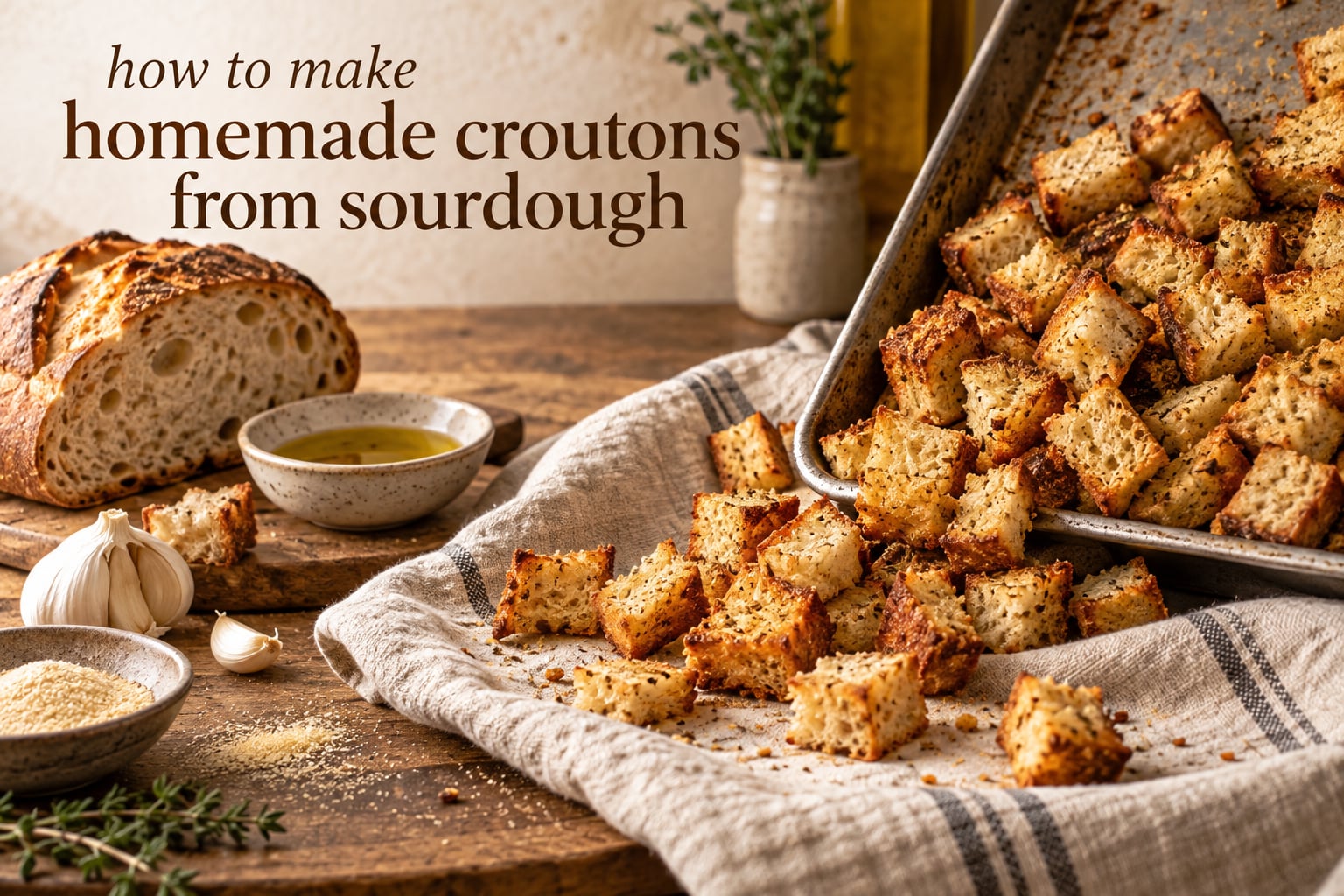
To make homemade croutons from sourdough, cut the loaf into 1-inch cubes, toss them with 2 to 3 tablespoons of olive oil and your seasonings, spread them across a rimmed baking sheet in a single layer, and bake at 400F for 12 to 15 minutes, flipping once halfway through. The whole job takes about 20 minutes start to finish, and it is the fastest good use for a loaf of sourdough that has gone a couple of days past its prime.
That last point is the reason sourdough shows up in crouton recipes so often. A country loaf keeps its sturdy crust and open, tangy crumb for days after baking, so a dense heel slice or a loaf that never quite rose still has plenty of structure left to crisp up. In our kitchen we make a batch most weeks, usually from whatever is closest to stale, and the crumb is what makes them better than a crouton cut from a soft white loaf.
Table of Contents
- The Short Answer
- Recipe Card: Sourdough Croutons
- How to Make Homemade Croutons from Sourdough (Step by Step)
- How to Make Croutons in an Air Fryer
- How to Make Croutons on the Stovetop or Under the Broiler
- What Bread to Use: Stale Sourdough vs Fresh Loaf vs a Failed Loaf
- How Big Should the Crouton Cubes Be?
- Why Croutons Go Chewy or Soft (and the Single Layer Rule)
- Seasoning Variations and Flavor Combinations
- Troubleshooting: Five Ways Croutons Go Wrong
- How to Store, Freeze, and Reheat Sourdough Croutons
- Ways to Serve Sourdough Croutons
- Frequently Asked Questions
- What’s the secret to perfect croutons?
- How long will homemade sourdough croutons last?
- What type of bread is best for making croutons?
- What is the best seasoning for homemade croutons?
- Do I need to dry out bread before making croutons?
- Can I use an air fryer for croutons?
- Can I make croutons from bread that failed to rise?
- Wrapping Up
The Short Answer
If you only need the numbers, these are the ones that matter.
- Total time: 20 minutes (5 minutes of prep, 12 to 15 minutes of baking)
- Temperature: 400F (205C), middle rack, fully preheated
- Bake time: 12 to 15 minutes, flipping the cubes once at the 7 minute mark
- Cube size: 1 inch, which is the sweet spot between salad-friendly and sturdy enough to survive soup
- Oil: 2 to 3 tablespoons per 4 cups of bread cubes, about 1 tablespoon per cup
- Seasoning: 1/2 teaspoon garlic powder, 1/2 teaspoon Italian seasoning, 1/4 teaspoon salt, 1/4 teaspoon black pepper, 1/3 cup grated parmesan
- Doneness cue: deep golden brown edges and a crunch you can hear from a foot away, not just a browned top
- Storage: up to 5 days airtight at room temperature, 2 to 3 months frozen
Four cups of bread cubes makes roughly 20 to 24 croutons, which is enough for two salads or one pot of soup plus snacking.
Last tested and updated for October 2026.
Recipe Card: Sourdough Croutons
Prep time: 5 minutes. Cook time: 12 to 15 minutes. Total time: 20 minutes. Yield: about 4 cups of croutons from a half loaf.
Ingredients
- 4 cups sourdough bread cubes, cut into 1-inch pieces (roughly half of a small loaf)
- 3 tablespoons olive oil, or melted butter, or avocado oil for a milder finish
- 1/2 teaspoon garlic powder
- 1/2 teaspoon Italian seasoning
- 1/4 teaspoon fine sea salt, plus more for finishing
- 1/4 teaspoon freshly ground black pepper
- 1/3 cup grated parmesan, optional but recommended
- Cooking spray or parchment paper for the baking sheet
Equipment
A rimmed baking sheet is the one tool that matters. The raised edge catches oil so the cubes season evenly instead of swimming, and a parchment-lined or lightly sprayed sheet keeps the cheese from welding itself to the metal.
How to Make Homemade Croutons from Sourdough (Step by Step)
Six steps, and the only one people rush is the last one. Cooling on the pan is what finishes the crisp.
Step 1: Preheat and prep the sheet. Set the oven to 400F (205C) and let it run for a full 10 minutes. While it heats, line a rimmed baking sheet with parchment or give it a light coat of cooking spray. A cold sheet drops the temperature of the oven the moment the bread hits it, which is where the first few minutes of crisping are lost.
Step 2: Cut the bread. Slice the loaf with a serrated knife and cut those slices into 1-inch cubes. Keep the crust on. It is the part that browns first and gives you the crunchy shell that holds a crouton together in a bowl of soup.
Step 3: Season and coat. Drop the cubes into a large bowl. Drizzle the olive oil over them, add the garlic powder, Italian seasoning, salt, pepper, and parmesan, then toss with your hands or a spatula for about 30 seconds. You are looking for every cube lightly glistening, with seasoning stuck to the surface, not a pool of oil at the bottom of the bowl.
Step 4: Spread in a single layer. Arrange the cubes on the baking sheet with a finger’s width of space between each one. If they touch, they steam each other instead of crisping, and you will get soft sides no matter how long you bake. Crowding one baking sheet is the single most common reason croutons come out chewy.
Step 5: Bake and flip. Bake for 12 to 15 minutes, turning the cubes once at about the 7 minute mark. Push any pale pieces toward the center of the sheet, where the heat is most even. Pull them when the edges are deep golden brown and the kitchen smells like toasted garlic.
Step 6: Cool completely. Slide the sheet onto a wire rack and let the croutons cool fully, about 10 minutes, before you move or bag them. Warm bread gives off its own trapped steam, and croutons stored warm seal that moisture inside the container and go soft overnight. This is the step that decides whether your batch lasts five days or one.
How to Make Croutons in an Air Fryer
Air fryer croutons need less oil and half the time, because the fan drives hot air past the food from every direction.
Toss the seasoned cubes as directed, then spread them across the air fryer basket in one layer with the same finger-width spacing. Air fry at 375F (190C) for 8 to 10 minutes, shaking the basket at the 4 and 7 minute marks. Check for deep golden edges rather than relying on the clock.
Because the airflow is so strong, use slightly less oil than the oven method, closer to 2 tablespoons per 4 cups. Air fryers run small, so a 4 cup batch usually needs two rounds.
How to Make Croutons on the Stovetop or Under the Broiler
A cast iron skillet is the fastest route, and it is the method most often mentioned in home baking communities for a reason: the pan holds heat like a griddle.
Heat 1 tablespoon of olive oil in a skillet over medium heat, add the seasoned cubes in a single layer, and cook for 3 to 4 minutes per side until golden on each face. Moving them a few times as they cook is worth the extra minute, since the edges crisp noticeably faster than the flat sides.
For an oven-baked batch with extra crunch, put the finished pan under the broiler for 2 to 3 minutes at the very end, keeping the oven door cracked and watching constantly. It goes from golden to scorched in seconds, so never walk away.
What Bread to Use: Stale Sourdough vs Fresh Loaf vs a Failed Loaf
Any bread works, but stale or day-old sourdough works best, because a drier crumb reaches the oven with less water to fight. That said, fresh sourdough makes perfectly good croutons, and bakers reach for a failed loaf more often than any other.
Two to four days old: the ideal window. The crumb has firmed up but still absorbs oil well, and the cubes crisp evenly all the way through.
Same day: workable, just expect a slightly softer center and a shorter bake, closer to 10 minutes. Drying the cubes out on the sheet for 5 minutes first closes the gap.
Dense or under-risen: absolutely use it. A loaf that never opened up is not ruined, it is just dense, and dense bread makes dense croutons, which is exactly what you want in a panzanella or a salad. Cut the heel and end slices first since those are the least desirable to eat on their own, and toast them a minute longer if they are especially tight.
Very hard, brittle bread: mist it with a few sprays of water and let it sit for 10 minutes so the oil has something to cling to.
How Big Should the Crouton Cubes Be?
Cut 1-inch cubes for most purposes. The size changes how the crouton behaves, and recipes that disagree are each right for a different dish.
| Cube size | Resulting texture | Best for |
|---|---|---|
| 1/2 inch | Crisp fast, very crunchy, a little brittle | Salads where you want crunch in every bite, and soups you are serving to guests |
| 1 inch | Even crispness, crunchy outside with a tender middle, holds its shape | Everything, which is why it is the default |
| 2 to 3 inch | Crisp on the outside, chewy-bready in the center, shrinks noticeably | Stirring into a big salad bowl, or eating as a snack, where the crouton is the whole bite |
Whatever size you choose, cut with a sharp knife and keep the pieces as even as you can. Uneven pieces mean the small ones burn before the large ones finish drying out, which is the most common reason a batch browns unevenly.
Why Croutons Go Chewy or Soft (and the Single Layer Rule)
Croutons crisp when heat drives the bread’s remaining moisture out as steam. The problem is that steam can also sit inside the cube and turn it chewy, and two things decide which one happens.
Space is the first thing. Cubes touching each other form a closed pocket that traps the steam they give off, so the bread cooks in its own moisture instead of drying. That is what a single layer means: roughly a finger’s width between every piece, and two sheet pans if your batch is large enough to need them.
Oil is the second thing. Oil is the moisture that leaves during baking, which is why an un-oiled cube dries to leather rather than to crunch. The useful ratio is about 1 tablespoon of oil per cup of bread cubes, so 2 to 3 tablespoons for a standard 4 cup batch. Too little and the surface never gets past dry, too much and the outside fries dark before the inside finishes drying.
Heat is the third variable, and it is a real trade-off. Higher heat (400F) gives a fast, loud crunch and a deeper color, with a higher risk of burning before the center dries. Lower heat (350F) colors more gently and dries more evenly, but the cubes can dry without ever crisping. A quick flip at the halfway point is what lets you get both.
Seasoning Variations and Flavor Combinations
The base blend of garlic powder, Italian seasoning, salt, and pepper is a solid default. These swaps work with the same 4 cup batch, using the same 2 to 3 tablespoons of oil.
| Flavor profile | What to add to the base | Best dish |
|---|---|---|
| Classic Italian | Base blend plus 1/3 cup grated parmesan | Caesar salad, tomato soup |
| Cheesy | Swap parmesan for 1/2 cup shredded mozzarella and 1/4 cup pecorino | Greek salad, baked pasta casseroles |
| Smoky | Add 1/2 teaspoon smoked paprika and 1/4 teaspoon chipotle powder | Bean soups, chili, black bean salad |
| Herbed | Use 1 tablespoon fresh rosemary, minced, instead of Italian seasoning, plus lemon zest | Roast chicken salad, lamb and feta salad |
| Sweet | Drizzle 1 tablespoon honey or maple and add 1 teaspoon cinnamon, 1 tablespoon sugar | Apple salad, breakfast yogurt bowls |
| Spicy | Add 1 teaspoon red pepper flakes or cayenne and 1/2 teaspoon cumin | Gazpacho, tomato soup, snack bowl |
Mix the seasonings into the oil first when the oil is what carries the flavor, which is the case with the smoked, sweet, and spicy profiles. Parmesan goes on with the dry seasonings so it browns without burning before the bread is done.
Troubleshooting: Five Ways Croutons Go Wrong
| Problem | What caused it | Fix |
|---|---|---|
| Chewy or bready in the center | Cubes too large, sheet overcrowded, or heat too low | Cut to 1 inch, use a second pan, and bake at 400F with a mid-bake flip |
| Soggy and soft all over | Not enough oil, so the bread dried out instead of crisping | Add 1 more tablespoon of oil per 4 cups and toss longer before baking |
| Burnt outside, raw inside | Heat too high for the piece size, or cubes sitting too close together | Drop to 375F, spread out fully, and pull at the first sound of crunch |
| Uneven browning | Pieces cut at different sizes, or the batch was not flipped | Measure your cuts and turn everything once at the halfway point |
| Soft again the next day | Stored warm, or the container was not airtight | Cool fully on a rack, then seal airtight, or refresh at 300F for 5 minutes |
If a batch comes out soft after all of that, the oven is the next suspect rather than the bread. A thermometer on the middle rack is a cheap fix for an oven that runs 25 degrees cool.
How to Store, Freeze, and Reheat Sourdough Croutons
Homemade sourdough croutons stay crisp for 5 days in an airtight container at room temperature, and 2 to 3 months in the freezer. The storage method matters more than the timeline.
| Method | How to do it | How long it stays crisp |
|---|---|---|
| Room temperature | Cool completely, then store in an airtight container or sealed bag at room temperature | Up to 5 days |
| With a bread slice | Add a plain slice of bread to the container so its starch absorbs moisture instead of the croutons | Extends storage by a couple of days |
| Refrigerator | Airtight, sealed well | About 1 week, though the texture softens faster than at room temperature |
| Freezer | Cool fully, seal airtight, freeze flat in a single layer, then stack | 2 to 3 months |
| Reheat in oven | Spread on a baking sheet at 300F for 5 to 8 minutes until crisp again | Best full crunch |
| Reheat in air fryer | 300F for 3 to 4 minutes, shaking the basket | Fastest full crunch |
Never seal warm croutons. The moisture they release while cooling gets trapped, which is why a batch stored straight off the baking sheet is soft by morning and a batch stored after a full 10 minute cool is still snapping on day four.
Ways to Serve Sourdough Croutons
Croutons are a topping first and a base second. A Caesar salad, a panzanella made with torn bread and ripe tomatoes, and a bowl of gazpacho are the classic uses, and they all take the same batch.
For soups, add croutons to each individual bowl at the table rather than to the pot. A large batch of croutons sitting in tomato soup absorbs liquid and goes soft within a few minutes, and no amount of reheating later brings that back.
One last note on cutting the loaf: save a few slices of the dense heel to blitz into breadcrumbs for coating cutlets or topping a pasta bake. Same loaf, ten extra minutes, and you get two things out of it instead of one.
Frequently Asked Questions
What’s the secret to perfect croutons?
Space, oil, and full cooling. Spread the cubes in a single layer with a finger’s width between them so they crisp instead of steaming, use about 1 tablespoon of oil per cup of bread, and let the batch cool completely on the pan before storing it. A mid-bake flip is what evens out the browning.
How long will homemade sourdough croutons last?
Up to 5 days in an airtight container at room temperature, about 1 week refrigerated, and 2 to 3 months frozen. Cool the croutons fully on a wire rack first, because sealing them while warm traps the steam and makes them soft overnight.
What type of bread is best for making croutons?
Stale or day-old sourdough works best because a drier crumb has less water to fight during baking, but a fresh loaf works too. A dense or under-risen loaf is also a good choice, since its firm crumb is exactly what you want in a crouton.
What is the best seasoning for homemade croutons?
The strongest simple blend is 1/2 teaspoon garlic powder, 1/2 teaspoon Italian seasoning, 1/4 teaspoon salt, 1/4 teaspoon black pepper, and 1/3 cup grated parmesan per 4 cups of bread cubes, tossed with 2 to 3 tablespoons of olive oil. Smoked paprika, red pepper flakes, fresh rosemary, and honey with cinnamon are the easiest swaps.
Do I need to dry out bread before making croutons?
No. Bread two to four days old needs no pre-drying, and bread cut fresh from the loaf can be spread on the sheet for 5 minutes first if you want the extra-dry result. The oven does the drying either way.
Can I use an air fryer for croutons?
Yes. Air fry at 375F for 8 to 10 minutes, shaking the basket at the 4 and 7 minute marks, and use slightly less oil than the oven method. A 4 cup batch usually needs two rounds in a small basket.
Can I make croutons from bread that failed to rise?
Yes, and many bakers prefer it. A dense loaf has a firm crumb that dries out into a solid crouton, and a sturdy sourdough crust holds up to high heat without collapsing. Cut the heel and end slices first and toast them a minute longer if they are very tight.
Wrapping Up
Learning how to make homemade croutons from sourdough is a 20 minute exercise, and the recipe barely changes no matter what state the loaf is in. Bake at 400F for 12 to 15 minutes, keep the cubes in a single layer, use about a tablespoon of oil per cup, and let them cool completely before they go anywhere near a container.
Three things decide whether a batch is good, and none of them are the recipe: space on the sheet, enough oil, and a full cool on the rack. Get those right and a day-old heel slice, a failed loaf, or a whole sourdough boule all turn into the same crunchy result. Since our best batches have come from bread that was one day past what we wanted to eat, that is where we would start.