
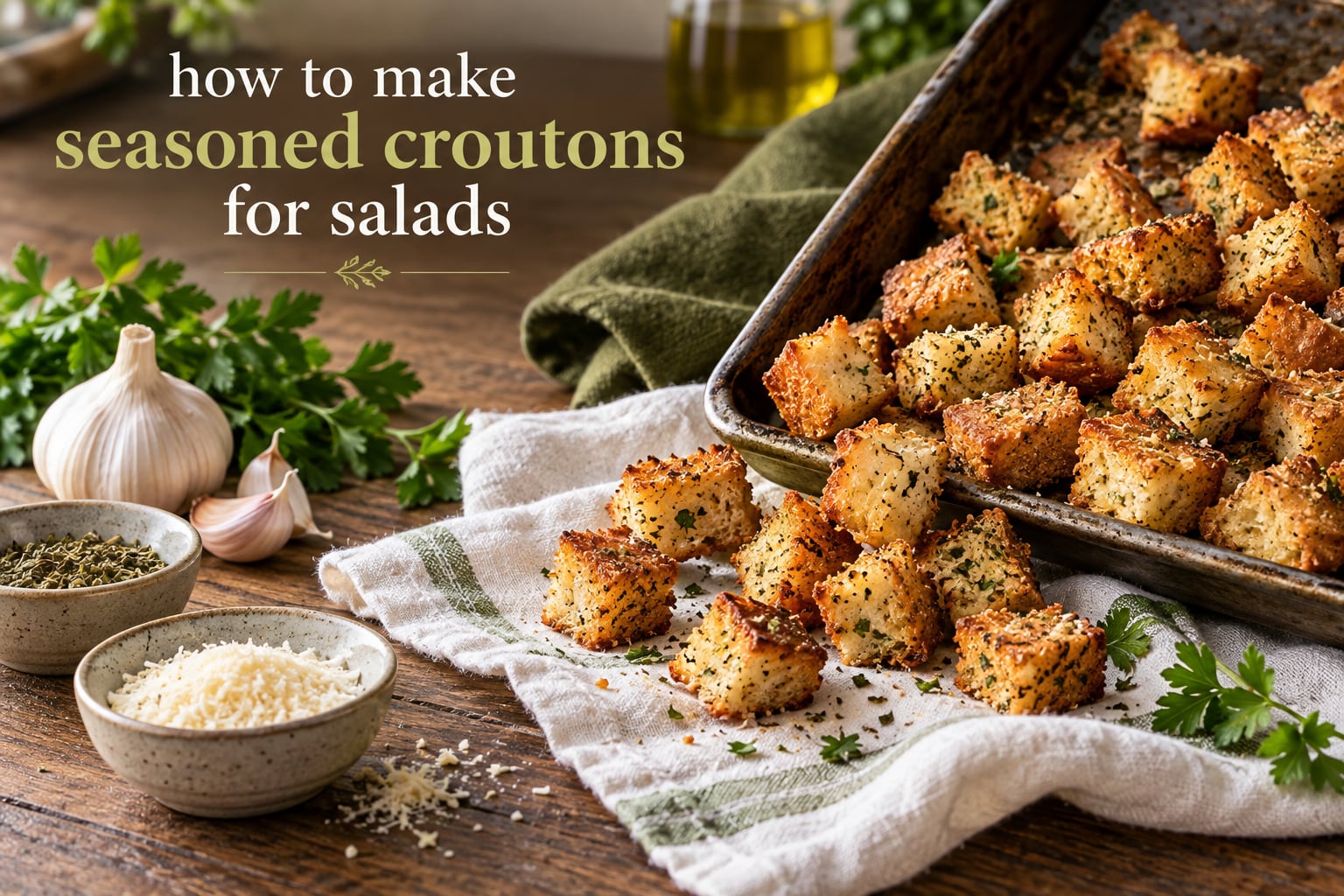
If you want to know how to make seasoned croutons for salads, here is the whole method in one sentence: cube a loaf of day-old bread into 3/4-inch pieces, toss with 2 to 3 tablespoons of olive oil, season with garlic powder, Italian seasoning, fine sea salt and black pepper, then bake at 375°F for 15 to 20 minutes, tossing once halfway through, until golden brown and crunchy. Tested and updated for October 2026.
I make a batch almost every week because it is the fastest way to fix a salad that tastes flat. A bowl of greens and dressing has crunch, so every bite is soft. Ten minutes of work and one sheet pan changes that.
The other reason to make them yourself is the ratio. Store-bought croutons are usually stale and barely seasoned, and home cooks rarely know how much oil and how much spice to use per loaf. Below is a formula that scales cleanly, the seasoning blends that suit different salads, and what to do when they turn out soft or burnt.
Table of Contents
- What You Need for Seasoned Croutons
- How to Make Seasoned Croutons for Salads: The 5-Step Method
- The Secret to Crispy Croutons
- Which Seasoning Goes With Which Salad
- How to Make Croutons Like Olive Garden
- Skillet and Air Fryer Methods
- How to Choose Your Bread
- Troubleshooting: Why Are My Croutons Soggy
- How to Store Croutons So They Stay Crunchy
- Ways to Use Homemade Croutons
- Frequently Asked Questions
- What is the best seasoning for homemade croutons?
- How can I make flavored croutons?
- How to make croutons like Olive Garden?
- What’s the secret to crispy croutons?
- Why are my croutons soggy?
- Can I make croutons ahead of time?
- Should I use fresh or stale bread for croutons?
- Do croutons get soggy in a dressed salad?
- Conclusion
What You Need for Seasoned Croutons
The ingredient list is three categories: bread for structure, fat as the carrier, and a dry aromatic blend for flavor. Get the ratio right and almost any loaf works.
- 1 loaf day-old bread, about 4 to 5 cups once cubed
- 2 to 3 tablespoons olive oil, or the same amount of melted butter
- 2 teaspoons Italian seasoning
- 1 teaspoon garlic powder
- 3/4 teaspoon fine sea salt
- 1/2 teaspoon black pepper
- 2 tablespoons grated Parmesan, added after baking (optional)
- Fresh parsley or basil, torn and added after baking (optional)
Day-old means two or more days old with no interior moisture left, not bread that has gone bad. If your loaf is fresh, slice it and let the slices sit out uncovered for a few hours, or spread them on a sheet pan and warm them briefly in the oven.
Recipe card summary: prep 10 minutes, cook 15 to 20 minutes, total 30 minutes, yield about 6 cups of croutons, roughly 25 to 30 pieces depending on cube size.
How to Make Seasoned Croutons for Salads: The 5-Step Method
Crisp, evenly seasoned croutons come down to five steps, and the order matters more than the temperature.
- Cut or tear uniform cubes. Aim for 3/4-inch pieces. Even size is what makes one sheet pan finish at the same rate, which is the difference between golden croutons and a pan of pale centers with burnt corners.
- Toss with oil. Drizzle 2 to 3 tablespoons of olive oil over the cubes in a large bowl and toss until every face looks faintly shiny. You want coated, not drenched. Melted butter gives a richer, nuttier result for people who do not need a vegan plate.
- Add the seasonings. Sprinkle on the Italian seasoning, garlic powder, salt and pepper, then toss again for 30 seconds so the powder spreads instead of settling in one clump. Taste a small pinch of the oil-and-spice mix before it goes on the bread if you are doubling the batch.
- Spread in a single layer on a baking sheet. Use parchment if you have it. Leave space between every cube. Touching pieces steam each other, and steamed bread never crisps.
- Bake at 375°F for 15 to 20 minutes, tossing halfway through. Pull them when they are deep golden brown and the centers sound hollow when you tap one. Cool completely on the sheet before storing.
If your oven runs hot and the edges darken before the centers take color, drop to 350°F and add a few minutes rather than pulling the pan early. Pale, under-baked croutons turn chewy once they cool.
The Secret to Crispy Croutons
The secret to crispy croutons is dry bread and space. Use day-old bread, coat it lightly rather than heavily in oil, spread the cubes in a single layer so they never steam each other, bake at 375°F tossing once, and let them cool completely on the sheet before storing. Trapped moisture is what softens them.
Which Seasoning Goes With Which Salad
Garlic powder plus Italian seasoning is the best general seasoning for homemade croutons, finished with flaky salt and cracked black pepper. Once you have that base down, swap the blend to match the bowl. The table below maps six salad styles to the blend and add-in that work best for each.
| Salad style | Seasoning blend | Optional add-in | Why it works |
|---|---|---|---|
| Caesar | Garlic powder, black pepper, 1/2 tsp Dijon powder | Grated Parmesan after baking | Mimics the anchovy and Parmesan bite without the fuss |
| Garden or Italian | 2 tsp Italian seasoning, 1 tsp garlic powder | Torn basil and a drizzle of olive oil | The classic blend, bright enough for tomato and cucumber |
| Greek | 1 tsp dried oregano, 1/2 tsp lemon zest | Crumbled feta after baking | Oregano and feta read as the same flavor family |
| Southwestern or Tex-Mex | 1 tsp smoked paprika, 1/2 tsp cumin, pinch of cayenne | Crumbled cotija or Monterey Jack | Warm spices hold up against lime and chili heat |
| Broccoli or cheesy salad | 1 tsp onion powder, 1/2 tsp black pepper | Sharp cheddar after baking | Onion powder gives the savory depth shredded cheese tops cannot |
| Soup and stew pairings | Thyme, rosemary, or sage, 1/2 tsp | Nothing, keep them plain | A single herb reads as the soup without masking it |
Two rules keep the blends from going wrong. Skip garlic salt when you already season with fine sea salt, or the batch turns aggressively salty. And add grated cheese after the bake, never before, because Parmesan and cheddar brown and burn long before the bread finishes drying out.
Fresh herbs are the other half of the rule. Dried herbs survive 15 to 20 minutes in a hot oven, so they go in before baking. Fresh herbs scorch, so parsley, basil and cilantro get torn over the cooled croutons instead. Everything bagel seasoning, za’atar, and a smoked paprika plus honey drizzle all work as savory-sweet experiments on the same formula.
How to Make Croutons Like Olive Garden
Restaurant-style croutons use larger 1-inch cubes, melted butter mixed with garlic powder and parsley, and a slightly lower, longer bake at 350°F for about 20 minutes so the outside browns while the center stays airy.
Tossing once at the halfway mark is what keeps the color even, and the bigger cube is the real trick. It gives you a crisp shell around a soft middle, which is exactly what a bowl of romaine expects. The parsley goes in with the butter, not after, because the long gentle bake will not scorch it.
Skillet and Air Fryer Methods
You do not need an oven at all. Both alternatives follow the same cut, oil and season steps, then change only the heat source.
Skillet, about 20 minutes: Heat 2 tablespoons of olive oil in a wide skillet over medium-low heat. Add the seasoned cubes in one layer and let them sit undisturbed for 3 to 4 minutes before turning. Keep the heat moderate; high heat burns the outside while the center stays soft. Repeat until everything is deep golden, then drain on a paper towel. A very thin coat of oil, plus a finishing sprinkle of olive oil once the pieces are dry, helps the seasoning stick.
Air fryer, about 4 minutes at 350°F: Toss the seasoned cubes with 1 teaspoon of oil, spread them in the basket in a single layer, and air fry at 350°F for 4 minutes, shaking the basket halfway. Check early, since air fryers run hot and the cubes are small.
How to Choose Your Bread
Day-old French, sourdough or Italian bread gives the best croutons, and any of them beats bread that is too soft. The tradeoff is density: whole wheat works, but dense whole-wheat sourdough tends to come out heavy and hard.
| Bread | Result | Note |
|---|---|---|
| Day-old sourdough | Best texture | Chews well, holds a lot of seasoning in the open crumb |
| Day-old French or Italian | Light, airy, porous | The safest all-purpose choice for a big salad bowl |
| Fresh bread | Works, slightly softer | Dry the slices first, or the centers turn gummy |
| Whole wheat | Heartier, nuttier | Skip dense whole-grain sourdough, the crumb is too tight |
| Gluten-free or protein bread | Crumbly, more fragile | Use a gentle toss and bake a minute or two less |
Torn bread beats clean cubes for holding seasoning. The ragged edges create nooks that catch oil and dried herbs, which is why many cooks tear sourdough instead of cutting it. The trade-off is a less uniform pan, so tear everything roughly the same size. If your loaf failed to rise properly or is going stale, this is the best use for it.
Troubleshooting: Why Are My Croutons Soggy
Soft croutons almost always come down to moisture, crowding, or not cooling fully before storage. Here are the four fixes that cover nearly every case.
| Problem | Likely cause | Fix |
|---|---|---|
| Soft or chewy center | Too much oil, or under-baked | Use 2 to 3 tablespoons of oil per loaf and bake to deep golden, not light gold |
| Uneven color, pale pieces | Cubes touching and steaming each other | Spread in one layer with space, and use two sheet pans for a double batch |
| Burnt edges, pale centers | Heat too high, bread too fresh | Drop to 350°F and start with drier bread |
| Bland seasoning | Oil too heavy, or seasoning added before the bread dried | Taste the oil-spice mix first, and finish with flaky salt after baking |
| Soggy after two days | Stored warm, or sealed before fully cooled | Cool fully on the sheet, then store airtight at room temperature |
Uniform cube size is the single biggest lever. Mixed sizes finish at different rates, so the small pieces burn and the large ones stay soft, and that is the pan most people describe as unevenly browned.
How to Store Croutons So They Stay Crunchy
Homemade croutons stay crunchy for 5 to 7 days in an airtight container at room temperature. The container matters more than the day count, because any trapped moisture softens the crust.
| Method | How long they stay crisp | How to bring them back |
|---|---|---|
| Airtight container at room temperature | 5 to 7 days | Bake at 350°F for 5 minutes |
| Freezer in a sealed bag | Up to 3 months | Reheat straight from frozen at 350°F for 8 to 10 minutes |
| Left out on a plate | A few hours | Not worth it, they absorb kitchen moisture fast |
Do not store them while warm. The residual steam from the oven condenses on the crust, and that is the number one reason a batch felt crisp at 5 pm and soft by breakfast.
Making croutons ahead is easy. Bake them up to two days early, store them airtight, and re-crisp at 350°F for 5 minutes right before serving so they hit the table hot and loud.
Ways to Use Homemade Croutons
Seasoned croutons do more than top a salad, and the ones in this batch are seasoned enough to eat on their own. A few reliable pairings:
- Caesar salad, with Parmesan and black pepper in the blend
- Greek salad, with oregano and crumbled feta
- Tomato soup and any thick soup, where they float rather than sink
- Gazpacho, where the croutons stand in for the traditional bread base
- Holiday stuffing, as the crisp base before you add stock
- Breadcrumbs for casseroles and gratins, pulsed coarsely
One habit fixes the soggy-in-the-bowl problem entirely: add croutons at the table, not before serving, and dress the salad separately if it will sit. A crouton that spends 30 minutes in dressing is a crouton that has gone soft, no matter how well you baked it.
Frequently Asked Questions
What is the best seasoning for homemade croutons?
Garlic powder plus Italian seasoning, finished with flaky salt and cracked black pepper. That blend works on almost any salad. Skip garlic salt if you already season with fine sea salt, and add grated Parmesan after baking so it crisps instead of burning. Dried herbs go in before the bake, fresh herbs after.
How can I make flavored croutons?
Start from the same base: day-old bread, 2 to 3 tablespoons of olive oil per loaf, baked at 375°F for 15 to 20 minutes. Then change the blend. Italian seasoning for a garden salad, Parmesan and black pepper for Caesar, oregano and lemon zest for Greek, smoked paprika and cumin for Southwestern. Add grated cheese after the bake.
How to make croutons like Olive Garden?
Restaurant-style croutons use slightly larger 1-inch cubes, melted butter mixed with garlic powder and parsley, and a longer bake at 350°F for about 20 minutes so the outside browns while the center stays airy. Tossing once at the halfway mark keeps the color even, and the parsley goes in with the butter.
What’s the secret to crispy croutons?
Dry bread and space. Use day-old bread, coat it lightly rather than heavily in oil, spread the cubes in a single layer so they never steam each other, bake at 375°F tossing once, and let them cool completely on the sheet before storing. Trapped moisture is what softens them.
Why are my croutons soggy?
Four causes cover nearly every case: too much oil, cubes touching so they steam each other, pulling the pan before the centers dry out, and storing them before they have cooled completely. Use 2 to 3 tablespoons of oil per loaf, spread in one layer, bake to deep golden, and cool on the sheet before sealing.
Can I make croutons ahead of time?
Yes. Bake them up to two days ahead, cool fully, and store airtight at room temperature for 5 to 7 days. Re-crisp at 350°F for 5 minutes right before serving. For longer storage, freeze them in a sealed bag for up to 3 months and reheat from frozen at 350°F for 8 to 10 minutes.
Should I use fresh or stale bread for croutons?
Day-old bread works best, meaning two or more days old with no interior moisture. If you only have a fresh loaf, slice it and let the slices sit out uncovered for a few hours so the surface dries. Whole wheat is fine, but dense whole-wheat sourdough makes heavy, hard croutons.
Do croutons get soggy in a dressed salad?
Yes, and the timing is the cause. Any crouton that sits in dressing for 30 minutes absorbs liquid and loses its crust. Add them at the table after the salad is dressed, and if the salad will sit, hold the croutons back and scatter them on each serving.
Conclusion
To make seasoned croutons for salads, the formula is simple: one day-old loaf, 2 to 3 tablespoons of olive oil, 2 teaspoons of Italian seasoning, 1 teaspoon of garlic powder, 3/4 teaspoon of salt, 1/2 teaspoon of pepper, baked at 375°F for 15 to 20 minutes in a single layer.
Make your first batch plain, then use the seasoning matrix to build a version for the salad you actually make. Start with the loaf on your counter that is going stale, and you will never buy croutons again.
{ “@context”: “https://schema.org”, “@type”: “Recipe”, “name”: “How To Make Seasoned Croutons For Salads”, “description”: “Day-old bread tossed in olive oil, garlic powder, Italian seasoning, salt and pepper, baked at 375°F until golden and crunchy.”, “prepTime”: “PT10M”, “cookTime”: “PT20M”, “totalTime”: “PT30M”, “recipeYield”: “6 cups, about 25 to 30 croutons”, “recipeIngredient”: [ “1 loaf day-old bread, cut or torn into 3/4-inch cubes”, “2 to 3 tablespoons olive oil or melted butter”, “2 teaspoons Italian seasoning”, “1 teaspoon garlic powder”, “3/4 teaspoon fine sea salt”, “1/2 teaspoon black pepper”, “2 tablespoons grated Parmesan, optional, added after baking” ], “recipeInstructions”: [ {“@type”: “HowToStep”, “text”: “Cut or tear the bread into uniform 3/4-inch cubes.”}, {“@type”: “HowToStep”, “text”: “Drizzle with olive oil and toss until every cube is lightly coated.”}, {“@type”: “HowToStep”, “text”: “Add garlic powder, Italian seasoning, salt and pepper and toss again.”}, {“@type”: “HowToStep”, “text”: “Spread in a single layer on a parchment-lined baking sheet.”}, {“@type”: “HowToStep”, “text”: “Bake at 375°F for 15 to 20 minutes, tossing halfway through, until deep golden brown.”}, {“@type”: “HowToStep”, “text”: “Cool completely on the sheet before storing.”} ], “keywords”: “seasoned croutons, homemade croutons, croutons for salad, olive oil, garlic powder, Italian seasoning, 375 degrees” }