
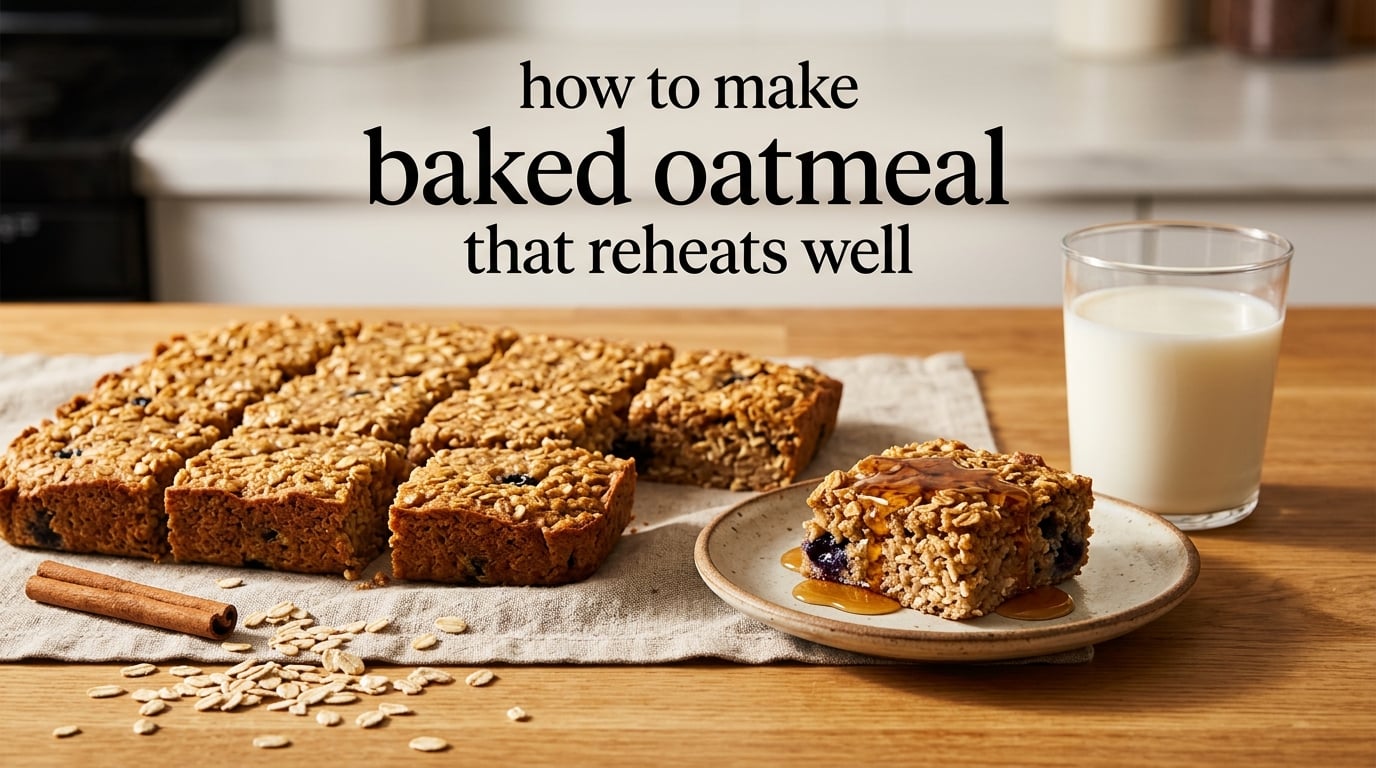
Baked oatmeal is one of the most useful make-ahead breakfasts a home cook can make, and it is also the one most often ruined on day two. The reason is simple: most recipes are formulated to taste good straight from the oven, not to survive a microwave two days later. Getting baked oatmeal that reheats well is less about the recipe you start from and more about three structural decisions you make before the oven preheats.
Getting baked oatmeal that reheats well comes down to this: build the bake with a binder and a restrained liquid ratio, bake it until the center is fully set rather than just hot, cool it completely before cutting, and reheat it with a small amount of added moisture. That combination is the whole method. Everything below expands it.
I tested this across several batches with different oat types, pan sizes, and storage windows, and the same pattern held every time. What changed between a batch that turned to paste on Wednesday and a batch that reheated like it was fresh came down to the ratio of liquid to oats, the presence of a real binder, and whether the pan was covered loosely while it baked.
Table of Contents
- Why Most Baked Oatmeal Turns Mushy (And the Three Fixes)
- How to Make Baked Oatmeal That Reheats Well: Build It in Nine Steps
- Choosing Your Base: Oat Type, Binder, and Liquid Ratio
- How to Reheat Baked Oatmeal: Times by Method
- Can You Reheat Baked Oatmeal More Than Once?
- How Far Ahead Can You Make Baked Oatmeal?
- Should Baked Oatmeal Be Refrigerated After Baking?
- Sunday Bake, Weekday Reheat: A Meal-Prep Workflow
- Troubleshooting Baked Oatmeal That Reheats Wrong
- Savory Baked Oatmeal Reheats by Different Rules
- Frequently Asked Questions
- What’s the best way to reheat baked oatmeal?
- Can baked oatmeal be reheated?
- Can I make baked oatmeal ahead of time?
- Can oatmeal be made in advance and reheated?
- Can baked oatmeal be prepared ahead of time?
- Should baked oatmeal be refrigerated after baking?
- Is baked oatmeal good for meal prep?
- What’s the secret to perfect baked oatmeal?
- Conclusion
Why Most Baked Oatmeal Turns Mushy (And the Three Fixes)
Three causes account for nearly every soggy batch, and you can diagnose which one you have by looking at the pan before you reheat a single square.
1. Too much liquid for the pan size. Oat starch needs liquid to soften, and it needs heat to set. When there is more liquid than the oats can absorb and set, the center stays in a suspension that never firms, and reheating simply makes it looser. The pan matters here: the same batter in a 9×13 is drier than in an 8×8, because the same volume of liquid is spread across more surface area for a longer bake.
2. No binder. Baked oatmeal without egg or a flax egg is held together by hydrated starch alone. That is enough for a fork, not enough for a square you can pick up out of a lunch container. On reheat day those squares crumble, and people then describe the whole batch as bad.
3. Skipping the rest. A five to ten minute pause after mixing lets the oats drink the liquid before they hit heat. Without it, liquid sits on top during the bake, the top sets hard, and the center steams itself into a gummy pocket that reheats into rubber.
Fix it in one line: rest the batter 10 minutes, add a binder, and cut the liquid by roughly a quarter cup for an 8×8 pan. Those three changes alone convert most mushy recipes into make-ahead recipes.
How to Make Baked Oatmeal That Reheats Well: Build It in Nine Steps
Here is the build sequence I use. Each step exists to protect the texture on reheat day, not just the texture out of the oven.
- Pick the pan before you mix. An 8×8 square for a small household, a 9×9 for a standard batch, a 9×13 when you are feeding a family all week. Wider pans need less liquid, not more.
- Grease and line. Butter or oil the sides, then add a parchment sheet with the edges standing up. A rim of parchment gives you a handle to lift squares out, and it keeps the edges from welding themselves to the metal.
- Whisk the wet ingredients first. Milk, eggs, maple syrup, melted butter, and vanilla go into the bowl before the oats, so the binder is evenly distributed instead of clumping in one corner.
- Fold in the oats gently. Stir until you see no dry patches, then stop. Overmixing develops a gummy paste in the wet spots, which is exactly what you do not want on day three.
- Rest the batter for 10 minutes. The surface will look thick and matte rather than soupy. That texture change is your cue that the oats have hydrated.
- Bake at 350F until the center is set. Expect roughly 30 to 40 minutes for an 8×8 and closer to 40 to 45 for a 9×13. The center should feel firm to a light press and the edges should pull away from the pan.
- Tent with foil for the last 8 to 10 minutes. This traps steam so the interior finishes moist instead of drying out, and it protects the top from over-browning while the middle sets.
- Test doneness in the center, not the edge. A cake tester or a thin knife should come out clean or with only moist crumbs. Edges always set first, so testing the edge tells you nothing.
- Cool completely in the pan before cutting. Warm baked oatmeal is fragile. Cutting it too soon gives you ragged, crumbly squares that never recover, even after a good reheat. Two hours on the counter, or 30 minutes if you need to speed it up in the fridge.
On doneness, one thing to remember: underbaking is a reheat problem, and overbaking is a reheat problem in the other direction. An underdone center reheats into mush because it never set. An overdone bake reheats into a dry brick because all the moisture left the crumb in the oven.
Choosing Your Base: Oat Type, Binder, and Liquid Ratio
Old-fashioned rolled oats are the safest choice for make-ahead baking. The flakes stay distinct, hold a slice together, and reheat to a chewy rather than gluey texture. This is the oat type most make-ahead recipes are built around, and it is the one I return to.
Quick oats break down faster, which means a softer, more compact crumb. They reheat well but slice less cleanly, so expect slightly crumbly edges and cut with a sharp knife rather than a dull one.
Steel-cut oats are the weakest choice for reheating. They absorb liquid slowly, so they stay firm in a way that reads as undercooked on day one and turns dry and hard after a microwave. If steel-cut is your only option, add extra liquid and expect to lean on the moisture restoration step below.
On the binder, an egg is the simplest and the strongest. A flax egg works well as a substitute: combine 1 tablespoon of ground flaxseed with 3 tablespoons of water, let it sit 5 minutes until it thickens, then stir it into the wet ingredients. The slices hold together noticeably better with either binder present, and that is what makes portable squares possible.
The liquid-to-oat ratio is the variable you are most likely to have wrong. As a working baseline, 2 cups of dry oats take about 1.5 cups of milk plus 2 eggs. Going to a 9×13, cut roughly a quarter cup of liquid. Going to a half batch, keep the same ratio and reduce the bake time by five to eight minutes, checking doneness early.
How to Reheat Baked Oatmeal: Times by Method
Reheat times vary more by the state of the oatmeal than by the appliance. Use these as starting points, and always check the center rather than the edge.
Microwave, from refrigerated: 30 to 45 seconds on full power for one square or a bowl-sized portion. Cover with a plate or a damp paper towel to trap steam.
Microwave, from frozen: 15 to 20 seconds to thaw the surface, then 45 to 60 seconds more. Two short bursts beat one long one, because the outside reheats long before the center does.
Oven, from refrigerated: 350F for 12 to 15 minutes, loosely covered with foil. Uncovered it will reheat faster but dry the surface.
Oven, from frozen: 350F for 20 to 25 minutes, covered. Wrap the portion in foil for the first 15 minutes, then uncover to finish.
Toaster oven or air fryer, from refrigerated: 350F for 8 to 10 minutes. This is the best method for recovering a re-crisped top, which the microwave cannot do.
Skillet, from refrigerated: 4 to 5 minutes per side over medium heat with a small knob of butter. This gives you a browned exterior and a soft center, and it is the fastest path to something that tastes freshly cooked.
Whole uncut pan, from refrigerated: 350F for 15 to 20 minutes, covered. Warming the whole pan at once is far more efficient than reheating squares one at a time, and the even heat keeps the center from drying out.
Moisture restoration. For portions three days old or older, add a splash of milk, a small pat of butter, or lay a damp paper towel over the square before microwaving. A dry, rubbery reheat is almost always a moisture problem, not a temperature problem, and this single step fixes most of them.
Can You Reheat Baked Oatmeal More Than Once?
Yes, within food safety limits. Each reheat should heat the portion through to steaming, and you should only reheat the amount you plan to eat, not the whole batch. Home cooks in cooking and oatmeal forums report routinely reheating the same portion twice within a morning, and the texture cost is small compared to the convenience.
What does degrade is the top surface. Each microwave cycle drives off moisture and tightens the surface proteins, so a square that has been through two full reheats will be drier than a fresh one. Warming in the oven or toaster oven is gentler on a second pass.
How Far Ahead Can You Make Baked Oatmeal?
You can get ahead by baking, not by mixing. A fully baked pan holds well in the fridge for 4 to 5 days and in the freezer for 2 to 3 months, which covers any realistic meal-prep window.
What you should not do is mix the batter and refrigerate it overnight before baking. This is the single most repeated complaint in home cooking forums, and it is correct. Unbaked oats continue absorbing liquid while they sit, so by morning the mixture has thickened into a paste that bakes into a dense, gummy slab that reheats terribly. If you want to save time, mix the dry ingredients in advance and add the wet ones right before baking.
The same logic applies to fruit. Dice firm apples or pears while frozen and fold them in without draining, so they do not release water during the bake. Fresh berries are the exception: they weep liquid on reheat day and turn the surrounding crumb pink and wet. If berries matter to you, add them after the bake, on the portion you are about to eat.
Should Baked Oatmeal Be Refrigerated After Baking?
Yes, once it has cooled completely. Cool the pan on the counter uncovered, then wrap it or move it to an airtight container and refrigerate at or below 40F. Covering a warm bake traps steam, and that condensation is what makes day-two oatmeal wet.
For storage, cut the pan into portions before refrigerating once the bake is cold. Individual squares reheat faster and more evenly than one slab, and you only open the container once instead of repeatedly exposing the whole batch to air.
Airtight matters more than the container shape. A loosely covered pan loses moisture within a day and produces the dry, crumbly reheat that people mistake for a bad recipe. For the freezer, wrap portions individually and push out the air around each one, or use a silicone cup per portion if you want the travel-friendly version.
Sunday Bake, Weekday Reheat: A Meal-Prep Workflow
The version of this that survives a real workweek takes about an hour and a half on a Sunday and about a minute per morning.
- Sunday, hour one: Mix, rest, and bake the 9×13 while you do something else in the house.
- Sunday, hour two: Cool the pan fully, then cut into 8 to 12 squares.
- Sunday, clean-up: Refrigerate the squares you will eat this week in one airtight container and freeze the rest individually in foil or a silicone cup.
- Wednesday evening: Move two squares from the freezer to the fridge so they are ready for Thursday and Friday mornings.
- Weekday morning: Microwave 30 to 45 seconds, or 8 to 10 minutes in a toaster oven if you want the top re-crisped. Add the splash of milk for older portions.
- Friday morning: The baked square goes straight from the freezer into a lunch bag and thaws at room temperature while you commute, ready to eat cold or to warm at noon.
For travel, foil wrapping beats a sealed container because it survives a bag better, and a warm slice in a napkin keeps a square from drying out on the drive.
Troubleshooting Baked Oatmeal That Reheats Wrong
Turns to mush after reheating: the center was under-set at bake time, or the batter had too much liquid for the pan. Fix the current portion with an extra 15 seconds of cook time on the first microwave burst, and next time reduce the liquid or tent with foil for longer.
Dry and crumbly on day three: almost always a moisture loss, either from storing uncovered or from reheating uncovered. Add a splash of milk, a pat of butter, or a damp paper towel, and switch to a covered reheat next time.
Squares fall apart when picked up: no binder, or the bake was cut while still warm. Mix in an egg or a flax egg next time, and wait for a full cool before cutting.
Reheats unevenly, hot edges and cold middle: the portion is too large for the microwave. Cut it in half before reheating, or give the center 20 extra seconds on its own. Two short bursts fix this more reliably than one long one.
Soggy puddle around the fruit: the add-ins are releasing water. Skip fresh berries and thawed rhubarb in the pan, or add them on top after reheating.
Top is rubbery, center is fine: the microwave without a cover. Always heat with a plate or damp paper towel on top, and finish in a toaster oven when you have a minute.
Savory Baked Oatmeal Reheats by Different Rules
Savory baked oatmeal skips the maple syrup and leans on cheese, herbs, and vegetables, and it follows its own reheat rules. The binder requirement is higher, not lower, because a savory square usually carries heavier mix-ins that pull at the crumb. Two eggs or a double flax egg is the better starting point.
Reheating gets easier and drier at the same time. Eggs tighten with heat, so savory oatmeal dehydrates faster than the sweet version, and a generous cover is worth more here than anywhere else. Fresh vegetables release water on reheat, so add them only to the portion you are warming, and store the baked base plain. A leftover square topped with cheese, cooked vegetables, or salsa after warming turns into a different meal entirely, which is the most common way home cooks use up the last of a savory batch.
Frequently Asked Questions
What’s the best way to reheat baked oatmeal?
The microwave is fastest and the oven or toaster oven is best for texture. From refrigerated, warm one square for 30 to 45 seconds on full power, covered with a plate or damp paper towel. Add a splash of milk if the portion is more than two days old. From frozen, use 15 to 20 seconds to soften, then 45 to 60 seconds more.
Can baked oatmeal be reheated?
Yes, baked oatmeal reheats well as long as it was built to be sliceable. Refrigerated portions stay good for 4 to 5 days and frozen portions for 2 to 3 months. Reheat only what you plan to eat, and heat each portion through until it steams.
Can I make baked oatmeal ahead of time?
Yes, and you should get ahead by baking rather than by mixing. A baked pan keeps for 4 to 5 days in the fridge and 2 to 3 months in the freezer. What does not work is mixing the batter and holding it overnight, because the oats keep absorbing liquid and turn the mixture into a paste that bakes gummy.
Can oatmeal be made in advance and reheated?
Baked oatmeal is one of the best make-ahead breakfasts there is, and it reheats well for several days. The batch holds together best when you add an egg or flax egg binder, rest the batter 10 minutes, and cool the pan fully before cutting. Those three steps are what separate a sliceable square from crumbs.
Can baked oatmeal be prepared ahead of time?
You can bake up to 5 days ahead for the fridge, or up to 3 months ahead for the freezer. Cool the pan uncovered on the counter, then portion it and store it airtight. Reheat 30 to 45 seconds in the microwave from refrigerated, or 20 to 25 minutes at 350F from frozen.
Should baked oatmeal be refrigerated after baking?
Yes, once it has cooled completely. Covering a warm bake traps condensation, which is the main reason baked oatmeal turns wet by day two. Cool the pan uncovered, then move it to an airtight container and keep it at or below 40F for up to 5 days.
Is baked oatmeal good for meal prep?
It is one of the strongest make-ahead breakfast options because the whole batch bakes at once and portions reheat in about a minute. A 9×13 pan yields 8 to 12 servings, and the squares keep for the week in the fridge and the month in the freezer. Watch the liquid ratio and the binder, and it travels well.
What’s the secret to perfect baked oatmeal?
Rest the batter 10 minutes after mixing, use a binder so the slices hold together, and keep the liquid-to-oat ratio restrained for your pan size. Bake until the center is firm and a tester comes out clean, then cool the pan completely before cutting. Reheat with a splash of milk for older portions.
Conclusion
How to make baked oatmeal that reheats well comes down to four decisions made before the oven heats: rest the batter so the oats hydrate, add a binder so squares hold together, keep the liquid restrained for the pan you chose, and bake until the center is fully set. Cool the pan completely before cutting, store portions airtight, and warm them with a small amount of added moisture when you eat them.
Start with the method above on your next batch and time the reheat at 30 to 45 seconds on day three. Once you have a baseline that works, adjust the liquid a quarter cup at a time and you will have a make-ahead breakfast that tastes close to fresh for the whole week. Our recipe files and kitchen notes on tortillasandhoney.com are updated for 2026, and the same ratio logic carries over to any make-ahead breakfast bake you take on next.