
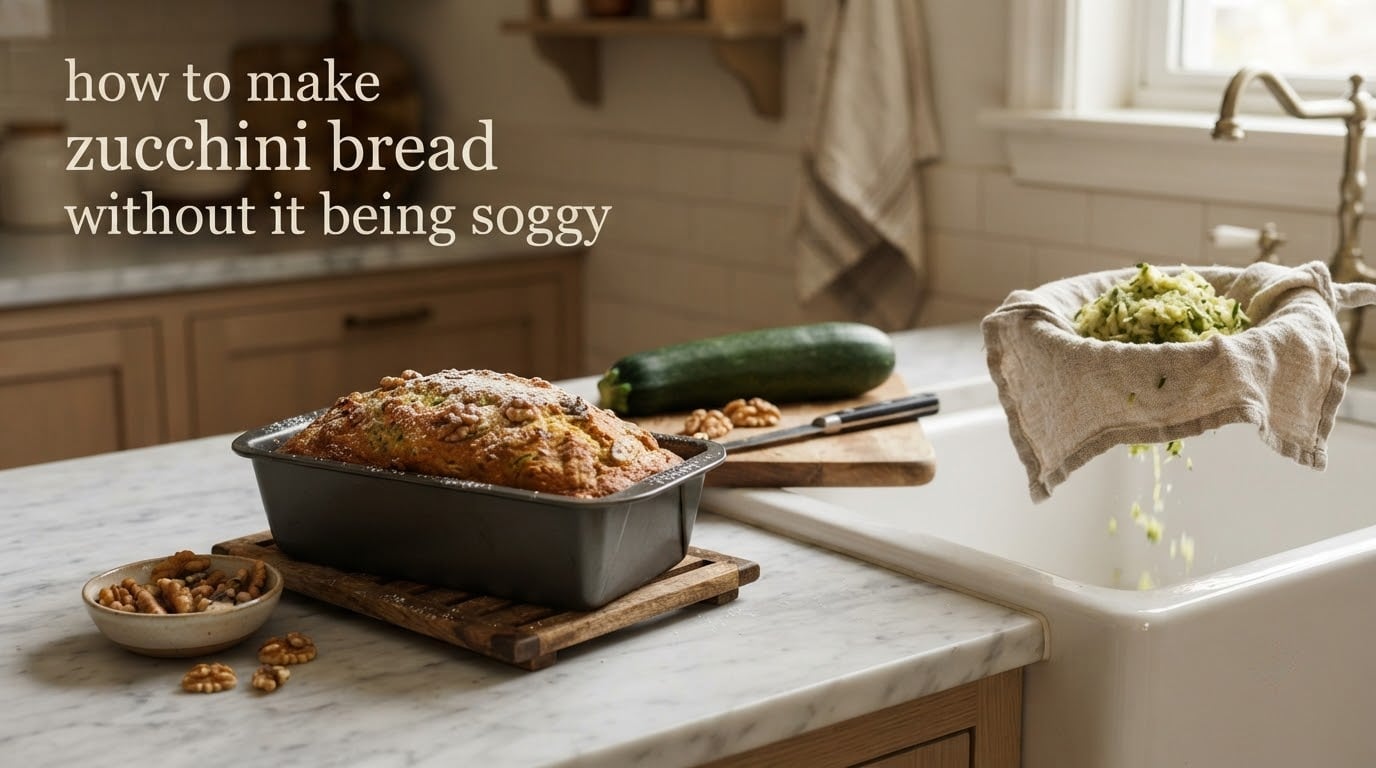
To make zucchini bread without it being soggy, remove as much water as you can from the shredded zucchini before it touches the batter, then bake until the center reaches 200-205F and let the loaf cool completely before you cut it. Those three things solve nearly every soggy loaf. Everything else in this guide is detail: how to squeeze, what to do when the zucchini is watery, why overmixing ruins the crumb, and what to do with a loaf that already came out wet.
A medium zucchini is about 95% water. Quick bread has no yeast and no long gluten network to drink that up, so whatever liquid the flour and eggs cannot absorb is still sitting in the center of the loaf when you pull it out. That leftover water keeps the starch from setting, and you get the heavy, gummy, sometimes sunken middle that people describe four different ways and that is really one problem with a handful of causes.
Our kitchen has made a lot of zucchini bread over the years, mostly from a garden that produces more zucchini than any household can reasonably eat. I have baked the same loaf wet, baked it dry, and baked it right, and the technique below is the version that survives a cool morning when the zucchini is at its most watery. I also weighed the same cup of shreds before and after squeezing, so the moisture numbers in this guide are measured rather than guessed.
The goal is not a dry loaf. Moist zucchini bread is the whole point. You are aiming for moist but not soggy, and that balance point is a narrow band, which is why blanket advice to squeeze harder is not the full answer.
Table of Contents
- Why zucchini bread turns out soggy
- Should you squeeze, blot, salt, or fold the zucchini in wet?
- How to make zucchini bread without it being soggy: step by step
- The no-soggy zucchini bread recipe
- How to know when zucchini bread is done and not overbaked
- Soggy, gummy, dense, or sunken: what went wrong and how to fix it
- How to fix a soggy loaf after it is already baked
- Gluten-free, whole-wheat, and egg-free loaves are more prone to gummy centers
- How to cool, store, and freeze zucchini bread
- Frequently Asked Questions
- How to fix soggy zucchini bread?
- Can you rebake undercooked zucchini bread?
- What are common mistakes when making zucchini bread?
- What’s the secret to great zucchini bread?
- What to do if zucchini bread is too wet?
- How can I make my zucchini bread crust crunchy?
- Why is my zucchini bread sunken in the middle?
- Why is my bread gummy in the middle?
- Why is my zucchini bread so dense?
- Should I squeeze the liquid from my zucchini?
- Do you have to squeeze the water out of zucchini for bread?
- Should I peel my zucchini for zucchini bread?
- Conclusion
Why zucchini bread turns out soggy
Here are the seven causes, in the order they show up. Fix the first two and you solve most soggy loaves.
- Excess liquid from the zucchini. This is the big one. Shredding breaks open the plant cells and releases water that was held in them. A cup of raw shreds weighs about 135 g; after a hard squeeze the same shreds come to roughly 70 g. That 65 g of water has to go somewhere. It thins the batter, it stops the crumb from setting, and it collects at the bottom of the pan.
- Underbaking. A loaf pulled at 45 minutes because the top looked golden can be raw in the middle. The crust browns long before the interior temperature is there, so a browned top means nothing. A browned top with a gummy center is the single most common failure in the reports we read.
- Overmixing. Quick bread batter is mixed with a light hand for a reason. Beating flour into wet ingredients develops gluten, and more gluten in a quick bread means a tighter, heavier, denser crumb. Dense reads as soggy to most people, but the fix is the opposite of what they expect.
- Pan size and oven temperature mismatch. A 9×5 inch loaf needs 50-80 minutes at 350F. A smaller 8.5×4.5 inch pan bakes faster and runs hotter in the middle, and a loaf poured into a pan two sizes too big will be pale, thin, and set before the liquid has anywhere to go. The top browns and the center never finishes.
- Extra wet ingredients on top of the formula. Sour cream, yogurt, applesauce, and oil all add liquid. Recipes built on them are not wrong, but adding them to a recipe that already calls for them pushes the loaf past the flour’s capacity to absorb. Read the wet ingredients as part of the total moisture budget, not as a free upgrade.
- Cutting hot. The crumb is still setting as it cools. Slicing a warm loaf releases steam and compresses the crumb into a gummy paste. This is the one that makes an otherwise good loaf look bad.
- Scooping flour instead of leveling it. A heaped cup can carry up to 25% more flour than a spooned and leveled one. Extra flour makes a loaf dry and dense rather than wet, and because it gets reported as a moisture problem, it usually gets fixed with the wrong correction.
Should you squeeze, blot, salt, or fold the zucchini in wet?
All four approaches work, and which one you pick depends on how watery your zucchini is and how much effort you want to spend. Cooks on r/KitchenPro and r/Paleo both described salting the shreds and letting them sweat as their main method for drawing water out before cooking, and the same principle works in a loaf.
| Method | Effort | Time | Water removed | Resulting texture | Best for |
|---|---|---|---|---|---|
| Squeeze by hand | High | 5 min | Most, about half the weight | Light, airy crumb, crisp edges | Everyday baking and very watery garden zucchini |
| Blot with paper towels | Low | 10 min | Moderate | Moist, tender, slightly denser than squeezed | Small supermarket zucchini |
| Salt and sweat | Low | 20-30 min | Moderate to high | Moist with a very tender crumb | Batch baking and eggplant |
| No drain, fold in wet | None | 0 | None | Wet center unless the formula is built for it | Only when the recipe was tested that way |
On the no-drain side, one widely shared social post claims that wringing the water out is what makes most loaves come out dry and that you should fold the zucchini in as it came off the grater. bsugarmama makes a version of the same argument for a crumb-topped loaf. They are not entirely wrong, and dismissing them is a mistake.
Here is the reconciliation. That advice works when the formula was written and tested with wet zucchini, usually with more flour or a drying ingredient like brown sugar and coconut oil to absorb the surplus. Poured into a formula already balanced for squeezed zucchini, the same move gives you a loaf with a wet bottom. The variable is not the principle, it is the wet-to-dry ratio of the specific recipe. If you love a recipe that calls for folding zucchini in wet, make that recipe the way it was written, and do not also squeeze the shreds.
The oven rule matters more than either camp suggests. If you skip the squeeze as a fallback, toss the wet shreds into the measured flour first and let them sit for ten minutes so the flour absorbs the water before the rest goes in. That recovers most of what the squeeze would have removed.
Over-drying has a cost too, and it is the one nobody mentions. Shreds squeezed bone dry, wrung and twisted until you can nearly hear them squeak, produce a loaf that is tight, heavy, and short on tenderness. Squeeze until the shreds are damp in your hand, not until they are dry. That is the balance point.
How to make zucchini bread without it being soggy: step by step
- Grate on the small holes. The fine side of a box grater melts the zucchini into the batter so you do not chew on strands. A food processor with the shredding disc works well for volume, and a spiralizer plus a quick chop is fine if you are careful. Large shreds create pockets of water and pockets of dry flour at the same time.
- Peel big garden zucchini, leave small ones alone. Oversized summer squash has thick, watery skin and big seeds. Scrape the seed core out with a spoon and peel it. A small tender zucchini does not need either.
- Drain the shreds. Pick a method from the table above. For the squeeze, gather the shreds in a clean towel or a cheesecloth, twist it over the sink, and press hard with both hands. Repeat once. Weigh it if you want the real number: about 135 g going in, about 70 g coming out.
- Measure the flour by spoon and level it. Scooping adds up to 25% more flour, which is a fast route to a dense loaf that tastes dry and reads as underbaked.
- Mix wet into dry only until just combined. Fold in the zucchini last, with a spoon, in a few additions. Stop the moment the streaks disappear. A spoon and a few gentle folds are the entire technique. Batter that looks slightly lumpy is usually right.
- Line the pan and fill it about two-thirds full. Parchment paper is the reliable liner, and it gives you a loaf that lifts out cleanly with no scraping at the bottom edge. Leave the loaf about an inch of headroom, or the center will dome up and then collapse as it cools.
- Bake at 350F for 50-80 minutes in a 9×5 inch pan. Start checking at 25-30 minutes because ovens vary widely and a thermometer is more reliable than a clock. Convection makes almost no difference here; the loaf is dense enough that fan baking does not speed the interior up.
- Cool in the pan for 10 minutes, then on its side on a wire rack. Cooling on its side keeps the bottom from steaming against the rack and keeps the edges crisper, and it reduces the chance of the center collapsing as it cools. Wait until the loaf is completely cool to cut, which is two to three hours.
If the top browns before the center is done, tent it loosely with foil rather than pulling the loaf. A dark crust with a raw middle is exactly the failure we are trying to avoid, and foil solves the coloring without changing the bake time.
The no-soggy zucchini bread recipe
One 9×5 inch loaf. Every measurement is given in cups and grams because cup measures vary and grams do not. This is the formula I bake when the zucchini is at its most watery in the morning.
- 2 cups (240 g) all-purpose flour, spooned and leveled
- 1 teaspoon baking soda
- 1/2 teaspoon baking powder
- 1 teaspoon fine salt
- 1 teaspoon cinnamon
- 1/2 teaspoon nutmeg
- 1/3 cup (75 g) granulated sugar
- 1/2 cup (100 g) brown sugar
- 2 large eggs, room temperature
- 1/2 cup (120 ml) neutral oil
- 1 teaspoon vanilla extract
- 1.5 cups (about 180 g) grated zucchini, squeezed until damp not dry
- 1 cup (110 g) chopped walnuts or 3/4 cup semisweet chocolate chips, optional
Whisk the flour, baking soda, baking powder, salt, cinnamon, and nutmeg in a large bowl. In a second bowl whisk the eggs, oil, vanilla, and both sugars until smooth and slightly thickened. Pour the wet into the dry and stir eight or nine times with a spatula. Fold in the squeezed zucchini and the nuts, then stop. Scrape into a parchment-lined pan and bake at 350F for 50-80 minutes.
The wet-to-dry math is the whole point of this formula. Two cups of flour and two eggs can hold roughly three-quarters cup of added liquid comfortably. The squeezed zucchini carries about half a cup of its own moisture, and the eggs and oil are counted in the formula already. Add a cup of unsqueezed zucchini on top of that and you have gone over the edge, which is why the drain step is not optional in this recipe.
Do not line the pan with a heavy buttering only. A thin film of oil or butter prevents sticking; a thick layer adds fat to the bottom edge and can scorch it. If you want a crisp bottom, oil lightly, line with parchment, and set the pan on a metal baking sheet so the heat underneath stays even.
How to know when zucchini bread is done and not overbaked
Three checks, used together, are more reliable than any one of them.
- Instant-read thermometer at the center. 200-205F is the target. Below 195F the crumb has not set and will be gummy; above 210F you are drying it out. If your oven runs hot, an inexpensive thermometer is the single best tool you can add to your kitchen.
- Toothpick or skewer. Insert it into the thickest part, not the crack. A clean pull with no wet batter is the sign. But note what a clean toothpick cannot tell you: it can come out clean from a crust that is done while the very center is still raw, so treat it as a secondary check.
- Press test. Press the top gently with a fingertip. It should spring back immediately. If the dent stays, the loaf needs more time. A crack running along the top from end to end is a good sign of a well-risen loaf.
The loaf continues to set for a few minutes after it leaves the oven, so pull it when the center reads about 200F rather than chasing a browned crust. A center crack that stays open rather than closing up is a classic sign of a loaf that was baked with too much liquid in the batter.
Soggy, gummy, dense, or sunken: what went wrong and how to fix it
These four get used interchangeably, and they are not the same problem. Soggy is wet, gummy is under-set, dense is over-mixed or over-floured, and a sunken middle is a structure failure that usually starts as a moisture problem and ends as a cooling problem.
| Symptom | What it means | Fix for next time |
|---|---|---|
| Gummy or wet center, browned crust | Underbaked, or too much liquid in the batter | Bake to 200-205F with a thermometer and squeeze the shreds harder next time |
| Dense, heavy, tight crumb | Overmixed batter or flour scooped rather than leveled | Fold with a spoon in a few additions and spoon-and-level the flour |
| Sunken in the middle | Excess liquid, or the loaf was cut while hot and the center collapsed | Drain the zucchini, fill the pan only two-thirds, and cool fully before cutting |
| Wet bottom, dry top | Liquid pooled under the batter in a pan that was not lifted, or overfilled | Line with parchment and set the pan on a baking sheet |
| Over-browned crust, pale interior | Oven runs hot, or the loaf was tented too late | Tent with foil at 30 minutes and verify oven temperature |
| Dry and crumbly, no moisture at all | Over-squeezed zucchini or extra flour | Squeeze only until the shreds are damp, and add a little oil or sour cream |
If your loaf is dense rather than wet, resist the urge to add more zucchini. That makes it worse. The heavy mix-ins count here too: a cup of walnuts or chocolate chips displaces flour and can suppress the rise, so weigh heavy add-ins and hold the flour where the formula puts it.
How to fix a soggy loaf after it is already baked
Yes, an underbaked loaf can often be saved. Work through these in order and stop as soon as the crumb firms up.
- Return the whole loaf to the oven. If it is still in the pan or you can keep it in one piece, back in at 325F for 10-15 minutes. Lower heat drives off water without hardening the crust. Check the center with a thermometer and stop at 205F.
- Slice it and dry the slices. For a loaf that is set but damp, cut it into slices and lay them on a baking sheet. Bake at 325F for 15-20 minutes, flipping once, or use a toaster oven. This is the method that actually rescues a gummy crumb, because it turns the moisture into steam and lets the slices crisp at the same time.
- Spread the cut face and re-bake. Cut the loaf in half lengthwise, cut sides down, and bake for 20-25 minutes. The open crumb exposes the wet part to direct heat.
- Give up on the center, keep the ends. A loaf with a bad middle and sound edges is a toast problem, not a baking problem. Cut off the damp section and use the rest. Grilled bread from a day-old loaf is a better use of it than a second bake.
What does not work is putting a wet loaf back in a sealed container. That traps the steam, and the crumb gets worse, not better. If you must store a still-damp loaf before serving, at least leave the cut face uncovered and let air move around it.
Gluten-free, whole-wheat, and egg-free loaves are more prone to gummy centers
These versions fail more often, and the reason is structural. A quick bread needs something to stand in for gluten. All-purpose flour gives it a framework that sets around the starch; nut flours and oat flour do not, which is why an egg-free or gluten-free loaf can taste wonderful and still slice like a dense pudding. A commenter on r/VeganBaking described an egg-replacement zucchini bread that came out sunken in the middle, and that is the most common version of this failure.
- Gluten-free flours. Reduce the liquid by a quarter. Use the gram weight for the flour, add an extra egg if the batter looks slack, and expect to need 5-10 more minutes. Oat flour plus psyllium husk is the most forgiving combination because the husk gives the crumb structure.
- Whole wheat. It is drier and heavier, so the gummy risk comes from flour quantity rather than moisture. Substitute at most half the all-purpose flour by weight, not by volume, and never scoop.
- Egg-free. Aquafaba and ground flaxseed both work, but neither gives the egg’s binding. Add one extra tablespoon of flour and make sure the batter is mixed only until combined.
- Any variation. Drain the zucchini harder than the original recipe says, and always go by thermometer rather than time.
A useful diagnostic: if a slice bends without cracking and smears on the knife, the crumb is under-set. If it cracks cleanly, you are done, whatever the texture opinion at the table.
How to cool, store, and freeze zucchini bread
Cooling is part of the technique, not a pause before it. Let the loaf sit in the pan for 10 minutes, turn it onto a wire rack, and stand it on its side so the bottom does not steam.
For storage, wrap a fully cool loaf tightly and keep it at room temperature for up to three days. Refrigeration is the one place wetness gets worse, because a cold loaf goes into the fridge already damp and then sits in that damp state. If you must refrigerate, seal it well and let it come to room temperature before slicing.
Freezing works well for up to three to six months. Wrap individual slices in plastic, then foil, and freeze flat on a sheet pan before bagging them. Thaw at room temperature in the wrapper rather than unwrapped, and refresh a slice in the toaster before serving.
If your problem is a recurring garden surplus, freeze the grated zucchini itself. Weigh a cup of shreds, bag them in measured portions, label with the weight, and skip the drying step on thawing because you can do it while the shreds are still frozen and firm. A bagged summer of measured squash turns into a loaf on a cold day with no last-minute prep.
Frequently Asked Questions
How to fix soggy zucchini bread?
Return the loaf to a 325F oven for 10-15 minutes, or slice it and bake the slices at 325F for 15-20 minutes. For the next bake, squeeze or blot the shredded zucchini until it is damp rather than dripping, mix the batter only until combined, and bake to a 200-205F center temperature instead of trusting the top color.
Can you rebake undercooked zucchini bread?
Yes, if it is only underbaked. Set it back in a 325F oven for 10-15 minutes and check the center with an instant-read thermometer, stopping at 205F. If the crumb is set but still gummy, slice the loaf, lay the slices on a baking sheet, and bake for 15-20 minutes at 325F, flipping once. A loaf that stays gummy through a full rebake is past saving for eating as-is.
What are common mistakes when making zucchini bread?
The usual mistakes are skipping the drain on the shredded zucchini, overmixing the batter with a whisk or electric mixer, measuring flour with a scoop instead of spoon and level, adding extra wet ingredients like sour cream or applesauce on top of a formula that already has them, pulling the loaf before the center reaches 200-205F, and slicing while the loaf is still warm.
What’s the secret to great zucchini bread?
Drain the shredded zucchini well but not to bone dry, and weigh it so you know how much liquid you are adding. Mix with a spoon until just combined, fill a 9×5 inch pan only two-thirds full, and bake to a 200-205F center temperature. Moisten the shreds with a spoonful of the wet ingredients so they are damp, never dripping. A cup of raw shreds weighs about 135 g and about 70 g after a hard squeeze.
What to do if zucchini bread is too wet?
Rebake at 325F, or slice the loaf and bake the slices at 325F for 15-20 minutes. Do not store a damp loaf sealed, because trapped steam makes the crumb worse. Never slice a warm loaf, since the crumb is still setting and cutting it early turns it gummy. For the next bake, drain the shreds harder, spoon and level the flour, and lean on a thermometer rather than the clock.
How can I make my zucchini bread crust crunchy?
Line the pan with parchment paper, use a light film of oil rather than a thick buttering, and set the pan on a metal baking sheet for even heat underneath. Tent loosely with foil at 30 minutes so the crust colors without the center overcooking. Cool the loaf on its side on a wire rack so the bottom does not steam, and wait the full two to three hours before slicing. A spoon of brown sugar on top before baking also helps.
Why is my zucchini bread sunken in the middle?
A sunken center means the loaf was structurally overloaded, usually by too much liquid or a pan filled too high. Drain the shreds, fill the pan only about two-thirds so there is an inch of headroom, and check the temperature at the center rather than the crust. Overmixing is the other common cause, and an egg-free or gluten-free version makes it likelier. Let the loaf cool fully before cutting, since cutting hot can collapse the center.
Why is my bread gummy in the middle?
Either the loaf came out of the oven before the starch set or too much water went into the batter. Bake to 200-205F at the center with an instant-read thermometer, since a browned crust means nothing. A gummy center with a nearly burnt top is the signature of underbaking, not overcooking. Next time, squeeze the shreds until they are damp rather than dry, and fold the zucchini in with a spoon in a few additions.
Why is my zucchini bread so dense?
Density is an overmixing or over-flouring problem, not a moisture problem, so adding more zucchini makes it worse. Beat the wet into the dry only until combined, then fold the zucchini in with a spoon. Measure flour by spooning and leveling, because scooping can add a quarter more flour. Heavy add-ins like a cup of walnuts also displace flour, so weigh them and keep the flour at the formula amount.
Should I squeeze the liquid from my zucchini?
In most cases, yes, and it is the highest-impact step for a light crumb. Squeeze until the shreds are damp in your hand rather than bone dry, since over-squeezing gives a tight, dry loaf. Blotting with paper towels and salting the shreds to sweat are both workable alternatives. If a recipe you like was tested with wet zucchini, follow that recipe as written instead of adding the squeeze.
Do you have to squeeze the water out of zucchini for bread?
You do not have to, but excess liquid is the most common reason a loaf turns out gummy. If you are skipping it, toss the wet shreds into the measured flour and let them sit for ten minutes so the flour absorbs the water, and drop any extra wet ingredient the formula does not call for. A recipe built and tested around wet zucchini can work without the squeeze, as long as you do not drain it and then follow a wet-to-dry ratio that no longer matches.
Should I peel my zucchini for zucchini bread?
Peel large, mature garden zucchini and scrape out the seed core, because their thick skin and watery flesh give a mealy, loose crumb. Small supermarket zucchini does not need peeling. Shredding on the small holes of a box grater melts the strands into the batter and reduces the pockets of water that make a center gummy.
Conclusion
Learning how to make zucchini bread without it being soggy comes down to two decisions made before the oven turns on: how dry your shreds are, and how little you mix. Drain the zucchini until it is damp rather than dripping, fold it in with a spoon, fill the pan two-thirds full, and bake to 200-205F at the center. Then let the loaf cool on its side, all the way, before you cut it.
Grab a cheap instant-read thermometer and a kitchen scale this week. Between them, the guesswork goes out of the process, and the loaves stop depending on how the oven felt that morning.