
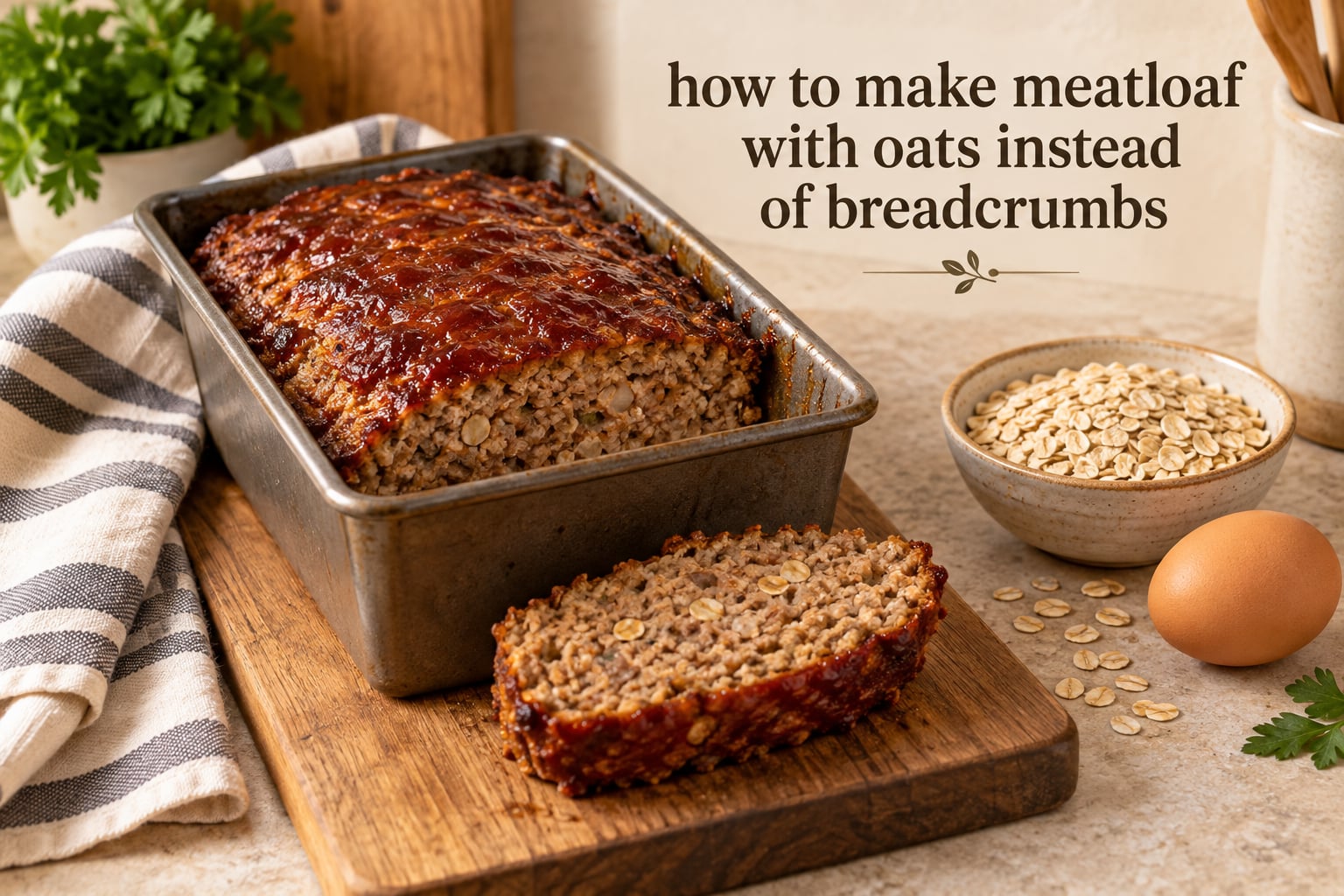
You can make meatloaf with oats instead of breadcrumbs, and most cooks find the loaf moister and more tender. Swap about 1 cup of breadcrumbs for 3/4 cup of uncooked rolled or quick oats, then add a little extra liquid because oats drink more moisture than bread does.
I baked this loaf side by side with a classic breadcrumb version, sliced both cold, and compared crumb, moisture, and how cleanly each one held together on a plate. The oat version won on juiciness and lost slightly on the airy, tender-crumb texture that makes a breadcrumb loaf feel light.
The rest of this guide covers the exact ratio, which oat cut to buy, the six-step method, a conversion table, and what to change when the mixture feels stiff or loose. I also worked through the four failure modes that show up in cooking groups most often, including the soggy bottom nobody warns you about.
Table of Contents
- Can I Substitute Oats for Breadcrumbs in Meatloaf?
- Oats vs. Breadcrumbs: Which Is Better?
- Which Oats to Use (and Which to Avoid)
- How to Make Meatloaf with Oats Instead of Breadcrumbs
- How Much Oatmeal for Meatloaf? Breadcrumbs to Oats Conversion
- Why Oats Make Meatloaf Better
- Adjusting Liquid and Binder When the Mixture Feels Off
- Troubleshooting: Why Your Oat Meatloaf Falls Apart
- Other Breadcrumb Substitutes
- Making Oat Meatloaf Gluten-Free, Storing, and Serving It
- Frequently Asked Questions
- Can I substitute oats for breadcrumbs in meatloaf?
- How many oats do I use per pound of ground beef?
- Do I have to cook the oats before adding them to meatloaf?
- Are old-fashioned oats or quick oats better for meatloaf?
- Why is my oatmeal meatloaf dry?
- Why is my meatloaf falling apart when I slice it?
- Is meatloaf with oats gluten-free?
- How long should meatloaf with oats bake?
- Conclusion
Can I Substitute Oats for Breadcrumbs in Meatloaf?
Yes. Use uncooked rolled or quick oats at roughly 3/4 cup for every 1 cup of breadcrumbs, and add 1 to 2 tablespoons extra milk, broth, or egg. Oats swell as they bake, so a straight 1:1 swap by volume makes a denser, drier loaf than you want.
Quick tips for success:
- Use dry oats. Rolled or quick, straight from the box, never cooked leftover oatmeal.
- Rest the mix 10 minutes before shaping so the oats finish hydrating.
- Skip flavored packets. Apple-cinnamon or brown sugar varieties will sweeten the whole loaf.
- Bake to 160F internal, not to the timer, because oat loaves vary in density.
Oats vs. Breadcrumbs: Which Is Better?
Neither one wins outright, and the difference comes down to the crumb you prefer. Here is how they compare on the things that actually change the finished loaf.
| Factor | Breadcrumbs | Oats |
|---|---|---|
| Moisture in the loaf | Drier, lighter crumb | Wetter, more tender crumb |
| Binding strength | Very firm, sets tight | Firm once hydrated and rested |
| Flavor | Neutral | Faintly sweet and nutty |
| Density | Airy, light | Denser and heartier |
| Gluten status | Contains gluten unless certified GF | Gluten-free only when oats are certified gluten-free |
| Fiber | Minimal | Noticeably higher, plus whole-grain nutrients |
| Needs extra liquid | Usually no | Yes, 1 to 2 tablespoons |
Our sliced comparison matched the table. The breadcrumb loaf flaked slightly when cut, the oat loaf pressed together cleanly, and both held their shape on a plate after reheating.
Which Oats to Use (and Which to Avoid)
Old-fashioned rolled oats are the best default because they have enough intact structure to bind without turning the loaf gummy. Quick oats work just as well and are cheaper, while steel-cut and seasoned packets should stay out of the bowl entirely.
| Oat product | Verdict | Reason |
|---|---|---|
| Old-fashioned rolled oats | Best default | Good binding, holds a slice well, mild flavor |
| Quick oats | Great, softer result | Blends in smoothly, gives a slightly finer crumb |
| Steel-cut oats | Avoid | Too hard and dense to soften enough during baking |
| Instant flavored packets | Avoid | Sugar and cinnamon sweeten the finished loaf |
| Cooked leftover oatmeal | Avoid | Adds water and turns the mixture pasty |
| Certified gluten-free oats | Required for a GF loaf | Regular oats are frequently cross-contaminated with wheat |
One note on wording, because it causes real confusion: in older recipes, oatmeal means uncooked rolled oats, not cooked porridge. If a family recipe calls for oatmeal and you have a bowl of cooked oatmeal in the fridge, that is a different ingredient with a very different water content.
How to Make Meatloaf with Oats Instead of Breadcrumbs
This is the version I bake most often. It uses 2 pounds of 85/15 ground beef, 1.5 cups of uncooked rolled oats in place of 2 cups of breadcrumbs, and one extra splash of liquid to account for oat absorption.
Ingredients
- 2 pounds 85/15 ground beef (80/20 ground chuck works too, with a slightly richer loaf)
- 1.5 cups uncooked old-fashioned or quick oats, the breadcrumb replacement
- 1 cup tomato sauce, plus more for the top
- 1 small onion, grated
- 2 cloves garlic, minced
- 1 egg
- 1/3 cup milk, plus 1 to 2 tablespoons extra if the mix feels stiff
- 2 teaspoons kosher salt and 1 teaspoon black pepper
- 1 tablespoon Worcestershire sauce
- Glaze: 1/2 cup ketchup, 2 tablespoons brown sugar, 1 teaspoon mustard
Step 1: Heat the oven and grease the pan. Set the oven to 350F. Grease a 9 by 5 inch loaf pan, and if you have a raised-rack loaf pan, use it so rendered fat drains away from the bottom.
Step 2: Combine the wet ingredients. Stir the milk, egg, tomato sauce, Worcestershire sauce, grated onion, and garlic together in a bowl. This is the panade, the binder layer that keeps the loaf from crumbling when you slice it.
Step 3: Add the oats and rest the mixture. Stir in the oats and let the bowl sit for 10 minutes. The oats are still thirsty after 10 minutes, and that rest is what makes the difference between a tender crumb and a dry one.
Step 4: Mix with the beef and shape. Add the ground beef, salt, and pepper, then mix with your hands or a sturdy spoon until no dry streaks remain. Do not overwork it. Pack the mixture firmly into the loaf pan and smooth the top flat so it bakes evenly.
Step 5: Glaze and bake. Spread the ketchup, brown sugar, and mustard glaze over the top. Bake at 350F for 60 to 75 minutes, until a meat thermometer inserted into the center reads 160F. A 2 pound oat loaf often reaches temperature 5 to 10 minutes later than a breadcrumb loaf of the same size.
Step 6: Rest, drain, and slice. Let the loaf sit in the pan for 10 minutes after it comes out of the oven. It firms up as it cools, so cutting too early is the most common reason an oat loaf crumbles on the plate. Lift it out, blot the surface fat, and slice with a serrated knife.
How Much Oatmeal for Meatloaf? Breadcrumbs to Oats Conversion
Use 3/4 cup of oats for every 1 cup of breadcrumbs, and scale by pound of beef at roughly 1/2 cup of oats per pound. Cooking groups consistently land a little below a 1:1 volume swap, because oats swell more than bread as they bake.
| Ground beef | Breadcrumbs | Use this much oats |
|---|---|---|
| 1 pound | 1 cup | 3/4 cup |
| 1.5 pounds | 1.5 cups | 1 to 1.25 cups |
| 2 pounds | 2 cups | 1.5 cups |
| 3 pounds | 3 cups | 2 to 2.25 cups |
| 4 pounds | 4 cups | 3 cups |
As a starting formula for a family-size batch, plan 1/2 cup of oats plus 1 egg plus 2 tablespoons extra liquid for every pound of meat. Leaner meat such as ground turkey needs another 2 tablespoons of liquid per pound, since there is less fat holding moisture in the loaf.
Why Oats Make Meatloaf Better
Oats are a soluble fiber that absorbs liquid, swells in the oven, and sets into a gel that glues the ground meat together. Breadcrumbs mostly sit there structurally. The oat gel holds moisture in the loaf and releases it back as the meat cooks, which is why the sliced interior stays juicy.
The secret ingredient to a great meatloaf is not a spice. It is a binder that hydrates, plus a fat source and an acid element, and the oats handle the first part while Worcestershire and tomato supply the rest.
The upgrade that helps most cooks is the 10-minute rest in step 3. Skipping it is the number one reason people describe oat meatloaf as dry even when they followed the recipe correctly.
Adjusting Liquid and Binder When the Mixture Feels Off
Judge the mix before it hits the pan, and adjust in tablespoon increments. A good oat meatloaf mixture holds together in your hand without dripping.
- Feels stiff or crumbly: add milk, broth, or water 1 tablespoon at a time until it presses together.
- Feels loose or soupy: stir in 1 more tablespoon of oats, and if still loose, add a second egg.
- What an extra egg does: it adds structure and moisture at once, which is why eggs are the standard fix for a loose mixture.
- Using lean turkey or chicken: add 2 tablespoons liquid per pound and consider a second egg, because there is no beef fat to carry the loaf.
Troubleshooting: Why Your Oat Meatloaf Falls Apart
Almost every oat meatloaf problem traces back to liquid, binder ratio, or pan drainage. Match your symptom to the cause and the fix below.
| Symptom | Cause | Fix |
|---|---|---|
| Dry, tough, shrunken loaf | Oats drew out the liquid, or the meat was too lean | Add 2 tablespoons more liquid next time, rest 10 minutes, and use 85/15 beef |
| Crumbly loaf, too much oats | Binder is above the egg and liquid | Drop to 2/3 cup oats per 3/4 cup breadcrumbs and keep the second egg |
| Falls apart when sliced | Sliced hot, or the mix was packed loosely | Rest 10 minutes, pack the pan firmly, and cut with a serrated knife |
| Soggy bottom | Rendered fat pooled in a solid loaf pan | Use a raised-rack loaf pan or set a wire rack over a rimmed baking sheet |
| Gummy or pasty interior | Cooked oatmeal was used, or the mix was overworked | Use dry uncooked oats and mix only until combined |
| Sweet or cinnamon-flavored loaf | Flavored instant oatmeal packet | Use plain rolled or quick oats only |
For a free-form loaf on a rimmed baking sheet, expect more crumbling than a pan-formed one, but the flavor is worth it and the cooked juices make a quick pan sauce. If you want a gluten-free version, the only change is certified gluten-free oats plus a loaf pan and utensils free of wheat cross-contact.
Other Breadcrumb Substitutes
Oats are the most reliable swap, but several pantry staples bind meatloaf just as well. The practical order of preference, based on how well each one both binds and keeps the loaf moist, runs from cooked white rice to crushed crackers, rolled oats, panko, and mashed potato.
- Mashed potato: soft and moist, binds gently, needs no extra liquid.
- Cooked white rice: a common budget swap, slightly grainy texture.
- Crushed crackers: use the same 3/4 to 1 cup ratio as oats.
- Boxed dry stuffing mix: a longtime favorite in frugal cooking groups for the same binding job, seasoned so go easy on salt.
- Cooked rice and shredded cheese: works, but raises the fat and salt of the finished loaf.
Making Oat Meatloaf Gluten-Free, Storing, and Serving It
A loaf made with regular old-fashioned oats is not gluten-free. Oats are frequently cross-contaminated with wheat during milling, so buy oats labeled certified gluten-free and keep the rest of the ingredients, pan, and utensils free from wheat.
For the air fryer, press the same mixture into a loaf tin and cook at 375F for 35 to 45 minutes, checking early and often because the small chamber browns faster than a conventional oven. A slow cooker works too: shape the loaf, set it on high for 3 to 4 hours, and glaze in the last 30 minutes for a juicier result than baking.
Store the cooled loaf in an airtight container in the refrigerator for up to 4 days, or slice it and freeze in layers for up to 3 months. Reheat slices in a skillet for 3 to 4 minutes per side, or microwave in short bursts so the center does not turn rubbery.
For serving, sliced oat meatloaf pairs well with mashed potatoes, green beans, a simple tomato salad, or extra pan gravy loosened with a little broth. Thick slices on white bread with a smear of mustard make the best sandwich, and a bowl of the reserved cooking juices is the easiest sauce on the table.
Frequently Asked Questions
Can I substitute oats for breadcrumbs in meatloaf?
Yes. Use about 3/4 cup of uncooked rolled or quick oats for every 1 cup of breadcrumbs, and add 1 to 2 tablespoons of extra milk, broth, or egg because oats absorb more liquid.
How many oats do I use per pound of ground beef?
About 1/2 cup of uncooked oats per pound of ground beef, plus 1 egg and 2 tablespoons extra liquid. For a 2 pound loaf, that works out to 1.5 cups of oats.
Do I have to cook the oats before adding them to meatloaf?
No. Add them dry and uncooked. Let the mixed bowl rest 10 minutes so they hydrate, but never add cooked leftover oatmeal, which adds water and makes the mixture pasty.
Are old-fashioned oats or quick oats better for meatloaf?
Both work. Old-fashioned rolled oats give a slightly heartier crumb and hold a slice well, while quick oats blend in smoother and produce a finer texture. Steel-cut oats are too hard and dense to use raw.
Why is my oatmeal meatloaf dry?
Usually the oats drew off the liquid and you did not adjust for it. Add 2 tablespoons more milk or broth next time, rest the mixture 10 minutes before shaping, and stick with 85/15 beef.
Why is my meatloaf falling apart when I slice it?
You probably sliced it too soon or packed the loaf loosely. Rest it 10 minutes in the pan, press the mixture in firmly, and use a serrated knife with a steady sawing motion.
Is meatloaf with oats gluten-free?
Only if you use certified gluten-free oats. Regular rolled oats are often cross-contaminated with wheat during milling, and Worcestershire sauce and ketchup also need gluten-free versions.
How long should meatloaf with oats bake?
Bake at 350F for 60 to 75 minutes for a 2 pound loaf, and stop when a meat thermometer in the center reads 160F. Oat loaves can take 5 to 10 minutes longer than breadcrumb loaves of the same size.
Conclusion
Learning how to make meatloaf with oats instead of breadcrumbs comes down to three rules: swap 1 cup of breadcrumbs for 3/4 cup of uncooked oats, add 1 to 2 tablespoons of extra liquid, and let the mixture rest 10 minutes before it goes in the pan. Bake at 350F and pull the loaf at 160F internal, not when the timer says so.
Next time you run out of breadcrumbs, grab the rolled oats on the top shelf of the pantry. Rest 10 minutes, slice the loaf after a 10-minute rest, and you will get a slice that holds together and stays moist.