
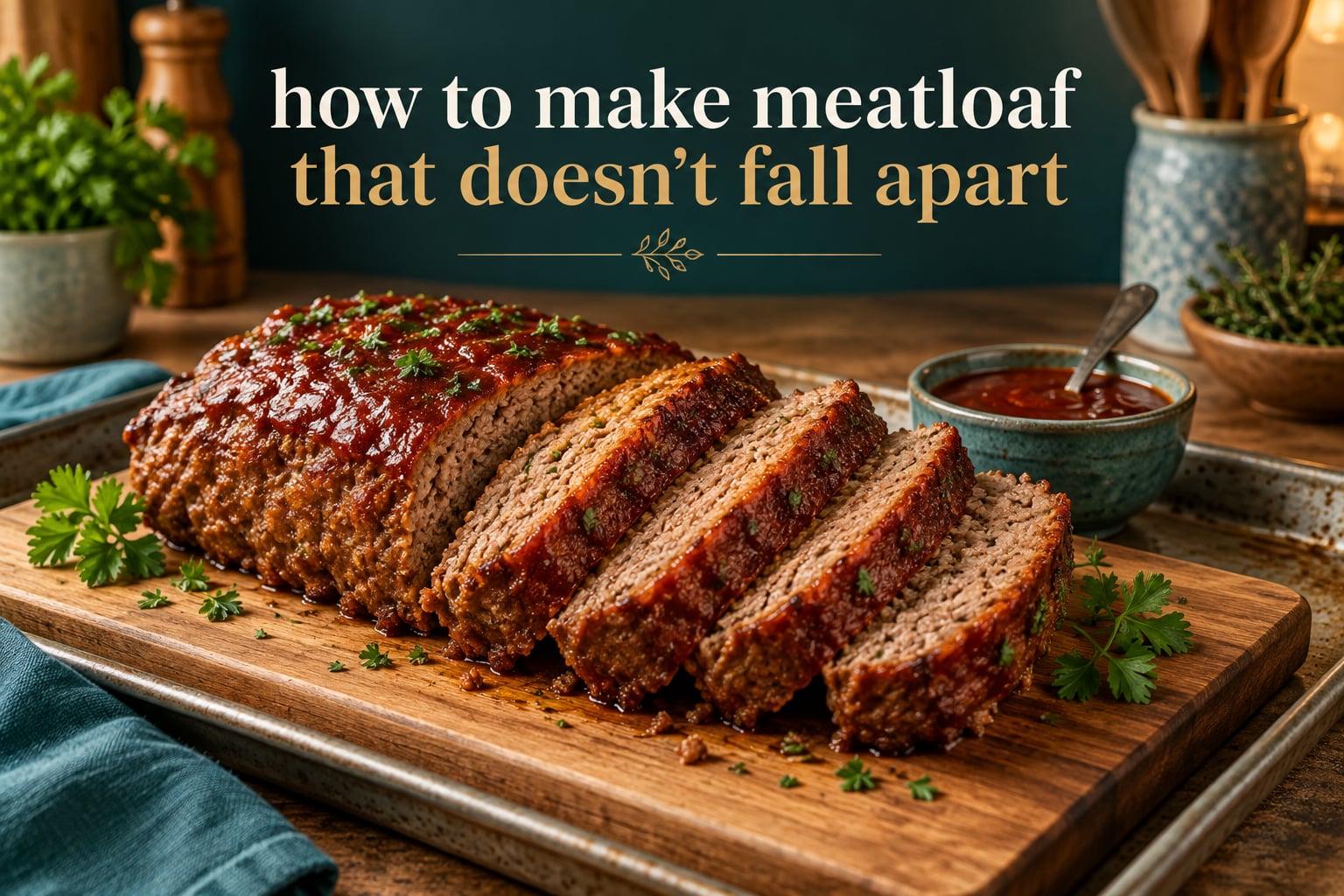
Meatloaf falls apart for five reasons: not enough binder, meat that is too lean, a mix that got overworked, a pan that traps steam, and slicing before the loaf has rested. Fix those five variables and the same basic recipe that crumbles in the pan will come out in clean, dense slices.
I have baked meatloaf more times than I want to admit, and most of my early loaves ended as a pile of seasoned crumbs on the cutting board. The problem was never the seasoning or the oven. It was technique, and it took me years to accept that the fix is boring and repeatable rather than clever.
This guide covers the whole chain, from the binder ratio per pound of meat to the temperature you pull the loaf at, the minutes you let it stand, and what to do when a loaf splits anyway. Everything here reflects what I have tested in my own kitchen through 2026, and it is ordered so that each step explains the one before it.
If you have a stubborn loaf on the counter right now, jump straight to the troubleshooting section on common mistakes and fixes. Each symptom maps to a specific cause, so you can correct the next bake instead of guessing.
Table of Contents
- Why Does Meatloaf Fall Apart? Six Causes and Their Fixes
- What Is a Panade and Why Does It Hold Meatloaf Together
- The Golden Binder Ratio: Eggs and Breadcrumbs per Pound of Meat
- Fat Content Matters: Why 80/20 Ground Beef Works Best
- Mixing Technique: Gentle Hands Beat a Stand Mixer
- Loaf Pan vs Baking Sheet: Which Shape Slices Cleaner
- Cooking Time and Doneness: Pull the Loaf at 160°F
- The Resting Rule: Wait 10 to 15 Minutes Before Slicing
- Step-by-Step Meatloaf Recipe
- Glaze and Sauce Options That Resist Burning
- Common Mistakes and How to Fix Them
- Alternative Ways to Cook Meatloaf
- Make-Ahead, Freezing and Storage
- Frequently Asked Questions
- What is the secret to good meatloaf?
- What is the best binder for meatloaf?
- How many eggs and how much breadcrumbs per pound of meat?
- Is it better to bake meatloaf covered or uncovered?
- What temperature should meatloaf be cooked to?
- How long do you rest meatloaf before slicing?
- What are the common meatloaf mistakes to avoid?
- Why did my meatloaf fall apart while cooking?
- Can you use oats instead of breadcrumbs in meatloaf?
- Can you make meatloaf ahead of time and freeze it?
- Conclusion
Why Does Meatloaf Fall Apart? Six Causes and Their Fixes
Meatloaf falls apart when the structure that holds it together never forms, or when it forms and then breaks under heat, weight, or a sharp knife. Almost every crumbling loaf traces back to one of the six causes below.
- Not enough binder for the amount of meat. Ground beef carries very little of its own binding proteins once the fat is rendered. Fix: one egg plus one-half to one cup of soaked breadcrumbs per pound of meat.
- Meat that is too lean. Above 90% lean, the loaf dries out, tightens, and crumbles. Fix: use 80/20 ground beef for the bulk of the loaf.
- Overmixing. A food processor or stand mixer on high speed develops the meat proteins into a dense, rubbery block that squeezes moisture out while baking. Fix: mix with a spoon and a light hand until the mixture looks homogeneous and nothing clumps at the bottom of the bowl.
- A covered pan or a loaf tin that steams the loaf. Trapped moisture keeps the surface wet, and a wet surface never sets into a crust. Fix: bake uncovered on a rimmed baking sheet or in a loaf pan with space around the meat.
- Slicing straight out of the oven. The interior is still cooking and still releasing steam. Fix: rest the loaf 10 to 15 minutes before the first cut.
- Overcooking. Every extra minute past the safe window squeezes out water and tightens the crumb. Fix: pull the loaf at 160°F internal.
Notice that none of these are about how good your ingredients are. A loaf made with expensive beef will crumble if the binder ratio is short, and a loaf made with supermarket ground beef will slice clean if the ratio, the fat, and the rest are right.
What Is a Panade and Why Does It Hold Meatloaf Together
A panade is bread or crumbs soaked in a liquid until they swell into a soft paste. That paste is the glue in a meatloaf, and soaking the crumbs first is the single change that made the biggest difference in my kitchen.
Here is the mechanism without the food science jargon. Dry breadcrumbs are just a pile of hard, dry granules. They sit between the meat particles without gripping them. Add milk or broth and the starch in the crumbs absorbs liquid, swells, and softens into a gel. That gel is sticky enough to coat the meat proteins and bridge the gaps between them.
Two things happen at once. The loaf stays moist because the water is locked into starch rather than evaporating out of the meat, and the loaf holds its shape because the swollen crumbs behave like mortar between the bricks.
Egg does its own separate job. Raw egg proteins set when they hit heat and glue the mass together, which is why skipping eggs is a fast route to crumbles. Breadcrumbs hydrate and tenderize, eggs coagulate and bind, and fat keeps the finished loaf from turning into a brick. You need all three, and you need them in balance.
A user on the r/meat forum described the exact opposite failure, telling the group their loaf came out soft, wet, and peeling into layers. They had used too little fat, which is worth reading as a warning: the panade supplies structure, but structure alone is not a meal.
The Golden Binder Ratio: Eggs and Breadcrumbs per Pound of Meat
One egg and one-half to one cup of breadcrumbs per pound of raw ground meat is the ratio that works in most home kitchens. For a standard two-pound loaf, that means two eggs and one to two cups of crumbs, plus roughly one-third cup of milk or broth to soak them.
The range matters more than the number. A leaner, pork-forward blend eats more binder than an all-beef 80/20 loaf. If your mixture looks loose and soupy before it hits the oven, you are short on crumbs and one more half-cup fixes it. If it looks like wet cement, you have gone too far and the loaf will be dense and bready.
Binder options compared
Plain breadcrumbs are the reliable default. Panko adds a lighter, crunchier crumb and is the pick if you want the slices to feel less dense. Rolled oats bind well and add a faint nuttiness, and they need a longer soak to hydrate. Cracker crumbs from saltines work and give a subtle sweetness. Cornstarch and flour bind, but they push the loaf toward a heavy, brick-like texture, so use them only in small amounts alongside crumbs.
Whatever you choose, soak it. Five to ten minutes in the liquid is enough for breadcrumbs and panko, and closer to fifteen for oats. Add the meat after the soak, not before, and mix gently so the hydrated crumbs disperse evenly instead of rolling into lumps.
If you want to see the panade step in action, the mixing section of the step-by-step recipe below is the clearest place to start.
Fat Content Matters: Why 80/20 Ground Beef Works Best
Ground beef at 80% lean and 20% fat is the sweet spot for meatloaf because fat is both moisture storage and flavor. The fat renders during the bake, leaving a moist interior and a browned, flavorful exterior, and it also shrinks the loaf, which is normal and not a sign of failure.
Going leaner is where things go wrong. At 90% lean the loaf has barely enough fat to stay tender, so the proteins tighten during cooking, the crumb turns dry and dense, and slices crumble in your hand. A user on r/meat put it plainly, describing a loaf that came out soft, falling apart, and separating into layers because the fat content was too low.
Going fattier has its own cost. A 70/30 blend produces a greasy loaf with a spongy interior and a visible oil ring on the baking sheet, and a layer of congealed fat often forms underneath after cooling.
Two workarounds are worth knowing. First, keep the loaf at 80/20 and add moisture elsewhere, which means soaked breadcrumbs, a splash of milk in the mix, and a sauce on top. Second, blend instead of substituting: a mix of 80/20 beef and 85/15 ground pork gives you the fat of pork plus the structure of beef, which many cooks consider the best-tasting version of all.
Mixing Technique: Gentle Hands Beat a Stand Mixer
Mix the meat with a spoon or your hands until the color is even and no streaks of raw meat remain, which usually takes under a minute. That is enough. More mixing than that is a mistake, not a bonus.
Ground meat is a network of muscle proteins. Aggressive mechanical action breaks those proteins apart and reforms them into long cross-linked strands, which is exactly what you want in a sausage casing and exactly what you do not want in a meatloaf, where the same cross-linking produces a dense, tight, tough crumb. A countertop mixer on medium speed and a full two minutes is more than the mixture needs.
There is a useful texture cue. Properly mixed meatloaf looks like a slightly sticky, uniform paste that holds together when you press a spoonful against the side of the bowl. Overmixed meatloaf looks smooth, dense, and glossy, almost like wet clay, and it feels like it is resisting you. Stop at the first state, not the second.
A user on r/MealPrepSunday described the opposite problem, saying the crumb mixture seemed to need more mixing into the meat than they expected before the loaf practically fell apart. If your crumbs are sitting in visible dry pockets, the issue is dispersion, not mixing speed, and folding the mixture a few more times with a light hand is the correction.
Loaf Pan vs Baking Sheet: Which Shape Slices Cleaner
Bake on a rimmed baking sheet for the crispest exterior and the best caramelized crust, and use a loaf pan when you want tall, narrow slices and a tidy shape. Both hold together fine, and the pan itself is rarely the reason a loaf crumbles.
A loaf pan gives the meat tall sides, so the loaf cooks more evenly from the edges inward and comes out in a compact brick. The tradeoff is a softer, less crusty outer layer because the sides shield the meat from dry oven heat.
A baking sheet exposes the entire surface to the oven, so the bottom and the corners develop a browned crust and the baked juices concentrate into a concentrated glaze on the sheet pan. You get better caramelization and slightly firmer edges, at the cost of a flatter, wider loaf that slices into shorter pieces.
This also settles the covered versus uncovered question. Meatloaf should bake uncovered. Covering it with foil traps steam, keeps the surface wet, and stops the exterior from setting, which is the opposite of what you want if structural integrity is the goal. If you are worried about the top browning too fast, lower the oven a notch or tent only the top edge loosely for the last ten minutes.
Line your pan with parchment paper. A bare loaf can bond to a metal pan through rendered fat and connective tissue, and when it does, tearing it out becomes the thing that pulls the loaf apart.
Cooking Time and Doneness: Pull the Loaf at 160°F
Ground beef is safe to eat at 160°F internal, and that is also the number at which a well-bound loaf stops crumbling. Use an instant-read thermometer inserted into the center of the loaf, not into the pan or the edge.
Time depends on weight, temperature, and pan shape more than it depends on your oven being accurate. Use these as starting points and let the thermometer decide.
- 1 lb loaf at 350°F: 35 to 40 minutes
- 1.5 lb loaf at 350°F: 50 to 55 minutes
- 2 lb loaf at 350°F: 60 to 70 minutes
- 3 lb loaf at 350°F: 85 to 95 minutes
- 2 lb loaf at 375°F: 50 to 60 minutes
- 3 lb loaf at 375°F: 75 to 85 minutes
Pull the loaf about 5°F before you think you need to, because carryover cooking adds heat after the pan leaves the oven. In practice that means pulling around 155°F, letting it sit, and confirming that the center reaches 160°F after a few minutes of resting.
Visual cues help when the thermometer is not handy. The juices run clear rather than pink, the internal temperature feels firm when pressed, and the internal temperature is the only one of those three that you should actually trust in a home kitchen with a good thermometer on hand.
The Resting Rule: Wait 10 to 15 Minutes Before Slicing
Let the loaf rest 10 to 15 minutes before cutting. Skipping this step is the most common reason a structurally sound meatloaf crumbles on the plate, and no amount of extra binder compensates for it.
During the first minutes out of the oven, the interior is still cooking and still releasing steam. The meat fibers are hot and contracted, and they are holding the juices in place under pressure. Cut in and the escaping steam pushes the juice out of the crumb and the slices collapse.
Resting lets the fibers relax and lets the juice redistribute through the crumb instead of pooling in the center. The slice holds its shape, and the flavor stays in the meat rather than on the board.
Set the loaf on a wire rack, not on a cutting board or a plate, so air can reach the underside. Fifteen minutes is enough for a small loaf, and a large one can take 20 without any harm. If you must cut early, use a serrated knife with a gentle sawing motion and a sharp straight knife for the rest of the slices.
Step-by-Step Meatloaf Recipe
Here is the version that comes out in clean slices every time. It uses a two-pound 80/20 beef and pork blend, a soaked breadcrumb panade, and a two-stage glaze.
Ingredients
One and a half pounds 80/20 ground beef, one-half pound ground pork, one cup plain breadcrumbs, one-third cup milk, two large eggs, one small onion diced, two cloves garlic minced, two tablespoons Worcestershire sauce, one tablespoon ketchup, one teaspoon salt, one-half teaspoon black pepper.
For the sauce: three-quarter cup ketchup, one-third cup brown sugar, two tablespoons yellow mustard, one tablespoon Worcestershire sauce, one teaspoon apple cider vinegar.
Method
- Soak the breadcrumbs. Combine the breadcrumbs and milk in a bowl and let them stand 5 to 10 minutes until the liquid is absorbed and the crumbs look damp. Stir the eggs into the soaked crumbs.
- Sweat the onion. Cook the diced onion in a skillet over medium heat for 4 to 5 minutes until soft and translucent. Let it cool a few minutes. Sautéing removes raw onion chunks, which are a common weak point in the crumb, and adds sweetness.
- Combine gently. Add the meat, cooled onion, garlic, Worcestershire, ketchup, salt, and pepper to the bowl. Fold with a spoon until evenly colored and no dry pockets remain, about 30 to 45 seconds.
- Shape. Lightly wet your hands and form the mixture into a loaf on a parchment-lined baking sheet, roughly 9 by 5 inches. Press the surface smooth and compact, because air pockets are the enemy of a clean slice.
- Bake first. Bake uncovered at 350°F for 40 minutes, until the edges pull from the pan and the top is no longer raw.
- Glaze. Stir the sauce ingredients together and spoon it over the loaf. Return to the oven for 15 to 20 minutes until the internal temperature reaches 160°F.
- Rest. Move the loaf to a wire rack and wait 10 to 15 minutes before slicing.
The two-stage bake is deliberate. Glazing at the start lets the sugar burn long before the meat is cooked through, which is the single most common glaze problem. Waiting until the loaf has set gives you a caramelized surface and an interior that is still moist.
Glaze and Sauce Options That Resist Burning
Most glazes work, and the choice is about flavor rather than structure. What matters for a loaf that holds together is that the sauce goes on late, stays thin enough to coat without pooling, and is not so sugary that it burns before the center cooks.
- Ketchup and brown sugar. The classic. Sweet, tangy, and familiar. Add a tablespoon of yellow mustard and a teaspoon of vinegar to keep it from tasting flat.
- Chili sauce and ketchup. A zesty version of the same profile with a little heat and a deeper tomato flavor.
- Barbecue sauce. Use a thick, molasses-based sauce rather than a thin one. Thin sauces run off the loaf and burn on the sheet.
- Mustard-based glaze. Dijon or yellow mustard with brown sugar and a splash of vinegar. Sharp, no tomato, and it sets into a glossy crust.
Whichever you pick, glaze in the last 15 to 20 minutes of cooking and use a pastry brush or the back of a spoon to lay it on evenly. A thick first coat caramelizes before the second coat does, so two thin coats beat one heavy one.
Common Mistakes and How to Fix Them
Match the symptom to the cause, and most meatloaf problems can be corrected on the next bake.
- The loaf crumbles when you cut it. Almost always short binder, overmixing, or no rest. Confirm the ratio at one egg and one-half to one cup of soaked crumbs per pound, and add the full 10 to 15 minute rest.
- The top layer peels away from the bottom. The mixture was too loose, usually from wet onion, too much milk, or a lean blend. Drain sautéed onion well and add breadcrumbs until the mixture holds its shape when squeezed.
- The interior is dense and dry. Overmixing or overcooking. Mix only until the color is even and pull the loaf at 160°F instead of cooking by color alone.
- The loaf shrinks dramatically. This is fat and water rendering out, and it is normal. If the loaf shrinks to a fraction of its original size, the fat content was too low, so move to 80/20.
- There is a pool of liquid under the loaf. The pan was too small or the loaf was not drained. Sheet-pan the meatloaf so the juices spread and reduce instead of collecting under the base.
- The glaze burned but the meat was still cold. You glazed too early. Wait 40 minutes before saucing, and add a second layer only in the final 15 minutes.
- Raw onion pieces break the slices. Dice fine and sauté them, or grate them instead. Raw onion releases water during baking and leaves holes in the crumb.
- Meatballs made from the same mixture crumble. They need a slightly higher ratio and a shorter bake. Add an extra egg and half-cup crumbs per two pounds, and bake on a lined sheet at 400°F for 12 to 15 minutes.
One forum user reported a loaf that looked like browned ground beef even though eggs and breadcrumbs were in the bowl, after baking it at 350°F for a full hour. The long, uncovered bake explains the texture: the loaf dried past the point where the binder could hold, so the same mixture cut cleanly in a shorter bake at the same temperature.
Alternative Ways to Cook Meatloaf
A conventional oven at 350°F is the reliable route, but three other methods work well once you adjust for heat.
Air fryer
Form a smaller, flatter loaf about 7 by 4 inches so it fits the basket with air circulating around it. Cook at 375°F for 25 to 30 minutes, checking the internal temperature at 20 minutes. The air fryer browns the exterior faster than an oven, so check for 160°F early rather than running the full time.
Slow cooker
Shape the loaf and place it in a slow cooker lined with a baking sheet or trivet. Cook on high for 3 to 4 hours, until the internal temperature hits 160°F. There is no browning in a slow cooker, so add the sauce for the final 30 minutes and broil in the oven afterward if you want a caramelized top.
Pressure cooker
Pressure cooking softens connective tissue so thoroughly that a straight meatloaf can turn to shreds. A user on r/biggreenegg described an hour in the pressure cooker producing a loaf so tender it had to be scooped out with a spoon. That is fine for a deconstructed meatloaf, but if you want clean slices, pressure cook a wrapped block for 40 to 50 minutes, chill it, then slice and glaze it.
Smoker
Smoke at 250°F until the internal temperature reaches 160°F, which takes roughly 2 to 3 hours for a two-pound loaf. Smoking keeps the interior moist and adds crust flavor, so skip the sauce entirely and finish with a mop of thin barbecue sauce in the last 20 minutes.
Make-Ahead, Freezing and Storage
Meatloaf is one of the best make-ahead dishes, and it freezes well at every stage.
To prep the day before, mix the meat and shape the loaf, then refrigerate the shaped loaf on its pan for up to 24 hours. Bake straight from the refrigerator and add about 10 minutes to the cooking time.
To freeze raw, shape the loaf, wrap it tightly in two layers of plastic wrap and then foil, and freeze for up to three months. Thaw in the refrigerator overnight and bake as usual. Some cooks freeze it in the loaf pan and slide the frozen block out with a knife, which works but leaves a layer of raw meat on the pan.
To freeze cooked, cool the loaf completely so condensation does not form, wrap it in foil or a freezer bag, and freeze for up to three to four months. Thaw in the refrigerator rather than at room temperature so the loaf does not go damp.
To reheat without drying it out, wrap slices in foil and warm them in a 350°F oven for 15 minutes, or microwave them in short bursts with a teaspoon of water. Reheating a whole loaf in a covered Dutch oven over low heat for 20 to 25 minutes keeps more moisture than the oven.
Cooked meatloaf keeps 3 to 4 days in the refrigerator. It is the base for next-day sandwiches, a hash with a fried egg, or a sauce for pasta where the shape of the original loaf no longer matters.
Frequently Asked Questions
What is the secret to good meatloaf?
The secret is fat plus binder plus rest. Use 80/20 ground beef, one egg and one-half to one cup of soaked breadcrumbs per pound of meat, mix gently, bake uncovered to 160°F internal, and rest the loaf 10 to 15 minutes before slicing. Most disappointing meatloaf fails at one of those five points, not at the seasoning.
What is the best binder for meatloaf?
Breadcrumbs soaked in milk, called a panade, are the best all-around binder, used at one-half to one cup per pound of meat. Panko gives a lighter crumb, oats need a longer soak, and crackers work with a slightly sweeter result. Cornstarch and flour bind but push the loaf toward a heavy texture.
How many eggs and how much breadcrumbs per pound of meat?
Use one egg and one-half to one cup of breadcrumbs per pound of raw ground meat. For a two-pound loaf that is two eggs and one to two cups of crumbs, plus about one-third cup of milk to soak them. Leaner or pork-heavy blends need slightly more.
Is it better to bake meatloaf covered or uncovered?
Uncovered. Foil traps steam and keeps the surface wet, which prevents the exterior from setting into a crust and leaves the loaf more fragile. If the top browns too quickly, tent only the top edge loosely for the last ten minutes or lower the oven temperature by 25°F.
What temperature should meatloaf be cooked to?
Cook ground beef meatloaf to 160°F internal. Pull the loaf at about 155°F, since carryover cooking adds several degrees while it rests, and confirm it reaches 160°F before slicing.
How long do you rest meatloaf before slicing?
Rest it 10 to 15 minutes for a small loaf and up to 20 minutes for a large one. Resting on a wire rack lets the fibers relax and the juices redistribute, so slices hold their shape instead of collapsing and pushing juice onto the board.
What are the common meatloaf mistakes to avoid?
The most common mistakes are too little binder, overmixing, meat that is too lean, a covered pan, glazing too early, cooking past 160°F, and slicing without resting. Each one is easy to fix once you know which symptom it produces.
Why did my meatloaf fall apart while cooking?
Most often there was not enough binder for the amount of meat, the mixture was overworked, or the bake ran long enough to dry the crumb out. A loaf that separates into layers usually started too wet, often from raw onion or too much liquid in the panade.
Can you use oats instead of breadcrumbs in meatloaf?
Yes. Rolled oats bind well and add a mild nutty flavor. Use a similar volume per pound of meat and soak them longer, closer to 15 minutes, so the starch fully hydrates before they go into the mix.
Can you make meatloaf ahead of time and freeze it?
Yes. Shape it raw, wrap it tightly, and freeze for up to three months, or bake it, cool it completely, and freeze the cooked loaf for three to four months. Thaw in the refrigerator either way, and add about 10 minutes when baking from cold.
Conclusion
Knowing how to make meatloaf that doesn’t fall apart comes down to four numbers and one pause: one egg and one-half to one cup of soaked crumbs per pound, 80/20 ground beef, 350°F until the center hits 160°F, a glaze added late, and 10 to 15 minutes of rest before the knife touches it.
Pick the two-pound recipe above and make it exactly as written once. After that, change one variable at a time so you can feel which one matters in your oven, in your pan, and with the beef you actually buy.
2026