
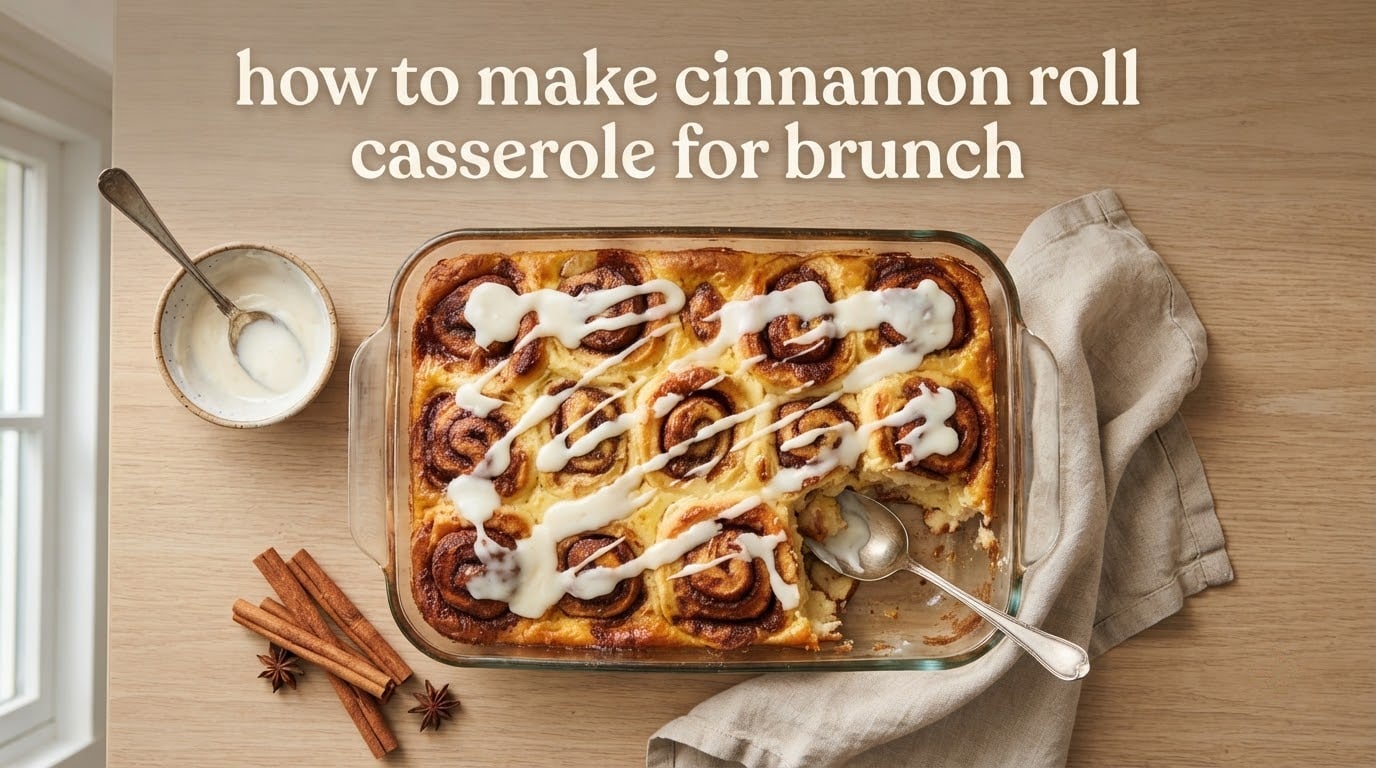
A cinnamon roll casserole is the fastest route to cinnamon-roll flavor for a crowd: cut two tubes of refrigerated rolls into pieces, layer them in a greased 9×13-inch baking dish, pour an egg-and-milk custard over the top, and bake at 375F for 22 to 28 minutes until the center is golden and set. One pan feeds 8 to 12 people, it can be assembled the night before, and it slices into neat squares for a buffet line. This guide covers the base method for a cinnamon roll casserole for brunch, the make-ahead rules, the storage math, and the fixes for the failure modes that trip people up most often.
Table of Contents
- Why Cinnamon Roll Casserole Works for Brunch
- What You’ll Need for a Cinnamon Roll Casserole
- How to Make Cinnamon Roll Casserole
- Make-Ahead Cinnamon Roll Casserole
- How to Store Cinnamon Roll Casserole and Reheat It
- Cinnamon Roll Casserole Variations
- Slow Cooker Cinnamon Roll Casserole
- Cinnamon Roll Casserole Substitutions and Dietary Swaps
- Troubleshooting Cinnamon Roll Casserole
- Frequently Asked Questions
- Can I prep cinnamon roll casserole ahead of time?
- Can I make a breakfast casserole the night before?
- Can you make Pillsbury cinnamon rolls the night before?
- How do you make a cinnamon roll casserole?
- Can I make cinnamon roll casserole in a slow cooker?
- Can I use homemade cinnamon rolls instead of canned?
- Why is my cinnamon roll casserole soggy?
- How long does cinnamon roll casserole keep in the fridge?
- Can I freeze cinnamon roll casserole before baking?
- Do you bake the cinnamon rolls before adding the egg mixture?
- Conclusion
Why Cinnamon Roll Casserole Works for Brunch
Brunch fails for one reason: the host is stuck in the kitchen. A cinnamon roll casserole fixes that because almost all of the work happens before anyone arrives. The rolls go in raw, the custard mixes in one bowl, and the oven does the rest while you sit down with your coffee.
The egg-and-milk custard is the engine of the dish. It soaks into the dough, sets into a French toast-like base, and binds the rolls into a single sliceable bake. That base is also why the texture stays creamy in the middle instead of drying out like a tray of reheated rolls.
On serving math, a standard 9×13-inch dish holds two 12.4 ounce tubes of rolls plus 4 eggs and 2 cups of milk, which lands at 8 to 12 generous brunch portions. One tube in a 9×9-inch square pan is the natural half batch. Three tubes want a deeper pan or a second dish, because two tubes spread thin in a large dish and read as under-filled.
Readers who make this repeatedly report the same thing: the casserole survives picky eaters better than almost any sweet breakfast. Cinnamon roll is a familiar flavor in a familiar shape, so kids who turn down eggs and fruit usually take a square of this.
One more practical note for 2026 hosting: a baked casserole holds its texture well for about an hour at room temperature, so a 30 minute head start on the bake relative to when you want to serve gives you a warm center without a soggy one.
What You’ll Need for a Cinnamon Roll Casserole
Equipment is minimal. You need a 9×13-inch baking dish (3.2 liters), a large mixing bowl, a whisk or electric beater, a sharp knife or kitchen shears for the rolls, and a sheet of foil or parchment for the counter while you wait.
For the base casserole:
- 2 tubes refrigerated cinnamon rolls, 12.4 ounces each (about 16 rolls total)
- 4 large eggs
- 2 cups whole milk (480 ml)
- 2 tablespoons granulated sugar
- 2 teaspoons vanilla extract
- 1 teaspoon ground cinnamon, plus more for the top
- 2 tablespoons unsalted butter, melted
- 1/4 cup heavy cream (60 ml), optional for a richer custard
- Reserved icing from the cans
For an optional pecan crumb topping:
- 1/2 cup chopped pecans (55 g)
- 1/3 cup brown sugar (65 g)
- 1/2 cup all-purpose flour (60 g)
- 4 tablespoons cold butter, cubed
- 1/2 teaspoon ground cinnamon
Butter the dish generously before the dough goes in. Melted butter on the base of the pan is the simplest insurance against the dough pulling away from the corners and leaving a bare ring.
How to Make Cinnamon Roll Casserole
Six steps, about 15 minutes of hands-on work and 22 to 28 minutes of baking.
- Preheat the oven to 375F (190C) and grease a 9×13-inch baking dish with melted butter.
- Cut each unrolled tube of cinnamon rolls into 8 pieces, or leave some rolls whole if you prefer larger pockets in the finished bake.
- Whisk 4 eggs, 2 cups milk, 2 tablespoons sugar, 2 teaspoons vanilla, and 1 teaspoon cinnamon until no streaks of white remain.
- Layer the dough pieces in the dish, drizzle the melted butter over the top, and pour the custard evenly so every piece is dampened.
- Bake at 375F for 22 to 28 minutes, until the edges are set and the center jiggles as one mass rather than sloshing.
- Rest the dish on a wire rack for 5 to 10 minutes, then spoon the reserved icing across the surface while it is still warm.
The custard is the step people rush, and it is the step that decides how the bake turns out. Beat the eggs into the liquid completely rather than stirring them in; streaks of white that survive the whisk show up as pale patches on the surface and cook into an eggy texture.
Whether you unroll the dough before cutting is a matter of preference, not correctness. Cutting the spiral into pieces gives more crisp edges. Leaving a few rolls whole creates softer, cakier pockets where the custard pools.
One more habit worth building in: set the pan on a foil-lined sheet pan. The custard is a dairy-and-egg mixture, and a leak from an overfull dish onto a hot oven floor is a cleanup job you will not enjoy on a brunch morning.
Make-Ahead Cinnamon Roll Casserole
Yes, you can prep a cinnamon roll casserole ahead of time, and one night ahead is the reliable window. Assemble it fully, cover it, and refrigerate. Two days ahead is where the quality starts to slide, so if you are booking further out, freeze it unbaked instead.
The overnight sequence:
- Whisk the custard and pour it over the cut dough in the greased dish.
- Cover tightly with foil or plastic wrap and refrigerate for up to 24 hours.
- Take the pan out of the fridge while the oven preheats, so the dish warms up while the oven heats.
- Bake at 375F for 27 to 33 minutes, adding 5 to 10 minutes over the standard time because the pan and custard start cold.
- Check for doneness at the 27 minute mark, since cold-start bakes can set unevenly.
Two rules make the difference. Put the cold pan into a cold oven, not a preheated one, so the bake rises gently and the custard has time to thicken before the top sets. And refrigerate branded refrigerated cinnamon rolls in their cans, since the dough is portioned for a specific number of rolls; cutting an open tube two nights ahead dries the exposed ends.
Whether the egg and milk mixture separates overnight depends on how well you beat it. A fully emulsified custard stays blended for 24 hours. Give it a 30-second whisk with the beaters right before it goes in the oven and the texture will be identical to a same-day bake.
For a brunch of 10 to 12, the timeline is simple: assemble and refrigerate the night before, set the table and make coffee in the morning, bake when guests arrive, and rest the dish 5 minutes before carrying it to the table with the icing already drizzled on.
How to Store Cinnamon Roll Casserole and Reheat It
Refrigerate a baked casserole in an airtight container for up to 4 days. Reheat a single serving at 350F for 10 to 15 minutes, or in the microwave on high for 60 to 90 seconds. Cover it loosely with foil so the top softens rather than turning rubbery, and add a fresh drizzle of icing after reheating if you have any.
Freezing works unbaked or baked. To freeze before baking, assemble in a disposable foil pan, wrap tightly, and freeze for up to 2 months. Bake from frozen at 350F for 45 to 55 minutes, which is longer than the 22 to 28 minute fresh bake because the pan and custard both start solid.
Cinnamon Roll Casserole Variations
The base custard is a blank canvas, and the changes are additive rather than substitutive. Fold in 1 cup of diced apple with 1 teaspoon cinnamon before baking for an apple-pie version. Scatter the pecan crumb topping over the surface for a streusel finish. Blend 4 ounces of softened cream cheese into 1 cup of the milk for a tangy custard, then top with cream cheese icing instead of the can icing.
Other additions that work: 1 cup of blueberries, 1/2 cup of dried cranberries, a drizzle of caramel sauce in place of maple syrup, chocolate chips pressed into the dough before the custard goes on, or rainbow sprinkles for a birthday brunch.
For savory-sweet brunch versions, add 8 ounces of cooked and crumbled breakfast sausage to the bottom of the dish before the dough, or lay 4 strips of cooked bacon across the top for the last 15 minutes of the bake. Pull the maple syrup down to a tablespoon in these versions so the custard is not cloying.
One correction to a common assumption: this is not an aggressively sweet dish. The cinnamon in the dough and 2 tablespoons of sugar in the custard are the only sweet additions besides the icing drizzle, which is why readers regularly comment that it turned out less sweet than expected.
Slow Cooker Cinnamon Roll Casserole
A 6-quart slow cooker reproduces the oven version without monitoring it. Grease the crock, add the quartered dough pieces, pour over the custard, and cook on low for 2.5 to 3 hours. Keep the lid on the whole time, since lifting it drops the crock temperature and slows the set. Add the icing at the end, once the center is firm enough not to absorb it.
Cinnamon Roll Casserole Substitutions and Dietary Swaps
Most swaps are one-for-one, with two exceptions worth knowing. Heavy cream replaces milk in equal volume for a richer, denser custard; half-and-half or eggnog works the same way, and a dairy-free or almond milk works too, with a slightly thinner set. For gluten-free, use a gluten-free refrigerated roll tube and expect a softer, cakier result.
Homemade rolls work if they are unbaked and unbrowned. Frozen dough needs a 20 to 30 minute thaw on the counter before you cut it, or you will be fighting a frozen block in the middle of the bake.
For an egg-light version, use 2 whole eggs plus 2 egg whites, which cuts the eggy flavor that some readers notice. If you want a less sweet bake, drop the sugar in the custard to 1 tablespoon, skip the crumb topping, and halve the icing.
Tube count changes the pan, not just the volume. One tube fits a 9×9-inch square pan or a deep 9-inch pie dish at roughly the same bake time. Two tubes need the 9×13. Three tubes want a deep 9×13 with a smaller custard, or two pans, and each additional pan in the oven can add about 10 minutes.
Troubleshooting Cinnamon Roll Casserole
The most common complaint, by a wide margin, is a soggy bottom, and it is a heat problem. The top browns before the base sets because the custard is insulating the dough from the oven floor. The fixes that work: pre-bake the cut dough for 5 minutes before adding the custard, use a metal pan instead of glass, tent loosely with foil for the first 15 minutes, or simply add 5 to 10 minutes to the bake. A metal pan is the single change most likely to fix it outright.
White streaks or visible egg patches mean the custard was not beaten long enough. Whisk until the liquid is uniformly yellow with no cloudiness, and strain it through a sieve if you are sensitive to texture.
A runny center that sloshes rather than jiggles as a mass is under-set. Give it 5 more minutes and check again, rather than pulling it at the first sign of color. The opposite problem, a browned top over a raw middle, is the same over-bake: tent with foil the moment the top hits the color you want.
If the reserved icing is too stiff to spread, microwave the lid cup for 10 to 20 seconds and stir it. It loosens into a pourable glaze and goes across the warm surface without dragging.
Finally, on the confusing 350F versus 375F spread you will find across recipes: 375F is faster and browns the top more aggressively, so tent it if your pan runs hot. 350F is gentler and is the right choice for a glass dish or a cold assembled bake, and it needs roughly 5 minutes longer than the 375F time.
Frequently Asked Questions
Can I prep cinnamon roll casserole ahead of time?
Yes, and one night ahead is the reliable window. Assemble the casserole fully, cover it tightly, and refrigerate for up to 24 hours. Take the pan out of the fridge while the oven preheats, put the cold pan into a cold oven, and add 5 to 10 minutes to the bake time since the custard starts cold.
Can I make a breakfast casserole the night before?
Yes. Any egg-and-milk breakfast casserole can be assembled the night before and baked in the morning, and a cinnamon roll casserole is one of the most forgiving because the dough is already portioned. Whisk the eggs into the milk completely, cover the dish, and refrigerate. Bake at 375F for 27 to 33 minutes from cold.
Can you make Pillsbury cinnamon rolls the night before?
You can prepare the casserole the night before, but keep the tube of refrigerated cinnamon rolls sealed in its can until you are ready to cut. Pre-shaping or portioning the dough the night before dries the exposed ends, which is why the make-ahead rule is to assemble, not to pre-cut. Never pre-bake the rolls before adding the custard.
How do you make a cinnamon roll casserole?
Cut 2 tubes of refrigerated cinnamon rolls into pieces, layer them in a greased 9×13-inch dish, whisk 4 eggs with 2 cups of milk, 2 tablespoons of sugar, and vanilla, pour it over the dough, and bake at 375F for 22 to 28 minutes. Rest 5 to 10 minutes, then drizzle the reserved icing over the top.
Can I make cinnamon roll casserole in a slow cooker?
Yes. Use a 6-quart slow cooker, grease the crock, add the quartered dough, pour over the same egg and milk custard, and cook on low for 2.5 to 3 hours. Keep the lid closed the whole time, and add the icing at the end once the center is set.
Can I use homemade cinnamon rolls instead of canned?
Yes, as long as they are unbaked and unbrowned. Shape them to fit the dish, then follow the same custard and bake time, checking 5 minutes early since a denser homemade dough may brown faster than store-bought dough.
Why is my cinnamon roll casserole soggy?
A soggy bottom is a heat issue, not a recipe issue. The top browns faster than the base sets. Use a metal pan instead of glass, pre-bake the cut dough for 5 minutes before adding the custard, tent loosely with foil for the first 15 minutes, and add 5 to 10 minutes to the bake time.
How long does cinnamon roll casserole keep in the fridge?
A baked casserole keeps for up to 4 days in an airtight container in the refrigerator. Reheat a serving at 350F for 10 to 15 minutes or in the microwave on high for 60 to 90 seconds, loosely covered, then add a fresh drizzle of icing.
Can I freeze cinnamon roll casserole before baking?
Yes. Assemble it unbaked in a disposable foil pan, wrap tightly, and freeze for up to 2 months. Bake from frozen at 350F for 45 to 55 minutes, since the pan and the custard both start solid and need longer than the 22 to 28 minute fresh bake.
Do you bake the cinnamon rolls before adding the egg mixture?
No, the standard method adds raw dough and custard together. The one exception is the soggy-bottom fix: pre-bake the cut dough for about 5 minutes, then pour over the custard for the full bake. That short pre-bake is what gives the base a head start.
Conclusion
To make a cinnamon roll casserole for brunch, the whole method is a 9×13-inch dish, two tubes of refrigerated rolls, an egg-and-milk custard, and 22 to 28 minutes at 375F. Cut the dough, whisk the custard until no streaks remain, pour, bake, rest, and drizzle the icing while the surface is still warm.
Everything else in this guide exists to make the morning less risky. Assemble it the night before and add 5 to 10 minutes to the bake. Use a metal pan if the last batch came out soggy underneath. Beat the eggs longer than you think you need to. Those three habits fix the problems readers run into most often.
Next step: pick your pan based on how many you are feeding, write the tube count on the outside of the dish before you refrigerate it, and put a note on your coffee maker for the morning of.